High School Physics · Grades 10–12
24Kinematics in Two Dimensions
Watch a car take a roundabout at a steady : the needle never moves, yet every passenger feels pulled sideways — the motion is changing, and it is not the speed. One number per instant no longer suffices: motion in the plane needs arrows. This chapter equips a moving point with three — position, velocity, acceleration — chained by the derivative, and reads whole families of motion off their geometry.
24.1 The position vector
Motion only exists relative to a stated reference frame — a rigid body plus a clock (Chapter 5). New this year is precision: attach to the frame an origin and two perpendicular graduated axes , , and record where the point is at every instant, as a pair of functions.
Definition 24.1 (Position vector)
In a frame equipped with an origin and axes , , the position vector of a moving point at time is , of coordinates : two functions of time, one per axis. The curve traced by as runs is its trajectory.
24.2 The velocity vector
Definition 24.2 (Velocity vector)
Over a short interval the point moves by ; divide by and let the interval shrink: this is the derivative from your mathematics course, applied to each coordinate. The velocity vector of is the derivative of its position vector, , in . Its norm is the speed — the one number the speedometer shows.
Example 24.3 (A drone in level flight)
A drone flies with and (meters, seconds): trajectory the line , velocity at all times, speed , constant.
Proposition 24.4 (Tangent to the trajectory)
At every instant, is tangent to the trajectory at the current position of , and points in the direction of travel.
Proof. The displacement is a chord of the trajectory; as shrinks, the chord’s direction becomes the tangent’s. ∎
24.3 The acceleration vector
Definition 24.5 (Acceleration vector)
The acceleration vector of is the derivative of its velocity vector, , in : how fast, and in which direction, the velocity vector is currently changing.
Remark 24.6 (Accelerating without speeding up)
whenever the velocity vector changes — in length or in direction: a braking car accelerates (backward); a turning car at constant speed accelerates (sideways). This is the quantity forces control (Chapters 16 and 25).
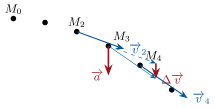
Method 24.7 (Reading a chronophotograph)
A chronophotograph records the positions of a moving point at equal time intervals .
24.4 Rectilinear motions
Along a straight line one axis suffices: , , , all signed numbers.
Definition 24.8 (Uniform rectilinear motion)
A motion is uniform rectilinear when is a constant vector: straight trajectory, constant speed, . Then .
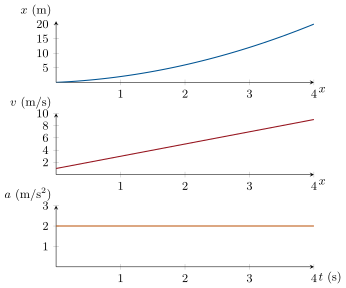
Proposition 24.9 (Uniformly accelerated rectilinear motion)
If a point moves along with constant acceleration , starting at from position with velocity , then
Proof. is an antiderivative of the constant : , and forces . In turn is an antiderivative of : , with . ∎
Example 24.10 (Braking distance)
A car at speed brakes with constant deceleration (acceleration ). It stops when , at , having covered . The square is the road-safety headline: doubling the speed quadruples the braking distance — with , from , from .
24.5 Uniform circular motion and the Frenet frame
Definition 24.11 (Uniform circular motion)
A motion is uniform circular when the trajectory is a circle of radius and the speed is constant. The period is the duration of one lap, and the frequency (in ) the number of laps per second: .
Constant speed — yet the velocity turns: there is an acceleration. Which way, and how big?
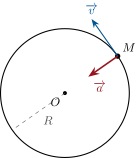
Theorem 24.12 (Centripetal acceleration)
In uniform circular motion of radius and speed , the acceleration — called centripetal — points from the moving point toward the center of the circle, with constant norm
Proof. Center the axes at the circle’s center and set , so the arc subtends the angle : the position is , . Differentiating, , of constant norm ; differentiating again, : opposite to the position vector — toward the center — of norm . ∎
Definition 24.13 (Frenet frame)
The Frenet frame at the current position of a point on a curved path is the pair of perpendicular unit vectors : tangent, along the motion; normal, toward the center of the circle of radius that best fits the curve there.
Proposition 24.14 (Acceleration in the Frenet frame)
Along any plane path of local radius , traveled at speed ,
the tangential acceleration changes the speed; the normal acceleration turns the velocity.
Proof. Admitted at this level. ∎
Remark 24.15 (Where the proof lives)
We proved the extremes: pure on a line (Proposition 24.9), pure on a circle (Theorem 24.12); the general decomposition is derived in the Year 1 volume.
Example 24.16 (Braking into a bend)
A car enters a bend of radius at while braking at : , , so , pointing backward and into the bend. The tires must supply both at once — why racing drivers brake before the turn.
24.6 Exercises
Exercise 24.1 ★
For , (meters, seconds), give , the speed, the trajectory and the class of motion.
Solution
Solution of Exercise 24.1.
, constant; speed . Trajectory: the line . Constant velocity vector: uniform rectilinear motion.
Exercise 24.2 ★
On a chronophotograph taken every , the dots lie on a line, evenly spaced apart. Identify the motion and compute the speed. What would opening spacings indicate?
Solution
Solution of Exercise 24.2.
Straight line, equal spacings: uniform rectilinear; . Opening spacings would mean the speed is increasing.
Exercise 24.3 ★
For along (meters, seconds), derive and , name the class of motion, and compute the speed at .
Solution
Solution of Exercise 24.3.
, : constant acceleration, uniformly accelerated rectilinear. .
Exercise 24.4 ★
A carousel horse rides a circle of radius , one lap every : compute the frequency, the speed and the acceleration (norm and direction).
Solution
Solution of Exercise 24.4.
; ; , pointing toward the carousel’s axis.
Exercise 24.5 ★
A graph climbs straight from at to at . Read off the acceleration, then the distance covered (area under the graph).
Solution
Solution of Exercise 24.5.
Slope: . Area (trapezoid): .
Exercise 24.6 ★★
A high-speed train takes a curve of radius at . Compute and compare it to ; why must high-speed lines avoid tight curves, even perfectly banked ones?
Solution
Solution of Exercise 24.6.
: . Since , high demands huge to keep the sideways acceleration (and the force on track and passengers) acceptable — banking changes who supplies it, not its size.
Exercise 24.7 ★★
A trolley on a straight rail has (meters, seconds). Find and , the instant and position of reversal, and describe the motion before and after.
Solution
Solution of Exercise 24.7.
; , constant. Reversal at : , at . Before: forward, slowing; after: backward, speeding up — uniformly accelerated throughout.
Exercise 24.8 ★★
A chronophotograph along a line, every , gives , , , , . Estimate the velocity at the three interior dots (Method 24.7), then the acceleration; conclude.
Solution
Solution of Exercise 24.8.
; ; . Velocity gains every : , constant — uniformly accelerated rectilinear.
Exercise 24.9 ★★
The Moon orbits the Earth on a near circle of radius in . Compute its speed and its centripetal acceleration; compare the latter to , knowing the Moon is about Earth radii away (Chapter 4).
Solution
Solution of Exercise 24.9.
: ; . Ratio: — gravity, diluted as the inverse square of distance (Chapter 4), exactly accounts for the Moon’s turning.
Exercise 24.10 ★★
A washing-machine drum of radius spins at revolutions per minute. Compute , , the rim speed and the rim acceleration in multiples of . Why does the laundry stay pinned while the water leaves?
Solution
Solution of Exercise 24.10.
, ; ; . The drum wall supplies the laundry’s ; through the holes nothing pushes the water inward, so it flies off along the tangent.
Exercise 24.11 ★★
A car at brakes with constant : compute the stopping time and the braking distance, and sketch .
Solution
Solution of Exercise 24.11.
: ; . Graph: a straight segment from down to at .
Exercise 24.12 ★★★
For , : compute ; check the speed is the constant and ; compute , show it is , and recover .
Solution
Solution of Exercise 24.12.
, of constant norm ; its dot product with vanishes, so it is perpendicular to the radius, hence tangent. Differentiating again, : toward , of norm .
Exercise 24.13 ★★★
A motorcycle enters a bend of radius at , braking at . Compute , , the norm of and its angle with the direction of motion. The tires grip up to in all: is the rider within the limit?
Solution
Solution of Exercise 24.13.
(backward), ; ; angle with the direction of motion: (i.e. from straight backward). : within grip, with little to spare.
Exercise 24.14 ★★★
A metro accelerates from rest at up to , cruises for , then brakes at to a stop. Compute the duration and length of each phase, the total distance and the average speed. Sketch and check the distance as an area.
Solution
Solution of Exercise 24.14.
Launch: , . Cruise: , . Braking: , . Total: in ; average (). is a trapezoid whose area, , checks the total.
Exercise 24.15 ★★★
A geostationary satellite circles at radius from the Earth’s center with period . Compute its speed and its centripetal acceleration. What supplies it, and why does the satellite hang over one fixed equatorial point (Chapter 27)?
Solution
Solution of Exercise 24.15.
; . Earth’s gravity at that distance supplies it; the period equals Earth’s rotation period, so satellite and ground turn together and it hangs over one equatorial point (Chapter 27).
24.7 Problem: The Accident Report
Problem 24.1
Weekend problem — the accident report: a dashcam film read frame by frame, a braking law rebuilt from skid marks, a roundabout that testifies about grip, and a verdict in kilometers per hour
A car strikes a van that pulled out of a side street; nobody is hurt, but the insurers disagree. The investigator has overhead camera footage (one frame every ), measured skid marks, and the car’s dashcam. The speed limit is .
Part I — Reading the film. The frames before any reaction give, along the straight road:
| () | 0.00 | 0.50 | 1.00 | 1.50 | 2.00 |
| () | 0.0 | 9.0 | 18.0 | 27.0 | 36.0 |
- Why must the report first name a frame and axes? Which are used here?
- Compute the average velocity on each of the four intervals.
- What class of motion is this? Justify from the table.
- Give the car’s speed in and .
- What is the acceleration during these two seconds?
Part II — The skid marks. Tire tests on this dry asphalt give a constant braking deceleration ; the skid marks are long. Take , at the start of braking, unknown speed .
- By antiderivatives, write and during braking.
- Express the stopping time ; show .
- Deduce from the skid marks. Consistent with Part I?
- The reaction time is : compute the reaction distance and the total stopping distance.
- Explain, from question 7, why doubling the speed quadruples the braking distance; compute at exactly .
Part III — The roundabout testifies. Earlier, the dashcam shows the car rounding a roundabout lane of radius at constant speed, a quarter turn in . The road can supply at most , with .
- The speed is constant there — is the velocity? Is the car accelerating? Explain.
- Compute the car’s speed on the roundabout.
- Compute its centripetal acceleration (norm and direction).
- Compute the maximum no-skid speed. Was the car within it?
- Give the period and frequency of a full loop at that speed.
Part IV — The verdict. The van appeared ahead of the car at the instant the driver started reacting.
- By how much, in and in percent, did the speed before braking exceed the limit?
- Compute the car’s speed at impact.
- Redo the stopping computation at exactly (same reaction, same braking): does the car stop, with what margin?
- Give the general stopping-distance formula ; why does speed enter twice — once linearly, once squared?
- The verdict, one sentence with its numbers: what speed was the driver doing, and would the accident have happened at the limit?
Solution
Solution of Problem 24.1.
1. Motion is relative (Chapter 5): every position and velocity must name its frame. Here: the ground (road) frame, along the road from the first frame’s position.
2. Each interval: — four equal values.
3. Straight road, equal displacements in equal times: uniform rectilinear motion.
4. .
5. .
6. ; .
7. gives ; then .
8. — exactly the filmed speed: the driver never slowed before braking.
9. Reaction: ; total .
10. : doubling multiplies by . At (): .
11. The speed is constant but the velocity’s direction turns: is not constant, so the car is accelerating.
12. Quarter turn: ; ().
13. , toward the roundabout’s center.
14. ; (). : within grip — consistent with the clean, skid-free lane.
15. .
16. over — about above the limit.
17. Braking acts over : , so at impact.
18. At : — the car stops short of the van.
19. : once linearly (the reaction covers before the brakes act), once squared (the kinetic part ) — which is why moderate excesses cost disproportionately.
20. The dashcam and the skid marks agree: in a zone; at the legal limit the car would have stopped short of the van — the accident is the extra .