Physics · Glossary

What is Normal force and friction?

Also known as: normal force · coefficient of friction

Definition 25.11 High School Physics · Chapter 25 — Newton’s Laws

A surface acts on a body through two components: the normal force N\vect N, perpendicular to the surface, and friction f\vect f, tangential. Experiment gives the friction laws: while the body does not slide, static friction adjusts itself up to a ceiling, fsμsNf_s \leq \mu_s N; once it slides, kinetic friction is fk=μkNf_k = \mu_k N, against the sliding. The coefficients of friction μs\mu_s and μk\mu_k (μkμs\mu_k \leq \mu_s) depend only on the two materials.

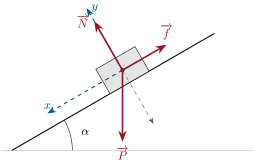
Free-body diagram on the incline: weight P, normal force N, friction f up the slope for a block sliding down. Axes along and perpendicular to the slope split P into mg and mg (dashed).
Free-body diagram on the incline: weight P\vect P, normal force N\vect N, friction f\vect f up the slope for a block sliding down. Axes along and perpendicular to the slope split P\vect P into mgsinαmg\sin\alpha and mgcosαmg\cos\alpha (dashed).

Examples

Example 25.12 (The incline, twice)

A block slides down a slope of angle α\alpha; axes: xx down the slope, yy perpendicular. On yy: N=mgcosαN = mg\cos\alpha. On xx, frictionless: ma=mgsinαma = mg\sin\alpha, so a=gsinαa = g\sin\alpha — no mass; at α=30\alpha = 30^\circ, a=4.9m/s2a = 4.9\,\mathrm{m}/\mathrm{s}^{2}. With kinetic friction: a=g(sinαμkcosα)a = g(\sin\alpha - \mu_k\cos\alpha); for μk=0.20\mu_k = 0.20, a=9.81(0.5000.173)=3.2m/s2a = 9.81\,(0.500 - 0.173) = 3.2\,\mathrm{m}/\mathrm{s}^{2}. And it stayed put in the first place only while the needed static friction fit under its ceiling: tanαμs\tan\alpha \leq \mu_s.

Read in context →