High School Physics · Grades 10–12
25Newton’s Laws
Smuggle a bathroom scale into an elevator. As the cabin pulls upward the needle reads three kilograms heavy; near the top it reads light; between the two, the plain truth — nothing aboard changed but the motion. This chapter states the three laws behind that needle and forges them into the method that runs all of mechanics: choose a system, draw its forces, project .
25.1 Momentum, and the first law made exact
Definition 25.1 (Momentum)
The momentum of a body of mass () moving with velocity is the vector
the velocity, weighted by the mass; for a system, the vector sum over its parts.
Definition 25.2 (Inertial reference frame)
An inertial reference frame is one in which every isolated body — no forces, or forces that compensate — moves in a straight line at constant velocity (Chapter 6). The ground is one to excellent accuracy, and so is any cabin in uniform straight-line motion over it; a braking train or turning carousel is not: there, loose luggage accelerates unpushed.
Theorem 25.3 (Newton’s first law)
In an inertial frame, the momentum of an isolated system does not change: is constant, i.e. .
Proof. Admitted at this level. ∎
Remark 25.4 (Inertia, sharpened twice)
The principle of inertia of Chapter 6, upgraded twice: it says where it holds — it defines the inertial frames as those where it does — and it guards a vector, , whose bookkeeping pays off at the chapter’s end.
25.2 Newton’s second law
Theorem 25.5 (Newton’s second law)
In an inertial frame, the net force on a body equals the rate of change of its momentum; for constant mass, since ,
Proof. Admitted at this level. ∎
Remark 25.6 (A law of nature, and its unit)
There is no proof: this is a law of nature, weighed against experiment for three centuries. Last year (Chapter 16) gave its shadow, ; the derivative (Chapter 24) makes it exact at every instant — its fine print waits in the Year 1 volume. Force gets a unit, ; and a body under its weight alone obeys : every mass falls with , and — the two readings are one.
Example 25.7 (Average force, no details needed)
A car goes from rest to () in : whatever the instant-by-instant story, the average net force is — momentum turns a force question into before-and-after bookkeeping.
25.3 Newton’s third law
Theorem 25.8 (Newton’s third law)
If a body exerts a force on a body , then exerts on the force : same line of action, same magnitude, opposite directions — at every instant, whatever the motion, contact or action at a distance.
Proof. Admitted at this level. ∎
Example 25.9 (The book, the table and the Earth)
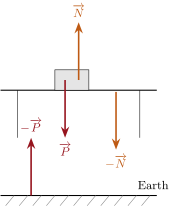
A book rests on a table: two interactions, two pairs. Gravitational: the Earth pulls the book down (), the book pulls the Earth up. Contact: the table pushes the book up (), the book presses the table down. Walking is the same deal: push the ground backward; its reaction is the only force driving you forward.
25.4 The method: choose, draw, project
Method 25.10 (Solving a dynamics problem)
- System: name the body (or set of bodies) studied.
- Frame: choose an inertial frame and axes fitted to the motion — slope axes, or the Frenet frame for a curve (Chapter 24).
- Inventory: list every force — the weight, then one force per contact, nothing else — and draw the free-body diagram: one point, one arrow per force.
- Project: write , project it on each axis.
- Solve and check: units, signs, limiting cases (, , …).
Definition 25.11 (Normal force and friction)
A surface acts on a body through two components: the normal force , perpendicular to the surface, and friction , tangential. Experiment gives the friction laws: while the body does not slide, static friction adjusts itself up to a ceiling, ; once it slides, kinetic friction is , against the sliding. The coefficients of friction and () depend only on the two materials.
Example 25.12 (The incline, twice)
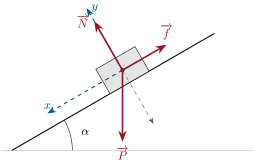
A block slides down a slope of angle ; axes: down the slope, perpendicular. On : . On , frictionless: , so — no mass; at , . With kinetic friction: ; for , . And it stayed put in the first place only while the needed static friction fit under its ceiling: .
Definition 25.13 (Apparent weight)
The apparent weight of a body is the normal force between it and its support — what a scale under it reads.
Example 25.14 (The elevator)
A passenger stands on a scale in an elevator of vertical acceleration (upward positive): , so . Pulling up at : , heavy; braking near the top: , light; steady cruise: — the first law; free fall, : , weightlessness on a scale.
Example 25.15 (Two blocks and a pulley)
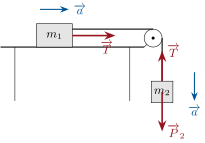
A block on a frictionless table is tied by a light rope, over an ideal pulley, to a hanging block . The rope transmits the same tension at both ends; the blocks share one magnitude of acceleration . One second law each, along each motion: and , so and — smaller than , as it must be for to accelerate downward.
Example 25.16 (The flat curve)
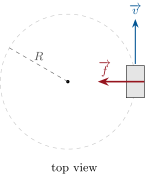
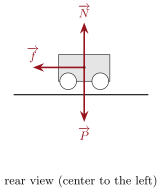
A car of mass rounds a flat curve of radius at constant speed . In the Frenet frame (Chapter 24) the acceleration is purely normal, , aimed at the center. Vertically, ; horizontally, the only centripetal force on offer is the static friction of road on tyres: , so , whatever the mass. For , dry road (): (); on ice the ceiling collapses — Exercise 25.13 banks the road; Exercise 25.10 swings the same projection on a wire.
25.5 Isolated systems: momentum is conserved
Proposition 25.17 (Conservation of momentum)
For two bodies whose external forces vanish or compensate, the total momentum is constant, whatever the forces they exert on each other.
Proof. Add the two second laws: : the internal pair cancels by the third law, and by hypothesis. ∎
Example 25.18 (Recoil)
A skater at rest on smooth ice throws a medicine ball horizontally at . Before: ; after: , so — she drifts backward. Nothing external pushed her: the ball did (third law), and the books stay at zero.
Remark 25.19 (How a rocket pushes on nothing)
A rocket is a machine for throwing mass. Each second its engines hurl a batch of gas backward; the gas carries away backward momentum, so the rocket gains the same amount forward — a steady thrust, roughly the mass expelled per second times the ejection speed. The rocket pushes on its own exhaust, not on air: it works best in empty space.
25.6 Exercises
Exercise 25.1 ★
Compute the momentum of (a) a sprinter at ; (b) a car at ; (c) an bullet at . Rank them. Why does the fastest rank last?
Solution
Solution of Exercise 25.1.
(a) . (b) : . (c) . Car sprinter bullet: five orders of magnitude of mass are more than speed can buy.
Exercise 25.2 ★
A passenger stands on a scale in an elevator. What does it read when the cabin (a) accelerates upward at ; (b) climbs at a constant ; (c) accelerates downward at ? Which law settles (b)?
Solution
Solution of Exercise 25.2.
: (a) ; (b) , so — the first law: constant velocity, forces compensate; (c) .
Exercise 25.3 ★
A block is released on a frictionless slope of angle . Compute its acceleration, then its speed after sliding . Where did the mass go?
Solution
Solution of Exercise 25.3.
; . The mass cancels between and .
Exercise 25.4 ★
A tennis ball arrives at and is returned along the same line at ; contact lasts . Compute the change of momentum and the average force of the strings; compare that force with the ball’s weight.
Solution
Solution of Exercise 25.4.
Reversal: ; — about times the weight, which is why gravity is ignored during contact.
Exercise 25.5 ★
A book rests on a table. Name the two forces acting on the book and, for each, its action–reaction partner (which body? which direction?). Why are the book’s weight and the table’s push not partners of each other?
Solution
Solution of Exercise 25.5.
Weight (Earth on book, down): partner = book pulls the Earth, up. Normal force (table on book, up): partner = book presses the table, down. Weight and normal act on the same body and belong to two different interactions — equal here only because .
Exercise 25.6 ★★
A crate sits on a horizontal floor, , . (a) What horizontal push just starts it? (b) If that push is maintained, what is its acceleration? (c) What push keeps it moving at constant velocity?
Solution
Solution of Exercise 25.6.
. (a) . (b) . (c) .
Exercise 25.7 ★★
The same crate is set on an adjustable ramp (, ). (a) At what angle does it start to slide? (b) At , compute its acceleration. (c) Once started at the angle of (a), does it keep accelerating? Why?
Solution
Solution of Exercise 25.7.
(a) Slides when : . (b) . (c) Yes: once sliding, friction drops to , so .
Exercise 25.8 ★★
A block on a frictionless table is tied over an ideal pulley to a hanging block. Compute the acceleration and the tension. Why did the tension have to come out smaller than the hanging weight?
Solution
Solution of Exercise 25.8.
; . The hanging block accelerates downward, so the net force on it points down: must undercut .
Exercise 25.9 ★★
A curve of radius is flat. Compute a car’s maximum speed for (dry) and (wet), in . Why does the answer hold for a scooter and a truck alike?
Solution
Solution of Exercise 25.9.
: dry ; wet . Both and carry : it cancels.
Exercise 25.10 ★★
A bob on a wire traces a horizontal circle, the wire holding a constant to the vertical (a conical pendulum). Project the second law vertically, then along the radius: compute the tension and the speed.
Solution
Solution of Exercise 25.10.
Vertical: , so . Radius ; radial: , so .
Exercise 25.11 ★★
A parcel rides a scale in a freight elevator; the readings:
| phase | |||
| scale () | 54.0 | 49.0 | 44.1 |
Compute the acceleration in each phase and describe a possible ride. Could the elevator have been moving downward the whole time?
Solution
Solution of Exercise 25.11.
with : , , . E.g. an upward trip: speed up, cruise, brake. Yes: entering already descending, the same readings mean brake, cruise, speed up again downward — the scale reads acceleration, not velocity.
Exercise 25.12 ★★★
A skater at rest on smooth ice throws a ball horizontally. (a) The ball leaves at over the ground: her recoil speed? (b) The is now measured relative to her: recompute both speeds. (c) Which force pushed her backward?
Solution
Solution of Exercise 25.12.
(a) : . (b) Ball at over the ground: , so and the ball flies at . (c) The ball’s push on her hands — the third-law partner of her throw.
Exercise 25.13 ★★★
A highway curve of radius is designed for with no help from friction. Show that the roadway must be banked at the angle given by and compute it. What must friction do for a car taking the curve slower — or faster?
Solution
Solution of Exercise 25.13.
Frictionless: (vertical) and (radial); dividing, : . Slower: the car tends to slip down the banking, friction must point up-slope; faster: the reverse.
Exercise 25.14 ★★★
A rocket’s engines eject of gas per second at . (a) How much momentum leaves per second — what thrust do the gases return? (b) The rocket masses at ignition: its weight? its lift-off acceleration? (c) Why does the engine work just as well in empty space?
Solution
Solution of Exercise 25.14.
(a) each second: thrust . (b) ; . (c) It pushes on its own exhaust (third law), not on the air.
Exercise 25.15 ★★★
A block on a table (, ) is tied over an ideal pulley to a hanging mass . (a) What minimum starts the motion? (b) For , compute acceleration and tension. (c) Check that recovers the frictionless formula of Exercise 25.8.
25.7 Problem: The Cable Car
Problem 25.1
Weekend problem — certifying the cable car: the tension the slope demands at rest, the surcharge of the start-up, the relief over the tower, the price of an emergency stop — and the one number the placard in the cabin may promise
A mountain cable car — cabin plus carriage, empty mass — rolls on a track cable inclined at , pulled by a haul cable parallel to the slope with tension . Rolling friction is negligible; the cabin floor stays horizontal throughout. The cabin seats passengers of average mass ; you are the certifying engineer. Unless stated otherwise, the cabin is full: .
Part I — At rest on the slope.
- Choose the system; say why the mountain frame will do as an inertial frame; inventory the three forces, with directions.
- Which law governs the wait? Project it along and perpendicular to the slope to express and the track cable’s normal force .
- Compute and .
- Recompute for the empty cabin. Why is proportional to the total mass?
- The haul cable snaps, brakes off: show that the runaway acceleration is , loaded or empty, and compute it.
Part II — Start-up. The winch accelerates the full cabin at up the slope until it cruises at .
- Express and compute the tension during this phase.
- By what fraction does starting up raise the tension above its value at rest?
- How long does the phase last, and over what distance?
- An passenger stands on the horizontal floor. Project the second law vertically to express and compute her apparent weight; compare with .
- Which force accelerates her horizontally, and how big? Why do passengers lean?
Part III — Over the tower. At a constant , the track cable bends over a support tower along a vertical circular arc of radius ; at the crest the velocity is horizontal.
- In the Frenet frame at the crest (Chapter 24), give both components of the acceleration, with their values.
- Project the second law along the normal to express and compute the normal force of the cable on the carriage.
- Same question for the passenger’s apparent weight at the crest: by what fraction is she lighter?
- At what speed would vanish? Compare with the cruising speed and comment.
- What force does the carriage exert on the cable over the tower — which law says so, with what magnitude and direction?
Part IV — Braking, a jump, and the placard.
- On the horizontal arrival stretch, an emergency stop takes the full cabin from to rest in : read as an average over the stop to compute the braking force.
- What horizontal force must stop an passenger, and can shoe–floor static friction () supply it? Conclude.
- At the platform, brakes off, the empty cabin hangs free and still; the last passenger () jumps off horizontally at relative to the cabin. Compute the cabin’s recoil speed and the passenger’s speed over the ground.
- In one sentence: which propulsion device lives on this recoil principle, and what fixes its thrust?
- Certification. The haul cable breaks at ; the rules cap the working tension at one fifth of that. Show the worst case met above is the start-up, deduce the maximum total mass, and print the placard: how many passengers may ride? Check the safety factor.
Solution
Solution of Problem 25.1.
1. System: cabin carriage ( passengers). The mountain is fixed to the ground, inertial to excellent accuracy. Forces: weight (down), normal force of the track cable (perpendicular to it), haul tension (up the slope).
2. At rest, the first law: . Along the slope: ; perpendicular: .
3. ; .
4. Empty: . Every force in the balance is proportional to , so is too.
5. Along the slope, : cancels, down the slope.
6. .
7. .
8. ; .
9. Vertical component of : , so against : heavier.
10. The floor’s static friction, horizontal: . Leaning puts the combined floor push through her center of mass, so it does not tip her.
11. (constant speed); , aimed at the center — straight down at the crest.
12. Normal axis (down positive): , so .
13. : lighter by .
14. at — more than triple the cruise: the carriage rides the cable with a wide margin.
15. Newton’s third law: , pressing down on the cable (hence on the tower) — slightly less than the resting weight, relieved by the curved flight.
16. , opposite the motion ().
17. ; the ceiling is : feet alone slip — hold the handrail.
18. : ; the passenger moves at over the ground.
19. The rocket: its thrust is fixed by the mass ejected per second times the ejection speed relative to it.
20. The largest tension met is the start-up (rest gives , the crest even less). Cap: , so : payload , i.e. passengers of (not ). Placard: 20 persons; then , , safety factor .