Physics · Glossary

What is Curvilinear abscissa; Frenet basis?

Definition 11.12 University Physics — Year 1 · Chapter 11 — Kinematics of a Point

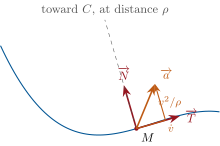
Along a trajectory, the curvilinear abscissa s(t)s(t) is the arc length from a reference point, counted algebraically; v=s˙v = \dot s. At MM, the unit tangent T= ⁣dOM/ ⁣ds\vect T = \dd\vect{OM}/\dd s points along increasing ss; the radius of curvature ρ>0\rho > 0 and the unit normal N\vect N, pointing toward the concave side (the center of curvature), are defined by

 ⁣dT ⁣ds=1ρN.\frac{\dd\vect T}{\dd s} = \frac{1}{\rho}\,\vect N .

(T,N)(\vect T, \vect N) is the Frenet basis; ρ=\rho = \infty on a straight line, ρ=R\rho = R on a circle of radius RR.

The Frenet basis at a point of a curve: T along the motion, N toward the center of curvature C. The acceleration splits into a tangential part v T (speeding up or braking) and a normal part (v2/ ) N (turning).
The Frenet basis at a point of a curve: T\vect T along the motion, N\vect N toward the center of curvature CC. The acceleration splits into a tangential part v˙T\dot v\vect T (speeding up or braking) and a normal part (v2/ρ)N(v^2/\rho)\vect N (turning).
Read in context →