The car on a roller coaster enters the loop at 90km/h, slows as it climbs, hangs for an instant at the top, and roars out again; its riders feel crushed into their seats at the bottom and almost weightless at the top. Describing that ride — where the car is, how fast it moves, how its velocity turns and changes — is kinematics, and it needs more than the x, y, z of a straight road: polar coordinates for anything that turns, and a frame that travels with the car itself. This chapter sets up those tools, proves the formulas for velocity and acceleration in each of them, and applies them to the motions that every later chapter will call upon: circular, helical, harmonic, and the motion along any curve.
A reference frame is a rigid body taken as fixed (the laboratory, the Earth, a train), together with a clock. A point particleM — a body whose size is irrelevant to the motion studied — is located at each instant by its position vectorOM(t) from an origin O attached to the frame; the curve described by M is its trajectory. Motion is always motion relative to a frame: the same passenger is at rest in the train and moving in the station.
Definition 11.2(Velocity and acceleration)
The velocity and acceleration of M in the frame are
v=dtdOM,a=dtdv=dt2d2OM,
derivatives of vector functions: the derivative of a vector is obtained by differentiating its components in a basis that is fixed in the frame. The velocity is tangent to the trajectory and points along the motion; its norm v is the speed. Units: m/s, m/s2.
Proposition 11.3(Cartesian coordinates)
With a fixed orthonormal basis (ex,ey,ez) and OM=xex+yey+zez,
v=x˙ex+y˙ey+z˙ez,a=x¨ex+y¨ey+z¨ez,
where the dot denotes d/dt.
Proof. The basis vectors are constant; only the components vary. ∎
Example 11.4(Projectile)
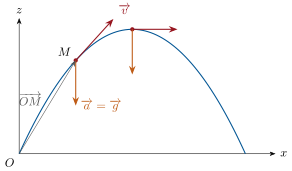
Launched from O at speed v0 and angle α above the horizontal, a ball’s coordinates (dynamics, next chapter) are x=v0cosαt, z=v0sinαt−21gt2. Then v=v0cosαex+(v0sinα−gt)ez, a=−gez: the acceleration is constant while the velocity turns; at the apex (z˙=0, t=v0sinα/g) the velocity is horizontal and the acceleration perpendicular to it. Eliminating t: z=xtanα−gx2/(2v02cos2α), a parabola.
A projectile’s parabola: the velocity is tangent to the trajectory and turns, the accelerationg is constant. At the apex velocity and acceleration are perpendicular: the speed is momentarily stationary while the direction still changes.
11.2 Cylindrical coordinates
Definition 11.5(Cylindrical coordinates and basis)
Point M is located by r≥0 (distance to the z axis), the angle θ of its projection on the xy plane with ex, and z: OM=rer+zez, where
er=cosθex+sinθey,eθ=−sinθex+cosθey,
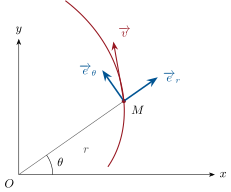
and ez form the local basis(er,eθ,ez), orthonormal and direct, which moves with M. In the plane (z fixed) these are the polar coordinates(r,θ).
Lemma 11.6(Derivatives of the local basis)
dtder=θ˙eθ,dtdeθ=−θ˙er,dtdez=0.
Proof. Differentiate the components: der/dt=θ˙(−sinθex+cosθey)=θ˙eθ, and similarly for eθ. A rotating unit vector’s derivative is perpendicular to it, of norm the angular rate. ∎
Theorem 11.7(Velocity and acceleration in cylindrical coordinates)
Proof. Differentiate OM=rer+zez with the lemma: v=r˙er+rθ˙eθ+z˙ez. Differentiate again: r¨er+r˙θ˙eθ+r˙θ˙eθ+rθ¨eθ−rθ˙2er+z¨ez; collect. ∎
Polar coordinates: the local basis(er,eθ) turns with M; the velocity has a radial part r˙ and an orthoradial part rθ˙. Here the trajectory (red) spirals outward, so r˙>0 and v leans outward from the tangent to the circle.
For uniformcircular motion (ω constant) the acceleration is purely centripetal, of norm v2/R=Rω2, although the speed is constant.
Proof. Set r˙=r¨=0 in the theorem; v=Rω. ∎
Example 11.9(Two circles)
A car rounds a roundabout of radius 20m at 36km/h (10m/s): a=v2/R=5.0m/s2, half a g, directed toward the center — what the tires must supply. The Moon (R=3.84×10⁸m, T=27.3d): ω=2π/T=2.66×10−6rad/s, a=Rω2=2.7×10⁻³m/s2, one 3600th of g at the Earth’s surface, at sixty Earth radii — the comparison Newton made (Chapter 16).
11.3 Spherical coordinates
Definition 11.10(Spherical coordinates)
Point M is located by its distance r=OM, the colatitudeθ∈[0,π] between OM and ez, and the azimuthφ of its projection on the xy plane: OM=rer with
er=sinθcosφex+sinθsinφey+cosθez;
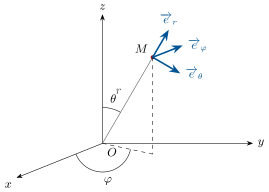
eθ (tangent to the meridian, toward increasing θ) and eφ (tangent to the parallel) complete the local orthonormal basis. On the Earth, θ is 90∘ minus the latitude and φ the longitude.
Proposition 11.11(Velocity in spherical coordinates)
v=r˙er+rθ˙eθ+rsinθφ˙eφ.
Proof.der/dt=θ˙eθ+sinθφ˙eφ: the first term is the rotation in the meridian plane (as in the polar case), the second the rotation about ez at rate φ˙ of a vector whose distance to the axis is sinθ. Then v=d(rer)/dt. The acceleration is not needed this year. ∎
Spherical coordinates(r,θ,φ) and their local basis: er radial, eθ along the meridian (toward the south on a globe), eφ along the parallel (toward the east).
Along a trajectory, the curvilinear abscissas(t) is the arc length from a reference point, counted algebraically; v=s˙. At M, the unit tangent T=dOM/ds points along increasing s; the radius of curvatureρ>0 and the unit normal N, pointing toward the concave side (the center of curvature), are defined by
dsdT=ρ1N.
(T,N) is the Frenet basis; ρ=∞ on a straight line, ρ=R on a circle of radius R.
Theorem 11.13(Acceleration in the Frenet basis)
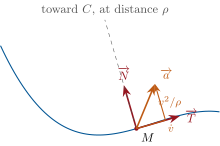
v=vT,a=dtdvT+ρv2N.
The tangential component dv/dt measures how fast the speed changes; the normal component v2/ρ, always toward the center of curvature, how fast the direction turns. The motion is uniform iff a⊥v; it is rectilinear iff a∥v.
Proof.v=(dOM/ds)(ds/dt)=vT. Then a=v˙T+vdT/dt=v˙T+v(dT/ds)s˙=v˙T+(v2/ρ)N. That dT/ds⊥T follows from T⋅T=1 differentiated. ∎
The Frenet basis at a point of a curve: T along the motion, N toward the center of curvature C. The acceleration splits into a tangential part v˙T (speeding up or braking) and a normal part (v2/ρ)N (turning).
Example 11.14(Braking in a bend)
A car at 90km/h (25m/s) in a bend of radius 100m brakes at 2.0m/s2: aT=−2.0m/s2, aN=625/100=6.25m/s2, a=4+39=6.6m/s2. The normal part dominates: a bend is first of all a turning, and the tires’ grip (next chapter) limits aT2+aN2, which is why one brakes before the bend.
On an axis, x¨=a constant, from x0 and v0: v=v0+at, x=x0+v0t+21at2, and v2−v02=2a(x−x0).
Proof. Integrate twice; eliminate t between the first two relations. ∎
Proposition 11.16(Helical motion)
r=R, θ=ωt, z=vzt (constants R, ω, vz): the speed v=R2ω2+vz2 is constant, the accelerationa=−Rω2er is centripetal of constant norm, and the radius of curvature is ρ=v2/a=R(1+vz2/R2ω2)>R.
Proof.Theorem 11.7 with r˙=0, θ¨=0, z¨=0; uniform motion, so a is purely normal and v2/ρ=Rω2. ∎
Proposition 11.17(Harmonic motion)
x=Acos(ωt+φ): x˙=−Aωsin(ωt+φ), x¨=−ω2x. The velocity leads the position by a quarter period and the acceleration is opposite to the position; vmax=Aω, amax=Aω2. This is the projection on a diameter of a uniform circular motion of radius A and angular velocityω.
Proof. Differentiate; for the projection, take x=Acosθ with θ=ωt+φ. ∎
Method 11.18(Choosing coordinates)
Straight-line or parabolic motion, constant acceleration: Cartesian.
Motion around an axis or a point (circles, spirals, orbits, turntables): cylindrical/polar; the basis moves, so use Theorem 11.7, never naive component differentiation.
A given curve (track, bend, loop) when the speed law is known: Frenet, which separates “how fast” from “which way”.
Whatever the choice, v and a are frame-dependent vectors, and a result is complete only with the frame named.
11.6 Exercises
Exercise 11.1★
A car starts from rest with x(t)=2.0t2 (SI units). Velocity and acceleration at t=3.0s; distance covered in the first 5s; time to reach 100km/h.
Solution
Solution of Exercise 11.1.
v=4.0t: 12m/s at 3.0s; a=4.0m/s2; x(5)=50m; 100km/h=27.8m/s at t=27.8/4.0=6.9s.
Exercise 11.2★
A point moves in a plane with r=2.0m and θ=3.0t (rad, SI). Give v and a in the polar basis, their norms, and the nature of the motion.
A ball is thrown with v0=12m/s at α=40∘; its coordinates are those of Example 11.4. Find the time to the apex, the maximum height, the range, and the velocity at landing.
Solution
Solution of Exercise 11.4.
v0sinα=7.71m/s, v0cosα=9.19m/s. Apex at t=7.71/9.81=0.79s, height 7.712/(2×9.81)=3.0m. Range 2×9.19×0.786=14.5m. Landing: (9.19,−7.71), 12m/s at 40∘ below the horizontal.
Exercise 11.5★★
A cyclist at 10m/s enters a bend of radius 25m and accelerates at 1.0m/s2. Give a in the Frenet basis and its norm; after 5s of the same acceleration on the same bend?
Solution
Solution of Exercise 11.5.
aT=1.0m/s2, aN=102/25=4.0m/s2, a=4.1m/s2. After 5s: v=15m/s, aN=225/25=9.0m/s2, a=9.1m/s2.
Exercise 11.6★★
A point follows the spiral r=bθ, θ=ωt (b, ω constants). Compute v, the speed, and a in the polar basis. Where does the 2r˙θ˙ term come from?
Solution
Solution of Exercise 11.6.
r=bωt, r˙=bω, r¨=0, θ˙=ω: v=bωer+bω2teθ, v=bω1+ω2t2; a=−bω3ter+2bω2eθ. The 2r˙θ˙ term has two equal halves: the radial velocity’s direction turns at rate θ˙ (giving r˙θ˙eθ), and moving outward increases the orthoradial speed rθ˙ (another r˙θ˙).
e˙r=θ˙(−sinθex+cosθey)=θ˙eθ; e˙θ=θ˙(−cosθex−sinθey)=−θ˙er. Then v=r˙er+rθ˙eθ, and differentiating once more with the product rule gives the acceleration of Theorem 11.7.
Exercise 11.10★★★
For the projectile of Example 11.4, find the radius of curvature of the trajectory at the apex and at the launch point (use the normal component of g). Which is smaller, and why?
Solution
Solution of Exercise 11.10.
Apex: v=v0cosα, aN=g: ρ=v02cos2α/g. Launch: v=v0, aN=gcosα: ρ=v02/(gcosα). The apex radius is smaller by cos3α: the parabola bends most where it is slowest and where all of g is normal.
Exercise 11.11★★★
A wheel of radius R rolls without slipping at speed v; a point of its rim has coordinates x=vt−Rsin(vt/R), y=R−Rcos(vt/R) (a cycloid). Compute its velocity and acceleration; show that when it touches the ground its velocity vanishes and its acceleration is v2/R upward; find its speed at the top.
Solution
Solution of Exercise 11.11.
x˙=v−vcos(vt/R), y˙=vsin(vt/R); x¨=(v2/R)sin(vt/R), y¨=(v2/R)cos(vt/R). At the ground (vt/R=2πn): x˙=y˙=0 and a=(0,v2/R), upward. At the top (vt/R=π): x˙=2v, y˙=0: speed 2v.
Exercise 11.12★★★
A person walks outward along a radius of a turntable turning at constant ω, at constant speed u relative to the turntable: r=ut, θ=ωt. Compute a in the polar basis, identify the two terms, and evaluate them for u=1.0m/s, ω=1.0rad/s at t=2.0s. Which term has no counterpart for a person walking on the ground?
Solution
Solution of Exercise 11.12.
r¨=0, r˙=u, θ˙=ω: a=−utω2er+2uωeθ. At t=2.0s: −2.0er+2.0eθ (m/s2). The first is the centripetal term of the rotation; the second, 2r˙θ˙, exists only because the radial direction itself rotates — on the ground, walking straight at constant speed gives no acceleration at all.
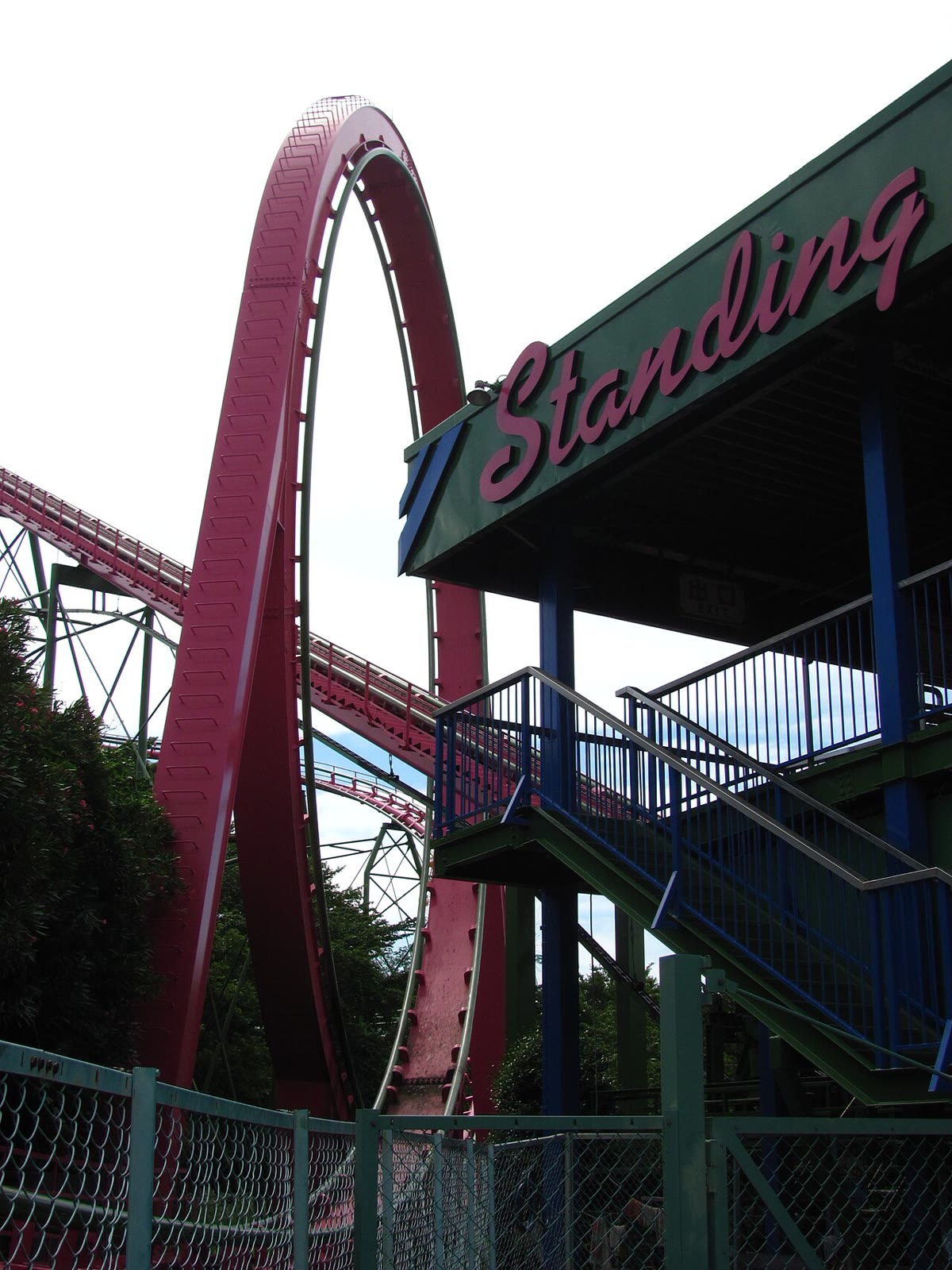
A vertical loop (Yomiuriland, Tokyo): a teardrop rather than a circle, so that the curvature is largest at the top where the speed is least — the geometry of the weekend problem. Photograph: Jeremy Thompson, CC BY 2.0.
11.7 Problem: The roller-coaster loop
Problem 11.1
Weekend problem — a car enters a vertical loop at ninety kilometers per hour: where it slows, where its acceleration points, how many g the riders feel, and why modern loops are not circles
A car, treated as a point M, runs on a vertical circular loop of radius R=10m, center C. Its position is given by the angle θ between CM and the downward vertical (θ=0 at the bottom, π at the top). Friction is neglected, and the speed law (derived in Chapter 13) is
v2=v02−2gR(1−cosθ),
with v0=25m/s the speed at the bottom; g=9.81m/s2.
Part I — Kinematics on the circle.
In polar coordinates centered at C (with er from C to M), write v and a for motion on the circle.
Identify the Frenet vectors T and N in terms of er and eθ, and the radius of curvature.
Compute the speed at the top, and at the side points θ=π/2 and 3π/2.
Differentiate the speed law with respect to time to show that the tangential acceleration is aT=−gsinθ. Interpret its sign on the way up and on the way down.
Express the normal accelerationaN(θ) and compute it at the bottom, the sides and the top.
Give the norm of a at the four points and the angle it makes with the vertical at the top.
At which points is a perpendicular to v? Parallel?
Part II — Angular rates and timing.
Express θ˙ as a function of θ and compute it at the bottom and the top.
Show that θ¨=−(g/R)sinθ (the equation of a pendulum) and comment.
For comparison, compute the period of small oscillations of a simple pendulum of length R (Example 1.8 gave its form; k=2π).
Estimate the time to go round the loop, using the average of the speeds at the four reference points.
The minimum speed at the top for the car to stay on the track (next chapter) is gR. Is it satisfied? What minimum v0 would be needed?
Part III — What the riders feel. The apparent weight per unit mass felt by a rider is a−g (admitted here, derived in Chapter 12); its norm in units of g is the “g-load”.
Compute the g-load at the bottom.
Compute it at the top, and say which way the rider is pressed (seat or restraint).
Compute it at the side points.
Riders tolerate about 4g briefly. Does this loop pass? Where is the problem?
Show that, for a circular loop entered just fast enough to clear the top (zero apparent weight there), the bottom g-load is necessarily 6g, whatever R.
Part IV — The clothoid loop. Modern loops are “teardrops”: the radius of curvature is large at the bottom and small at the top.
Using the Frenet form of a, explain why varying ρ along the track changes aN without changing the speed law (which depends only on height).
Choose ρbottom so that the g-load at the bottom is 3g with v0=25m/s.
At the top, the height is still 2R=20m above the bottom. Choose ρtop so that the g-load there is 1.5g.
A clothoid has curvature proportional to arc length, 1/ρ=s/A2. Along such an entry, with the speed nearly constant, how does aN grow with time, and why is that gentler on the neck than a circle (where aN jumps at the entry)?
Sketch the resulting loop shape qualitatively and summarize in two sentences why it replaced the circle.
Part V — Seen from the ground. A camera at ground level, 50m from the loop’s center in its plane, follows the car.
When the car is at the top, moving horizontally at 15m/s, at what angular rate (rad/s) must the camera turn? (Polar coordinates from the camera.)
Why is a camera that turns at constant rate a poor tracker of uniform circular motion?
Summarize the chapter’s lesson from the loop: which coordinate system answered which question.
Solution
Solution of Problem 11.1.
1.v=Rθ˙eθ; a=−Rθ˙2er+Rθ¨eθ.
2.T=eθ (motion with θ increasing), N=−er (toward C), ρ=R.
21.aN=v2/ρ=v2s/A2=v3t/A2: it grows linearly from zero — a constant rate of change of acceleration — instead of jumping from 0 to v2/R at the entry of a circle, which the neck feels as a blow.
22. A teardrop: wide and gently curved at the bottom where the car is fast, tight at the top where it is slow. It keeps the load near 3g throughout and brings it on gradually.
23. Line of sight: horizontal distance 50m, height 20m: r=53.9m, elevation β=21.8∘. The horizontal velocity’s transverse component is vsinβ=15×0.371=5.6m/s; θ˙=5.6/53.9=0.10rad/s.
24. Seen from an off-center point the angular rate of the line of sight is not constant (fast when the car is near, slow when far): a constant-rate camera drifts off the car.
25.Polar coordinates at C for velocity and acceleration on the circle; the Frenet split for “speeding up” versus “turning” and for the clothoid; polar coordinates at the camera for the tracking rate; energy (next chapters) for the speed law.