Physics · Glossary

What is Velocity and acceleration?

Definition 11.2 University Physics — Year 1 · Chapter 11 — Kinematics of a Point

The velocity and acceleration of MM in the frame are

v= ⁣dOM ⁣dt,a= ⁣dv ⁣dt= ⁣d2OM ⁣dt2,\vect v = \frac{\dd\vect{OM}}{\dd t}, \qquad \vect a = \frac{\dd\vect v}{\dd t} = \frac{\dd^2\vect{OM}}{\dd t^2},

derivatives of vector functions: the derivative of a vector is obtained by differentiating its components in a basis that is fixed in the frame. The velocity is tangent to the trajectory and points along the motion; its norm vv is the speed. Units: m/s\mathrm{m}/\mathrm{s}, m/s2\mathrm{m}/\mathrm{s}^{2}.

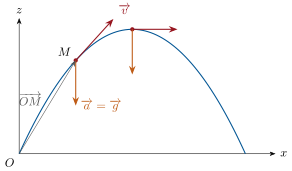
A projectile’s parabola: the velocity is tangent to the trajectory and turns, the acceleration g is constant. At the apex velocity and acceleration are perpendicular: the speed is momentarily stationary while the direction still changes.
A projectile’s parabola: the velocity is tangent to the trajectory and turns, the acceleration g\vect g is constant. At the apex velocity and acceleration are perpendicular: the speed is momentarily stationary while the direction still changes.

Examples

Example 11.4 (Projectile)

Launched from OO at speed v0v_0 and angle α\alpha above the horizontal, a ball’s coordinates (dynamics, next chapter) are x=v0cosαtx = v_0\cos\alpha\,t, z=v0sinαt12gt2z = v_0\sin\alpha\,t - \tfrac12 gt^2. Then v=v0cosαex+(v0sinαgt)ez\vect v = v_0\cos\alpha\,\vect e_x + (v_0\sin\alpha - gt)\vect e_z, a=gez\vect a = -g\vect e_z: the acceleration is constant while the velocity turns; at the apex (z˙=0\dot z = 0, t=v0sinα/gt = v_0\sin\alpha/g) the velocity is horizontal and the acceleration perpendicular to it. Eliminating tt: z=xtanαgx2/(2v02cos2α)z = x\tan\alpha - gx^2/(2v_0^2\cos^2\alpha), a parabola.

Read in context →