 Coach
CoachWhen a solid deforms, the particle initially at moves to : is the displacement field. For small deformations, the local distortion is measured by the strain tensor, the symmetric array
A diagonal component is the relative elongation of the material along (dimensionless, e.g. for a steel cable in service); an off-diagonal component is half the closing of the angle between the and material directions — a shear. The trace is the relative change of volume, the dilatation:
Examples
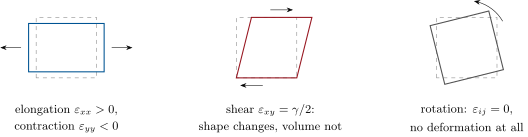
Example 3.2 (Three elementary deformations)
Uniform dilation : , volume change , no shear. Simple shear : , all diagonal components zero — shape changes, volume does not. Rigid rotation : identically — the antisymmetric part of , discarded by the symmetrisation, is exactly the part that rotates without deforming. Strain measures deformation only.