University Physics — Year 3 · Bachelor Year 3
3Continuum Mechanics and Elasticity
Press your ear to a long steel rail while a distant worker strikes it: you hear two clangs — one through the steel, one through the air, a second or more apart. Rock, steel, bone and rubber all carry forces and waves the way a fluid carries pressure, but with something no fluid has: they resist changes of shape, not only changes of volume. The Year 2 volume built the mechanics of fluids on two ideas, the material particle and the pressure field; this chapter extends them to solids. The displacement of each particle becomes a field, its local distortion a strain, the internal forces a stress, and between them stands the solid’s identity card, Hooke’s law with its two elastic constants. The payoff runs from the everyday — why cables stretch, why bottles burst, how a diving board bends — to the planetary: earthquakes send through the Earth exactly the two kinds of elastic wave this chapter predicts, and their arrival times were the first sound ever taken of our planet’s interior.
3.1 Strain: describing deformation
Definition 3.1 (Displacement field and strain tensor)
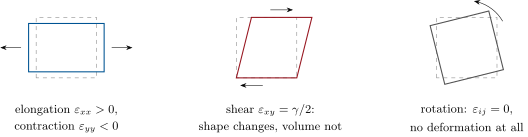
When a solid deforms, the particle initially at moves to : is the displacement field. For small deformations, the local distortion is measured by the strain tensor, the symmetric array
A diagonal component is the relative elongation of the material along (dimensionless, e.g. for a steel cable in service); an off-diagonal component is half the closing of the angle between the and material directions — a shear. The trace is the relative change of volume, the dilatation:
Example 3.2 (Three elementary deformations)
Uniform dilation : , volume change , no shear. Simple shear : , all diagonal components zero — shape changes, volume does not. Rigid rotation : identically — the antisymmetric part of , discarded by the symmetrisation, is exactly the part that rotates without deforming. Strain measures deformation only.
3.2 Stress: describing internal forces
Definition 3.3 (Traction and the stress tensor)
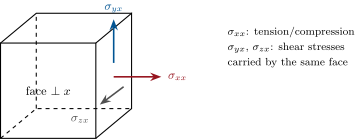
Cut the solid, in thought, along a small surface of normal : the material on the side pulls on the other side with a force — the traction. This force depends linearly on (Cauchy), so it is encoded by the stress tensor :
in pascals. is a pull (: tension) or push (: compression) across a face normal to ; is a force along carried by a face normal to — a shear stress. A fluid at rest is the special case : pressure pushes equally on every face and shears on none, which is why fluids flow — they cannot carry static shear.
Proposition 3.4 (Equilibrium and symmetry)
In a solid at equilibrium under a body force per unit volume (e.g. ),
at every interior point; and the stress tensor is symmetric, .
Partial proof. Balance the forces on a small cube of side : the tractions on the two faces normal to differ by per unit area, and likewise for the other pairs; the net surface force per unit volume is , which must cancel — the same bookkeeping that gave in the fluid statics of the Year 1 volume. Symmetry: the torque of the shear stresses about the cube’s centre is at leading order, while its moment of inertia scales as ; an asymmetric stress would spin small cubes infinitely fast. The full continuum argument is admitted. ∎
3.3 Hooke’s law and the elastic constants
Theorem 3.5 (Linear isotropic elasticity)
For small strains, an isotropic solid responds linearly: stress is proportional to strain,
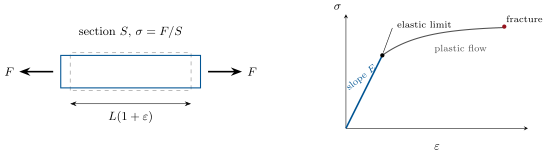
with two material constants, the Lamé coefficients and ( is also written , the shear modulus). In the simple traction test — a bar pulled along , free on its sides — the same law takes the engineer’s form
defining Young’s modulus (stiffness against stretching) and Poisson’s ratio (lateral contraction), with
This is Hooke’s “as the extension, so the force” (1678), promoted to a tensor. It holds up to a material-dependent elastic limit.
Proof. Admitted at this level. ∎
Remark 3.6 (Orders of magnitude)
for steel, for aluminium and window glass, for granite, for bone and concrete, for wood along the grain, and only a few MPa for rubber — five orders of magnitude, the span between a bridge and an elastic band. lies between (cork, nearly) and (rubber): means volume-preserving deformation, and is typical of metals. A strain of in steel already means , close to the yield stress of ordinary grades: everyday elasticity lives below one part in a thousand.
Example 3.7 (An elevator cable)
A steel cable of cross-section carries a car: , , stretch — and the cable behaves as a spring of stiffness : the formula is how a continuum hands back the springs of the Year 1 volume.
Proposition 3.8 (Elastic energy)
A strained solid stores, per unit volume, the energy density
the three-dimensional .
Partial proof. In simple traction, bringing the stress from to does the work per unit volume — the area under the stress–strain line, exactly as for a spring. The general quadratic form follows by superposing the components; admitted. ∎
Method 3.9 (Solving small-elasticity problems)
(1) Identify the geometry and the loading; guess which stress components are nonzero (a pulled bar: only ; a twisted wire: shear; a pressurised shell: tangential tensions). (2) Write force balance on a well-chosen piece — a half-cylinder, a slice, a cube. (3) Convert stress to strain by Hooke’s law, strain to displacement by integrating. (4) Energies via (or in shear). (5) Always check the strain stays small and the stress below the elastic limit — otherwise the answer describes a solid that no longer exists.
3.4 Elastic waves
Proposition 3.10 (The two sounds of a solid)
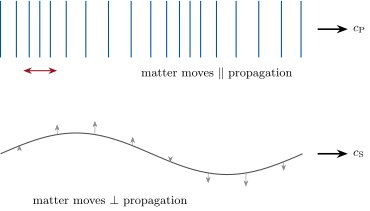
In an unbounded elastic solid of density , small disturbances propagate as two independent kinds of wave: longitudinal (P) waves, in which matter oscillates along the propagation direction by compression and dilation, at speed
and transverse (S) waves, in which matter shears sideways, at
A fluid has : no S waves — shear cannot be transmitted — and the P speed reduces to the sound speed of the Year 2 volume. For (typical rock), and .
Partial proof. Take a plane disturbance . Newton’s law per unit volume is (the equilibrium equation with inertia restored). For the longitudinal component, Hooke’s law gives (the lateral strains vanish in a plane wave, the neighbouring matter forbidding lateral release), so : d’Alembert at speed . For the transverse component, , whence : speed . That a general disturbance splits into these two families is admitted. ∎
Example 3.11 (The rail and the earthquake)
Steel: — a strike on a rail away arrives through the steel in and through the air () in : two clangs. Granite (, , ): , . An earthquake therefore announces itself twice: a sharp P jolt, then, seconds later, the slower, stronger S shaking — and the delay measures the distance (Problem 3.1). Earthquake early-warning systems live inside that delay: the P wave, and the radio message it triggers, outrun the S wave that does the damage.
Remark 3.12 (Strings, rods and sound recovered)
The waves of the Year 2 volume are all limits of this chapter. A thin rod, free to thin sideways, carries compression waves at (slower than : the lateral release softens the response); a stretched string carries transverse waves at , with tension standing in for stiffness; a fluid keeps only — its bulk modulus — and the single sound speed .

3.5 Exercises
Exercise 3.1 ★
(a) Check the units: what is a pascal in terms of kg, m, s, and what is the unit of strain? (b) A steel cable works at : compute its strain. (c) A rubber band () is stretched to twice its length: what “strain” is that, and why does this chapter’s framework not really apply? (d) Rank by stored elastic energy density at their working stress: steel at , rubber at .
Solution
Solution of Exercise 3.1.
(a) ; strain is a pure number. (b) . (c) Doubling the length is : a thousand times beyond “small”, and rubber’s response there is strongly nonlinear (and of a different, entropic origin) — Hooke’s law only opens the curve. (d) : steel ; rubber — the soft material stores more per unit volume at working stress, which is why slingshots are rubber, not steel.
Exercise 3.2 ★
Compute the strain tensor of each displacement field and describe the deformation: (a) ; (b) ; (c) ; (d) — which experiment realises it?
Solution
Solution of Exercise 3.2.
(a) : isotropic dilation, . (b) , rest zero: pure shear, volume unchanged. (c) : rigid rotation, no deformation. (d) : the traction test — stretch along , Poisson contraction across.
Exercise 3.3 ★
The base of a granite column of height carries the stress . (a) Derive this from the equilibrium equation with gravity. (b) Granite crushes at about : what is the tallest column? (c) Everest is high: comment. (d) Why can a mountain be a little taller than a column of its own rock (think about the shape)?
Solution
Solution of Exercise 3.3.
(a) With only and weight: (taking compression positive downward), at the base. (b) . (c) Everest is at the crushing limit of its own base — Earth’s mountains are as tall as rock strength allows, and no taller. (d) A cone of height loads its base with only (a third of the column: the mass grows with the section), so a mountain-shaped pile can stand about three times taller than a column.
Exercise 3.4 ★
A steel rod (, ) is stretched by . (a) Lateral strain? (b) Relative volume change? (c) For which would the volume not change at all, and which common material is close to it? (d) Why is impossible (consider hydrostatic compression)?
Solution
Solution of Exercise 3.4.
(a) . (b) . (c) : incompressible deformation — rubber. (d) For the bulk modulus would be negative: squeezing from all sides would grow the volume, and the material would release energy by collapsing — no stable solid can do it.
Exercise 3.5 ★★
Hoop stress. A thin-walled cylinder (radius , wall thickness ) holds a pressure . (a) Balancing forces on a half-cylinder of unit length, show the wall carries the tangential stress . (b) Show the longitudinal stress (balance on a cross-section) is : a cylinder is stressed twice as hard around as along — which way do sausages split? (c) A diving cylinder: , , : compute and compare with a steel yield stress of . (d) Why do high-pressure tanks have hemispherical ends?
Solution
Solution of Exercise 3.5.
(a) On a half-cylinder of unit length, the pressure pushes with (projected area) and the two cut walls pull back with : . (b) On a cross-section, : — half. A sausage splits lengthwise: the bigger hoop stress tears the skin along the axis. (c) : a factor below yield — which is why cylinders are proof-tested and inspected. (d) A sphere carries in every direction: hemispherical ends halve the stress and avoid the corners where flat ends would concentrate it.
Exercise 3.6 ★★
A rubber block (, ), base , height , is glued between two plates; the top plate is pushed sideways with . (a) Compute . (b) Shear stress and shear angle ; sideways displacement of the top plate. (c) Why is for rubber (what is hard and what is easy for a tangle of polymer chains)? (d) Such rubber blocks carry entire buildings in earthquake zones: which property of this mount protects the building, stiffness in compression or softness in shear?
Solution
Solution of Exercise 3.6.
(a) . (b) ; ; displacement . (c) A rubber network changes shape by mere reorientation of its chains (easy), but changing volume means packing the chains closer, as hard as compressing a liquid: , hence . (d) Softness in shear: the mount lets the ground shake horizontally underneath while transmitting little force, yet remains stiff enough in compression to hold the building’s weight.
Exercise 3.7 ★★
A climbing rope, length , cross-section , effective modulus . (a) Its stiffness . (b) A climber falls freely before the rope engages: equating energies, find the maximum rope stretch (solve the quadratic; neglect the fall continued during braking at your first pass). (c) Deduce the peak force and the peak deceleration in . (d) Why must a rope that has held a hard fall be retired (where did the energy go, and what does the stress–strain curve say)?
Solution
Solution of Exercise 3.7.
(a) . (b) : , . (c) ; deceleration — the reason ropes are made deliberately stretchy. (d) Part of the absorbed energy went into breaking fibres and plastic rearrangement: the rope now sits on a degraded stress–strain curve, stiffer and weaker, and the next fall would be harder in both senses.
Exercise 3.8 ★★
Torsion. A wire of radius , length , shear modulus is twisted by an angle . (a) Show a tube of radius inside it suffers the shear angle . (b) Its shear stress is : integrate stress over the section to get the restoring torque . (c) The : halve the radius, and by what factor does the torsional stiffness drop? (d) This extreme softness is why Cavendish (1798) hung his balance from a fine wire: for , , , compute and the period with a rod of moment of inertia .
Solution
Solution of Exercise 3.8.
(a) The top of a tube of radius turns by the arc over the length : . (b) . (c) By . (d) ; — a quarter of an hour per swing: sensitivity enough to feel the gravity of lead spheres.
Exercise 3.9 ★★
(a) From the plane-wave derivation of Proposition 3.10, compute and for steel (, , ). (b) Compare with the thin-rod speed and explain the difference in one sentence. (c) For water (, bulk modulus ): the S speed and the P speed. (d) At what angle does a P wave’s matter motion differ from an S wave’s, and how does a seismometer with three components tell them apart?
Solution
Solution of Exercise 3.9.
(a) , : , . (b) The thin rod gives : in the rod the sides bulge freely (Poisson release), softening the response; in the bulk the surrounding matter forbids it. (c) ; — the sound speed of water. (d) P moves the ground along the ray (near-vertical for a deep source), S across it: the three components of a seismometer separate the polarisations, and the P/S delay then dates the distance.
Exercise 3.10 ★★★
Bending. A beam is bent to a radius of curvature ; its inner fibres shorten, its outer fibres stretch, and a neutral surface in between keeps its length. (a) Show the fibre at distance from the neutral surface has strain , hence stress . (b) Summing moments over the cross-section, show the bending moment is with (the second moment); compute for a rectangle of width and height . (c) The : why does a plank bent flat-wise sag visibly while the same plank on edge feels rigid? Compute the ratio for . (d) For a cantilever of length loaded by at its tip, the tip sag is (admitted): estimate for a diving board (, , , wood ) under a diver, and comment.
Solution
Solution of Exercise 3.10.
(a) An arc at radius has length against at the neutral surface: , . (b) ; for the rectangle . (c) Flat: ; on edge: — ratio for : same wood, twenty-five times stiffer, purely by geometry. (d) , ; : exactly the pleasant give of a diving board.
Exercise 3.11 ★★★
Buckling. A slender column (length , flexural rigidity ), pinned at both ends, carries an axial load . Suppose it bows sideways by . (a) Show the load then exerts the bending moment about the displaced axis, so . (b) With , show a nonzero bow first becomes possible at Euler’s critical load . (c) Compute for a metre rule (, , ) and compare with your hand’s push. (d) Explain from why bones, bamboo and bicycle frames are tubes.
Solution
Solution of Exercise 3.11.
(a) In the bowed configuration the axial load acts with lever arm about the section at : , and gives . (b) with : nonzero first at , i.e. ; below it the straight column is the only solution, above it bowing costs no force. (c) : — the weight of an apple: a metre rule buckles under a finger. (d) grows as material moves away from the axis: a tube puts all its section at large , maximising (hence ) for a given weight of material — the design of bones, bamboo and bicycle frames.
Exercise 3.12 ★★★
The speed of sound in a solid, from atoms. Model a solid as chains of atoms, spacing , connected by “springs” of stiffness ; atomic mass . (a) Show that stretching the chain maps onto continuum traction with (count springs per unit area, stretch per spring). (b) Show and conclude . (c) Estimate from the depth of an interatomic bond ( over ): ; with and , estimate . (d) Compare with measured metal sound speeds, and conclude what everyday elasticity is made of.
Solution
Solution of Exercise 3.12.
(a) One chain per area ; stretching by strain stretches each spring by , force per chain, stress : . (b) , so and . (c) . (d) Right on the measured few km/s of metals: the stiffness of everything solid — and the speed of every earthquake wave — is the stiffness of the chemical bond.
3.6 Problem: Listening to the Earth
Problem 3.1
Weekend problem — how earthquakes revealed the liquid core
A single earthquake rings the whole planet, and the two elastic waves of this chapter, crossing it, x-ray it. This problem follows the physics from Hooke’s law in granite to Oldham’s 1906 discovery that the Earth has a core — with the straight-ray estimate of its size. Take for the crust and mantle rock , , ; Earth radius .
Part I — Rock as an elastic solid.
- Compute the Lamé coefficients and of this rock, and observe that makes them equal.
- Compute and , and verify .
- An earthquake slips two rock faces by metres in seconds: estimate the strain released if a slip relaxes rock over a scale, and the stress that had built up.
- From the energy density , estimate the elastic energy per cubic metre, then the energy in a volume; compare with a megaton ().
- Why does the S wave usually shake buildings harder than the P wave (think about the direction of ground motion for a wave arriving from below)?
- In which of the two waves does the ground change volume?
Part II — The seismometer’s two arrivals.
A station records the P arrival, then the S arrival later. For a source at distance (short enough for straight rays), show
- Evaluate the coefficient: how many kilometres per second of S–P delay?
- A station measures : how far is the earthquake?
- One station gives a distance, not a place: how many stations determine the epicentre, and how, geometrically?
- Japan’s early-warning sirens sound seconds before the strong shaking: for a quake below a city, how much warning does the P–S delay itself provide?
- Modern warnings add the speed of light: the P wave detected near the source is radioed ahead of both waves. For a city from the epicentre, how long after the rupture does the S wave arrive, and what warning can a radio message sent at the P’s first arrival from the source give?
Part III — Waves that cross the planet.
- At the pressures of the deep mantle the moduli grow: P speeds reach at the mantle’s base. Taking a rough average , how long does a P wave need to cross the Earth diametrically?
- Stations register quakes from the far side of the globe: what does the mere existence of these arrivals say about the deep Earth (is it elastic? molten through?)?
- Define the epicentral angle (angle at the Earth’s centre between source and station). For straight rays, show that the chord length is .
- Evaluate the chord and its straight-ray travel time for at the average .
- Around 1900, Oldham noticed that S waves are recorded up to and then disappear: no direct S beyond. What property of a region deep inside the Earth kills S waves, and what state of matter has that property?
- P waves beyond are not absent but weakened, delayed and displaced (a “shadow zone” up to ): why does a liquid region delay and refract P waves but not stop them?
- Conclude in one sentence what sits at the centre of the Earth.
Part IV — Weighing the core with a ruler.
- A straight S ray leaving the source grazes the core if its closest approach to the centre equals the core radius . Show that this grazing ray reaches the surface at the epicentral angle .
- From , compute .
- The modern value is : compute your error, and explain its sign: real rays curve back toward the surface as speed grows with depth — argue whether straight rays over- or underestimate the core.
- In 1936 Inge Lehmann found weak P arrivals inside the shadow zone: what did she conclude sits inside the liquid core?
- The inner core’s radius is and it is solid: propose the wave observation that could confirm solidity (which wave exists there that the outer core forbids?).
- Summarise the named result: two elastic wave speeds in rock ( and ), one missing wave beyond , and a ruler give a liquid core of radius — within of the modern , measured through of solid rock.
Solution
Solution of Problem 3.1.
1. ; : for , . 2. ; ; ratio . 3. ; — the measured “stress drop” of real earthquakes is indeed a few MPa. 4. ; over : , about three-quarters of a megaton — a large earthquake. 5. From below, P moves the ground vertically — buildings are built to carry vertical loads; S moves it horizontally, the direction in which buildings are weakest. 6. Only the P wave: it is a compression wave; the S wave is pure shear, at constant volume. 7. , : , inverted as stated. 8. per second of delay — the field seismologist’s “eight kilometres per second”. 9. . 10. Three (in general): each station knows a circle of possible epicentres; two circles cross in two points, the third decides. 11. , : about of warning between the jolt and the destructive shaking. 12. S arrives at . The P reaches at ; a radio message is practically instantaneous, so the city can have almost a minute of warning — current systems achieve tens of seconds. 13. , some twenty minutes. 14. That elastic waves cross it at all: the deep Earth is not molten through — it transmits, and (S waves crossing the mantle) even shears, like a solid. 15. Two radii and the angle between them: the chord is . 16. ; . 17. Beyond every ray must pass through a deep central region; if that region is fluid (), it carries no shear wave: the S waves die there. Fluids are the state of matter that cannot resist shear. 18. A fluid still carries compression: P waves cross the core, but slower — so they refract sharply at its boundary, and the bent rays leave an annular shadow instead of a clean cut. 19. A liquid core sits at the centre of the Earth. 20. The chord’s closest approach to the centre is ; grazing means , i.e. . 21. . 22. too large. Speed grows with depth, so real rays curve back toward the surface: a ray whose deepest point just touches the core comes up at a smaller angle than the straight chord through the same depth — so from the observed , the straight-ray inversion places the tangent point too shallow, i.e. overestimates the core. 23. Weak P energy inside the shadow means something inside the liquid core bends rays back out: a distinct inner core (Lehmann, 1936). 24. Shear waves exist only in solids: a P wave converting to a shear wave inside the inner core and back (the phase called PKJKP) would prove it solid — its detection, long sought, is the accepted evidence. 25. Two speeds in rock ( and ), one missing wave beyond , and the chord geometry yield a liquid core of — within of the modern : Hooke’s law, read at planetary scale.