
Physics · Glossary

What is Efficiency?

Definition 70.7 Primary & Middle School Physics · Chapter 70 — Forms of Energy and Conversions

The efficiency of a converter is the fraction of its input energy delivered in the wanted form:

efficiency=useful energy outtotal energy in,\text{efficiency} = \frac{\text{useful energy out}}{\text{total energy in}},

a number between 00 and 11 (or its percentage). The remainder is not destroyed — conservation forbids — but escapes in unwanted forms, nearly always warmth.
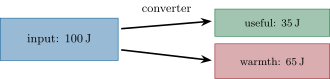
An efficiency diagram: one hundred joules in, thirty-five delivered as wanted, sixty-five leaked as warmth — and not one joule missing from the sum.
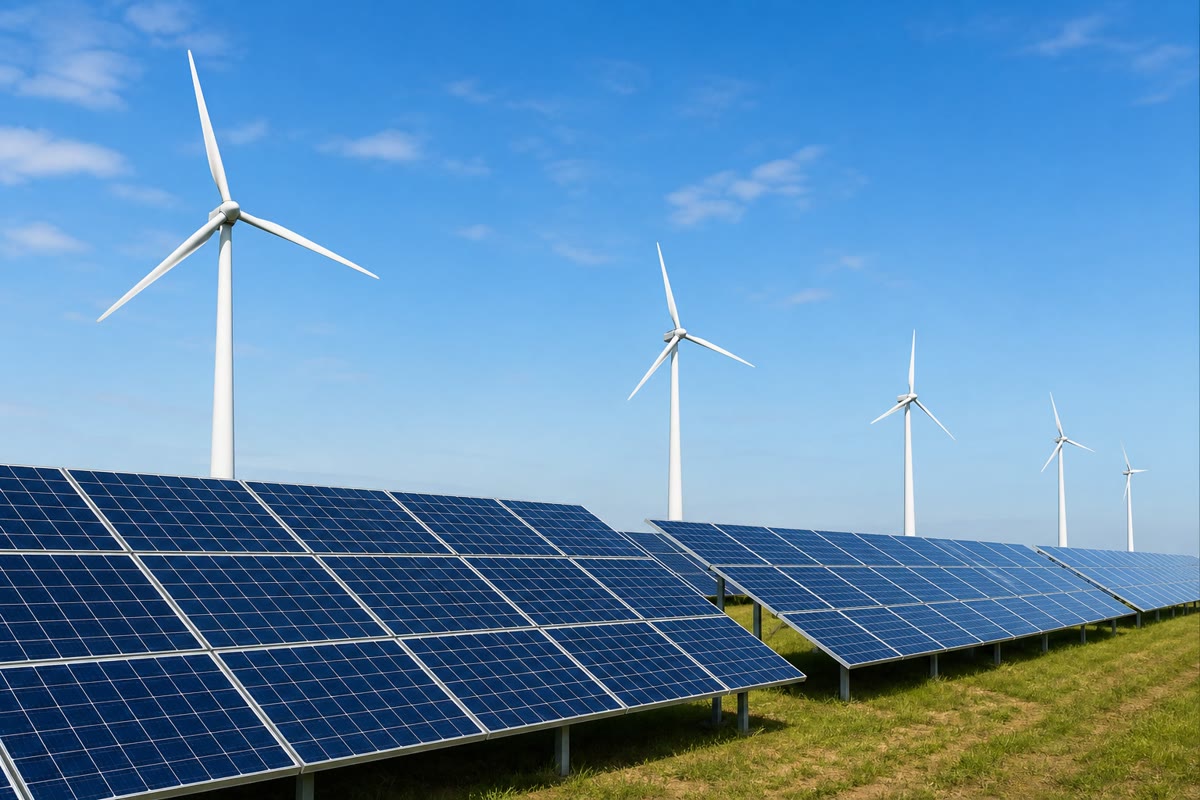
Two converters in one field: sunlight to electrical energy in the panels, moving air to electrical energy in the turbines.

Examples

Example 70.8 (Report cards)

The glowing ancestor bulb: five percent light, ninety-five warmth — a heater with a hobby. Its modern successor: thirty-plus percent, the rest still warmth. A car engine: about a third useful motion, two thirds out the radiator and exhaust. An electric motor: above ninety. The great alternators: near ninety-nine — civilization’s finest converters. No honest converter reaches one hundred: some leak to warmth is nature’s universal commission.
Read in context →
Definition 9.12 High School Physics · Chapter 9 — Energy: Forms and Conservation

A converter consumes EconsumedE_{\text{consumed}} and delivers the wanted form EusefulE_{\text{useful}}; its efficiency is

η=EusefulEconsumed<1.\eta = \frac{E_{\text{useful}}}{E_{\text{consumed}}} < 1 .

Conservation forbids η>1\eta > 1, and real converters never reach 11: the missing energy is not destroyed — it leaves as heat.

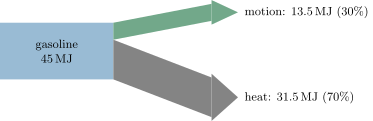
The car engine’s budget, arrow widths to scale: of 45\, MJ consumed, 13.5\, MJ moves the car; the rest is heat.
The car engine’s budget, arrow widths to scale: of 45MJ45\,\mathrm{MJ} consumed, 13.5MJ13.5\,\mathrm{MJ} moves the car; the rest is heat.

Examples

Example 9.13 (Where the gasoline goes)

A kilogram of gasoline stores 45MJ45\,\mathrm{MJ} of chemical energy; a car engine converts it with η0.30\eta \approx 0.30: 13.5MJ13.5\,\mathrm{MJ} of motion, 31.5MJ31.5\,\mathrm{MJ} heating the exhaust, the radiator and the street. Two thirds of every tank warms the atmosphere.

Read in context →