Primary & Middle School Physics · Grades 1–9
41Electric Circuits and Safety
Three years of loops, bulbs and branches have made you a builder of circuits. This year you become something rarer: a writer of circuits. Electricians in every country read and draw the same wordless language — and its grammar, plus a chapter of hard-won safety wisdom, is what stands between clever wiring and burnt fingers.
41.1 The wordless language
Definition 41.1 (Circuit diagram)
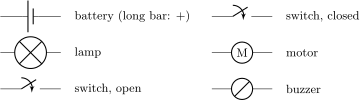
A circuit diagram is the standard drawing of a circuit: each device is shown by its agreed symbol, and the wires by straight lines drawn with square corners. A diagram shows how the circuit is connected — who feeds whom, what forks where — and deliberately ignores how the real wires snake across the table.
Method 41.2 (From table to paper, and back)
To draw a built circuit:
- list the devices, and pick each one’s symbol;
- follow the real loop with a finger from the battery’s , noting the order of devices and every fork;
- redraw as a tidy rectangle: symbols spaced out, wires straight, corners square — same connections, no snakes.
To build from a diagram, run the translation backward — and afterward, check as always: every loop traced from must reach through at least one device.
Example 41.3 (Same circuit, two portraits)
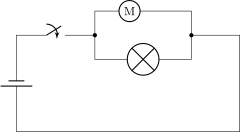
On the table: a battery, a tangle of alligator-clip wires looping over a pencil case, a lamp leaning on a book, a switch dangling. On paper: a calm rectangle — battery on the left, switch on top, lamp on the right. The tangle and the rectangle are the same circuit: every connection identical. To decide whether two circuits are the same, ask one question only: who is connected to whom?
Example 41.4 (Motors and buzzers join the game)
Two newcomers to your kit behave just like lamps in a diagram: the motor (symbol: M in a circle) spins whenever current flows through it — fans, toy cars, drills; the buzzer (a struck circle) sounds whenever fed — doorbells, alarms. Series and parallel rules apply to them unchanged: a switch in series commands them; parallel branches make them independent.
41.2 Old rules in the new language
Example 41.5 (Reading a diagram like a pro)
Given any diagram, interrogate it with the finger-walk of the parallel-circuits chapter: from , walk every road to . All devices on one road: series — one gap stops all, order free, brightness shared. Roads that fork at junction dots: parallel — branches independent, full brightness each, switch placement now a real decision. The language changed; the laws did not.
41.3 The chapter of scars
Electricity’s safety rules were paid for in fires and worse. Here they are, with their reasons — a professional knows both.
Definition 41.6 (Short circuit)
A short circuit happens when a bare conducting road connects a battery’s (or socket’s) two sides directly, skipping every device. With nothing useful in its way, the current rushes wildly — wires heat, insulation melts, batteries are ruined, and mains wiring can catch fire. Next year’s circuits chapter studies the villain closely; this year, learn its face and keep it out of your builds.
Remark 41.7 (The house’s bodyguards)
Look inside the fuse box at home: rows of small switches — circuit breakers — one per branch of the house’s great parallel circuit. Each stands guard over its branch: if a fault lets the current rush — a short circuit, an overloaded socket — the guard snaps itself off in a blink, cutting the branch before wires overheat. When a breaker “trips”, it is not misbehaving: it has just done its one job. Find the fault before resetting it.
Remark 41.8 (The rules, with reasons)
- Battery experiments only; the socket, never. The mains pushes hundreds of times harder — through damp skin it can stop a heart.
- No bare wire straight across a battery. That is a short circuit: ruined cells, hot wire, burnt fingers.
- Water and mains electricity never share a room’s reach: no gadgets by the bath, no wet hands on plugs — damp skin is a conductor.
- Never poke anything into a socket. The guard in the fuse box is fast, but you must never bet on it.
- Damaged cords go to the bin, not the drawer: cracked insulation is a fence with a gap.
41.4 Exercises
Exercise 41.1 ★
What does a circuit diagram show faithfully, and what does it deliberately ignore?
Solution
Solution of Exercise 41.1.
Faithfully: the connections — which device joins which, where roads fork. Ignored: the real wires’ lengths, colors and snaking paths across the table.
Exercise 41.2 ★
Draw from memory the symbols: battery; lamp; open switch; closed switch; motor; buzzer. Which mark tells the battery’s side?
Exercise 41.3 ★
Draw the diagram of a doorbell: battery, push-switch and buzzer in one loop. Why does the bell stop when the finger lifts?
Solution
Solution of Exercise 41.3.
One rectangle: battery, push-switch and buzzer in a single loop. Lifting the finger opens the switch — a gap in the only road, and the loop law silences the buzzer instantly.
Exercise 41.4 ★
Two circuits are built from the same box of parts: are they “the same circuit”? What single question decides?
Solution
Solution of Exercise 41.4.
Not necessarily. The deciding question: who is connected to whom? Same devices with the same connections — same circuit, however different the tangles look.
Exercise 41.5 ★
In the chapter’s lamp-and-motor diagram, what happens to the fan if the lamp burns out? And to both if the switch opens? Which old rules answer?
Exercise 41.6 ★
What is a short circuit, and why does it heat wires? Name two of its victims.
Exercise 41.7 ★
A circuit breaker in the fuse box has tripped. What has it just done for the house? What should be done before resetting it?
Exercise 41.8 ★
Give the reason behind each rule: no gadgets near the bath; damaged cords to the bin; battery games yes, socket never.
Exercise 41.9 ★★
Translate to a diagram (in words or drawing): a battery; from its , a wire to a closed switch; from the switch a fork — one branch through a buzzer, one through a lamp; branches rejoin and return to . Predict what is heard and seen, and what changes if the buzzer’s branch alone gets its own extra switch, opened.
Solution
Solution of Exercise 41.9.
Diagram: battery, closed switch on the common road, then a fork — buzzer branch and lamp branch — rejoining to . Predicted: the lamp shines and the buzzer sounds, independently. With an opened extra switch on the buzzer’s branch: silence there, but the lamp shines on — branch switches command only their branch.
Exercise 41.10 ★★
A toy fan is wired: battery to motor, motor to battery , and — “for solidity” — one extra bare wire directly from to . The fan barely turns and the extra wire grows hot. Diagnose with Definition 41.6: what road is the current preferring, and why is the build dangerous?
Solution
Solution of Exercise 41.10.
The extra wire is a short circuit: a bare direct road from to . Current prefers the easy empty road to the hard-working motor, so the fan starves while the shortcut wire carries the rush and heats — draining the battery and inviting burns. Remove the “solidity” wire.
Exercise 41.11 ★★
Grandpa’s workshop trick: before touching any light fixture, he switches off its wall switch and the whole branch’s breaker in the fuse box. Using series thinking, explain what each cut achieves — and why the careful man makes both.
Solution
Solution of Exercise 41.11.
The wall switch opens the fixture’s own loop — the lamp’s road is cut. The breaker opens the whole branch farther upstream — even if the fixture’s wiring is faulty or the wall switch mislabeled, the branch is dead. Two gaps in series: either alone stops the current, both together forgive a mistake about either.
Exercise 41.12 ★★★
Design the wiring of a puppet theater: one master switch that darkens everything; two stage lamps that must fail independently; a curtain motor and a showtime buzzer, each with its own control switch. Describe (or draw) the diagram — which devices ride common road, which ride branches, where each switch sits — and check your design against every rule of series and parallel you own.
Solution
Solution of Exercise 41.12.
Battery, then the master switch on the common road, then four parallel branches: stage lamp 1; stage lamp 2; curtain motor with its own series switch; buzzer with its own series switch. Checks: master commands all (common road); lamps fail independently (separate branches); motor and buzzer each obey their own switch (series within their branch) and ignore each other (parallel between branches).
41.5 Problem: Wiring the Garden Shed
Problem 41.1
Weekend problem — a family wires its garden shed; diagrams before screwdrivers; the inspector’s checklist
The family plans the shed’s little battery-powered network on paper first — as professionals do.
Part I — The plan on paper. The wish list: one ceiling lamp switched at the door; a workbench lamp with its own switch; a small ventilation fan (motor) with its own switch.
- Why must the three devices ride parallel branches rather than one series loop? Give two comforts that would break in series.
- Each branch carries its own switch. What does each switch command, and what does none of them command?
- Where must a master switch sit to darken and silence the whole shed at once?
- Draw (or describe precisely) the full diagram: battery, master switch, three branches, four switches in all.
Part II — The build, inspected.
- Built and switched on, the ceiling lamp shines — but dimly, and the workbench lamp shines only when the fan’s switch is closed. The finger-walk finds the bench lamp and fan sharing one branch, one behind the other. Name their arrangement, and explain both symptoms with the old rules.
- Give the one-wire repair that restores the plan.
- During tidying, a screwdriver briefly lies across the battery’s two bare terminals and grows warm. Name the event, and state what the family should check about the battery afterward.
- The inspector-parent adds a rule: “every joint wrapped, no bare copper anywhere.” Which two dangers is that one rule guarding against?
Part III — The night of the storm.
- A rainy night: the shed roof leaks onto the workbench. Why must the family not touch the wiring with wet hands, even in a battery-powered shed — and why would the same touch be far graver in the mains-powered house?
- The house’s own lights flicker and one breaker trips. What has the breaker detected, and what is the wise order of actions?
- Morning: the family debates adding a doorbell — buzzer at the shed, push-switch at the house, long twin wire between. Series or parallel with the shed’s network? Where does its current come from? Sketch the loop.
- Write the family’s three-line safety charter for the shed, one line each: sockets, water, bare wires.
Solution
Solution of Problem 41.1.
1. In series, one dead or switched-off device would darken everything, and three devices would share the push, all dim and feeble. Parallel keeps each device independent and at full strength. 2. Each switch commands exactly its own branch’s device; none of them commands the other branches. 3. On the common road, between the battery and the first fork — upstream of every branch. 4. Battery master switch junction forking into three branches — (ceiling lamp its switch), (bench lamp its switch), (fan motor its switch) — rejoining and returning to the battery. 5. They are in series on one branch: sharing the push (both feeble — the dim ceiling lamp was really the bench pair’s symptom), and the fan’s switch, sitting on their shared road, commands them both. 6. Split them: run one new wire so the bench lamp gets its own branch across the supply — each then full-strength and independent. 7. A short circuit across the terminals. Check whether the battery still delivers — shorts drain and can ruin cells (a warm battery deserves retirement). 8. Short circuits (bare wires meeting each other) and shocks or burns (fingers meeting bare copper). 9. Damp skin conducts far better than dry; even the battery build deserves dry-hands discipline — and in the house the same touch meets the mains’ push, hundreds of times mightier: possibly deadly. Habits must be trained on the safe circuit. 10. The breaker detected that too much current was rushing in its branch — a fault, likely rain in a fitting. Wise order: leave the breaker off, unplug and inspect the branch, fix or dry the fault, only then reset. 11. Its own loop, separate from the shed’s network (or as one more parallel branch on the shed battery): battery, push-switch at the house, long twin wire, buzzer at the shed, back again — a doorbell is a series loop of its own however far its wires stretch. 12. For example: “Sockets: our experiments end at the battery — the socket is not ours. Water: wet hands touch no wiring, indoors or out. Bare wires: every joint wrapped; a bare wire is a fault, not a shortcut.”