Primary & Middle School Physics · Grades 1–9
70Forms of Energy and Conversions
Energy has run through this book like a river under a city — glimpsed at every corner, never yet mapped whole. The time has come. Every form gets its name, one of them gets this year’s second great formula, and over them all presides the mightiest bookkeeping law in science: the total never changes. Ever.
70.1 The forms, assembled
Definition 70.1 (The forms of energy)
The forms of energy, formally presented: kinetic energy — motion’s share, ; potential energy — stored by position or arrangement (the lifted, the stretched, the compressed); thermal energy — the disordered molecular jiggling that temperature measures; chemical energy — stored in matter’s arrangements: food, fuels, batteries; electrical energy — the marching current’s deliverable; radiant energy — carried by light itself, sunshine’s shipping form; and nuclear energy — locked in the atom’s core, the deepest store humans have opened.
Proposition 70.2 (Gravitational potential energy)
Lifting a mass (in ) through a height (in ) against gravity’s stores in it the potential energy
joules — recoverable in full on the way back down. The lifted axe, the drawn-back swing, the mountain lake: all hold on account. (This is the borrowed formula of the road-safety posters — now officially yours.)
Example 70.3 (The great trade: against )
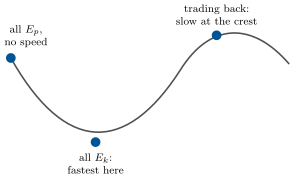
Drop a ball from height : as it falls, its account transfers, joule by joule, from potential to kinetic. At the ground, the whole has become — set them equal and the mass cancels:
this year’s square root earning its keep. From : — seventy kilometres per hour, mass be what it may. The pendulum plays the trade both ways forever (minus a whisper to the air); the skateboarder in the half-pipe likewise: height to speed to height, the two formulas passing one sum back and forth.
70.2 The great law
Proposition 70.4 (Conservation of energy)
In every process ever examined — collisions and chemistry, machines and storms, stars and cells — energy changes form and owner, but the total is exactly conserved: none created, none destroyed, every joule accounted for. This is the deepest bookkeeping law in physics: it retired the forever-machines of the childhood chapters, it audits every chain of this book, and no experiment in three centuries has caught it in an error. (Why nature keeps this law so faithfully is a profound question with a beautiful answer — one of the jewels of the university years.)
Method 70.5 (Auditing any process)
The physicist’s universal bookkeeping:
- fence off the system — what is inside the audit;
- list the energy accounts before: each form, each store;
- list them after — including, always, the thermal small change: friction’s warmth, sound’s whisper;
- balance the books: the totals must match. A deficit means a form went uncounted — look again for the leak; it is usually warm.
Example 70.6 (Audits, worked)
The braking car: kinetic account emptied, thermal account at the discs credited in full — retirement, not destruction. The bouncing ball that dies away: each bounce skims kinetic into warmth of ball and floor; the childhood answer, now auditable. Your breakfast cycling uphill: chemical store down, potential account up ( of you and bicycle), thermal share radiated — muscles run warm. Every mystery of the early energy chapters closes under the same three columns.
70.3 Efficiency
Definition 70.7 (Efficiency)
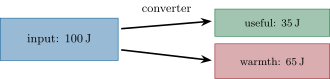
The efficiency of a converter is the fraction of its input energy delivered in the wanted form:
a number between and (or its percentage). The remainder is not destroyed — conservation forbids — but escapes in unwanted forms, nearly always warmth.
Example 70.8 (Report cards)
The glowing ancestor bulb: five percent light, ninety-five warmth — a heater with a hobby. Its modern successor: thirty-plus percent, the rest still warmth. A car engine: about a third useful motion, two thirds out the radiator and exhaust. An electric motor: above ninety. The great alternators: near ninety-nine — civilization’s finest converters. No honest converter reaches one hundred: some leak to warmth is nature’s universal commission.
Remark 70.9 (What “saving energy” really means)
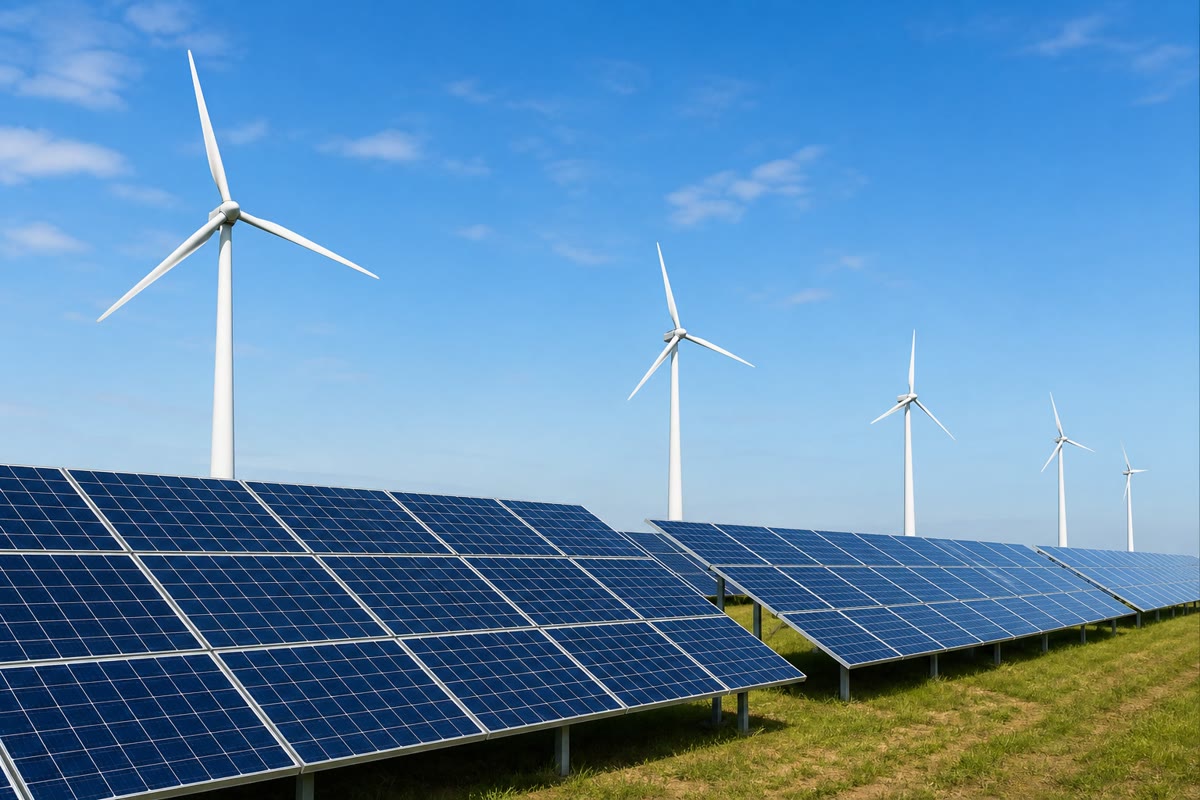
If conservation guards every joule, why must anyone “save energy”? Because the law preserves amount, not usefulness. Concentrated stores — fuel, charge, height — can be spent into warmth spread thinly through the world, and spread warmth, though every joule of it survives, can no longer drive kettles or trains: the river ran downhill. Civilization’s energy problem is not a shortage of joules — the Sun showers us with thousands of times our needs — but the husbanding of useful ones. That idea, made precise, is one of the most celebrated stories in physics; it waits in the university years under its famous name.
70.4 Exercises
Exercise 70.1 ★
Name the seven forms of the catalog, each with one household example.
Solution
Solution of Exercise 70.1.
Kinetic (the rolling ball), potential (the raised bucket), thermal (the warm bath), chemical (breakfast, the battery), electrical (the wall’s supply), radiant (sunshine through the window), nuclear (the power station’s core).
Exercise 70.2 ★
Compute : a bucket raised ; a hiker atop a climb.
Solution
Solution of Exercise 70.2.
Bucket: . Hiker: — nearly three hundred kilojoules of altitude.
Exercise 70.3 ★
State the conservation law, and what it did to the forever-machines of your childhood chapters.
Exercise 70.4 ★
Audit the pendulum through one swing: accounts at the top, at the bottom, and the slow overall drift — to where?
Exercise 70.5 ★
Use : the splash speed from a diving board — and why the diver’s mass never entered.
Exercise 70.6 ★
Define efficiency. A motor takes and delivers of motion: efficiency, and the fate of the rest?
Solution
Solution of Exercise 70.6.
Useful over total: — eighty-five percent. The missing : warmth in windings and bearings.
Exercise 70.7 ★
Why was the ancestor bulb fairly called “a heater with a hobby”? Give both percentages.
Solution
Solution of Exercise 70.7.
Five percent of its input left as light; ninety-five left as warmth. A device sorted by its outputs was a heater — that happened to glow.
Exercise 70.8 ★
Write the full conversion chain of the cyclist’s climb — breakfast to summit — naming each form and each leak.
Solution
Solution of Exercise 70.8.
Chemical (breakfast) muscles’ work kinetic energy of rider and machine stored as potential energy, , at the summit — with thermal leaks throughout: warm muscles, warm air stirred, warm tires. Total: conserved.
Exercise 70.9 ★★
The dam’s ledger: of water falls through the turbines. Compute the delivered ; at ninety-percent conversion, the electrical energy per tonne — and the tonnes per second needed for a output.
Solution
Solution of Exercise 70.9.
Per tonne: ; at ninety percent, about electrical. For : tonnes per second through the turbines.
Exercise 70.10 ★★
A ball dropped from rebounds to . Audit the bounce: energies before and after, the skim’s size and destination — and the rebound height after which no audit will find kinetic or potential energy left.
Exercise 70.11 ★★
“The lift converts electrical energy into potential energy at ninety percent efficiency.” Compute the electrical energy to raise a cabin — and reconcile the extra ten percent with the conservation law.
Solution
Solution of Exercise 70.11.
; at ninety percent the meter must supply . The extra tenth is not lost to the universe — it warms motor, gears and shaft: conservation holds; the lift’s ledger simply includes a thermal line.
Exercise 70.12 ★★★
The half-pipe skater starts from rest at the left rim, height . Predict the crossing speed at the bottom, the height reached on the right — ideally and really — and sketch the long-term fate of the motion and of its energy. Then explain, with Remark 70.9, why no push at the rim can ever be recovered in full: what has the world’s ledger gained, and what has the skater irrecoverably lost?
Solution
Solution of Exercise 70.12.
Bottom speed: . Ideally the right rim is regained at exactly ; really a little lower, each crossing lower still, until the skater rocks to rest at the bottom — the whole retired into warmth of wheels, ramp and air. Nothing was destroyed, but everything useful was spent: the world’s ledger gained spread-out warmth, and the skater lost the concentrated, reusable height — the amount survives; the usefulness does not return.
70.5 Problem: The Theme Park Commission
Problem 70.1
Weekend problem — the theme park hires a physics consultant; coasters, towers and the ledger that cannot lie
The park’s new attractions must pass your energy audit before opening day. Take ; ignore friction until it refuses to be ignored.
Part I — The Great Drop. A coaster train is winched to a summit and released from rest.
- The train’s at the summit?
- Its ideal speed at the bottom of the drop, by the mass-canceling formula — in and ?
- The designers add a second hill of just after the drop. Veto it with the ledger — and state the tallest second hill the ideal train could crest.
- The measured bottom speed is , not the ideal. Compute both kinetic energies and charge the difference to the proper account.
Part II — The winch and the bill.
- The winch lifts the train to its summit in . At perfect efficiency, its power?
- The real winch draws . Its efficiency?
- Each ride runs every four minutes, ten hours a day. The winch’s daily energy in kilowatt-hours (real winch, count the lifts), and its cost at per unit?
- A designer proposes recovering the train’s arrival energy with a generator-brake feeding the grid — “the ride pays for itself!” Audit the dream: what fraction could realistically return, and which law forbids the full circle?
Part III — The freefall tower and the report. The tower drops a gondola into magnetic brakes at .
- Speed entering the brake zone (a ideal fall)?
- Energy the brakes must retire, and where induction sends it. (The brakes are the alternator chapter’s cousins — eddies of induced current heating metal.)
- Riders scream that they were “weightless” during the fall. From the falling-companions idea of the gravitation chapter, adjudicate the claim in one sentence.
- Sign the commission’s report: three sentences — the trade the coaster lives by, the law every attraction obeyed, and the account that quietly taxed them all.
Solution
Solution of Problem 70.1.
1. . 2. . 3. A crest demands more energy than the summit granted: the ledger forbids it. From a start at rest, no later hill may exceed — and really, friction demands visibly less. 4. Measured: against the ideal : about charged to the thermal account — rails, wheels and air, warmed. 5. — some fifteen kilowatts. 6. : seventy-four percent. 7. Ten hours at one lift per four minutes: lifts; each costs ; daily — currency units. 8. A generous brake-generator might recover a fair share of the arrival kinetic energy — but every stage (rails, brake, generator, transformer) pays its thermal commission, and the recovered joules can never equal the winch’s spending: conservation allows recycling; efficiency-less-than-one forbids the full circle. The ride can defray itself, never pay for itself. 9. . 10. Kinetic at entry , plus the last ten metres’ : about for the brakes — sent, by induced eddy currents, into warmth of the brake fins: induction as retirement plan. 11. The claim stands, felt if not worded exactly: gondola and riders fell together, and falling companions press on nothing — the scream is shared free fall, gravity present in full and unfelt. 12. For example: “Our coasters live by one trade: height for speed and back, against . Every attraction obeyed one law: the energy total, audited at every point, never moved. And one account taxed them all: warmth — friction’s quiet commission, payable on every ride.”