 Coach
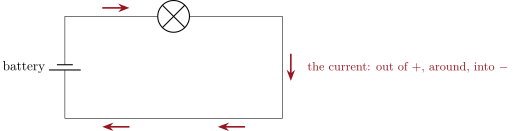
CoachThe electric current is the flow that runs around a closed circuit: a crowd of charged particles — unimaginably many, unimaginably small, cousins of the molecular world — set marching through the metal of the wires by the battery’s push. No loop, no march: the current exists only while the road is closed. (What exactly the marchers are, and how a metal lets them through, is a fine story reserved for the last years of this book.)
Examples
Example 47.4 (The misconception on trial)
The tempting error: “the first bulb uses up some current, so the second must glow weaker.” The circuit itself refutes it. Wire two identical bulbs in series and look: both glow with exactly equal brightness — and swapping them changes nothing. If current were consumed on the way, bulb two should always be the dim one, whichever bulb sits there. It never is. The current arrives whole; what the pair shares is the battery’s push, which is why both are dimmer than a lone bulb — equally dimmer.