
সব বই

পেশাদার

1 Markets I: The Ecosystem and Exchange-Traded Marketsবাজার অনলাইন 2 Markets II: Rates, FX and Creditবাজার অনলাইন 3 Markets III: Commodities, Energy and Cryptoবাজার অনলাইন 4 Quantitative Methodsপদ্ধতি অনলাইন 5 Derivatives and Volatilityডেরিভেটিভস অনলাইন 6 Rates, Credit, XVA and Riskসুদহার, ঋণ ও ঝুঁকি অনলাইন 7 Research Craft: Predictors, Backtests, Measurement, Portfoliosগবেষণা অনলাইন 8 Strategies I: Equities and Futuresকৌশল অনলাইন 9 Strategies II: Volatility, Relative Value, Macro and the Bank Desksকৌশল অনলাইন 10 Microstructure and Executionএক্সিকিউশন অনলাইন 11 Market Making and High-Frequency Tradingমার্কেট মেকিং অনলাইন 12 Machine Learning for Marketsমেশিন লার্নিং অনলাইন 13 Low-Latency Softwareপ্রযুক্তি অনলাইন 14 Networks, Hardware and Trading Infrastructureপ্রযুক্তি অনলাইন 15 Research, Data and Risk Platformsপ্রযুক্তি অনলাইন 16 The Desk and the Firmপ্রতিষ্ঠান অনলাইন 17 The Industry: Firms, Roles and Careersক্যারিয়ার অনলাইন 18 Interviews I: Maths, Probability and Speedক্যারিয়ার অনলাইন 19 Interviews II: Markets, Trading Games and the Final Roundক্যারিয়ার অনলাইন 20 Interviews III: Codeক্যারিয়ার অনলাইন
অ্যাপ পরিচিতি Coach সাইন ইন পড়া শুরু করো

বইগুলো এখনো বাংলা ভাষায় পাওয়া যায় না — ইংরেজি সংস্করণ দেখানো হচ্ছে।

Physics · পরিভাষা

Electric current কী?

Definition 47.1 Primary & Middle School Physics · অধ্যায় 47 — Circuits: Loops, Series, Parallel

The electric current is the flow that runs around a closed circuit: a crowd of charged particles — unimaginably many, unimaginably small, cousins of the molecular world — set marching through the metal of the wires by the battery’s push. No loop, no march: the current exists only while the road is closed. (What exactly the marchers are, and how a metal lets them through, is a fine story reserved for the last years of this book.)
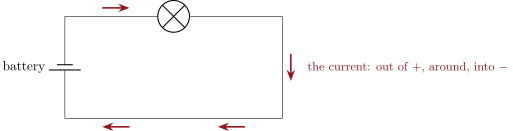
The convention every electrician on Earth shares: current arrows leave the battery’s +, tour the loop, and return by -.
The convention every electrician on Earth shares: current arrows leave the battery’s ++, tour the loop, and return by −-.

উদাহরণ

Example 47.4 (The misconception on trial)

The tempting error: “the first bulb uses up some current, so the second must glow weaker.” The circuit itself refutes it. Wire two identical bulbs in series and look: both glow with exactly equal brightness — and swapping them changes nothing. If current were consumed on the way, bulb two should always be the dim one, whichever bulb sits there. It never is. The current arrives whole; what the pair shares is the battery’s push, which is why both are dimmer than a lone bulb — equally dimmer.

প্রসঙ্গসহ পড়ো →
Definition 6.1 University Physics — Year 1 · অধ্যায় 6 — DC Circuits: Kirchhoff’s Laws and Theorems

The electric current through a surface (a wire’s cross-section) is the charge crossing it per unit time, counted positively in a chosen orientation:

i= ⁣dq ⁣dt(amperes: 1 A=1 C/s).i = \frac{\dd q}{\dd t} \qquad (\text{amperes: } 1\,\mathrm{A} = 1\,\mathrm{C}/\mathrm{s}).

Reversing the orientation changes the sign of ii. In a metal the carriers are electrons, which drift against the conventional current direction, at a fraction of a millimeter per second.

প্রসঙ্গসহ পড়ো →