 Coach
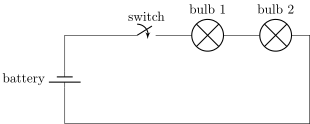
CoachPlayers in a circuit are in series when they sit on a single loop, one after another, like beads on one necklace: the current’s road passes through the first, then the second, then the third, with no branching anywhere. A circuit built this way is a series circuit.
Examples
Example 23.5 (The party lights, solved)
The old mystery is now no mystery: the party bulbs are in series, dozens of beads on one necklace. One missing bulb is a gap, and rule one darkens the whole string. Finding the guilty bulb by trying them one by one taught generations of families rule one the hard way — modern strings are built differently, as next year will show.
Example 23.7 (Nose to tail)
Batteries can also queue up in series — but they are fussier than bulbs: they must stand nose to tail, each battery’s touching the next one’s . Two batteries queued this way push together, and the bulb shines clearly brighter than with one. Turn one battery around — nose to nose — and the two pushes fight each other: the bulb gives nothing.
Example 23.8 (Inside the flashlight)
Open a flashlight: the batteries slide in one behind the other in a tube — a ready-made nose-to-tail queue — then the bulb and the button-switch complete one single loop through the case. A flashlight is a series circuit in a pocket. And now you know why it goes dark if a single battery is inserted backward: nose to nose, the pushes cancel.