Primary & Middle School Physics · Grades 1–9
47Circuits: Loops, Series, Parallel
Four years of circuits have filled your toolbox: loops, diagrams, the two great wirings. But one character has worked namelessly all along — the something that flows. This year it takes its name, its direction, and its strangest property: it is never used up. With the current on stage, series and parallel stop being recipes and become laws.
47.1 The current takes the stage
Definition 47.1 (Electric current)
The electric current is the flow that runs around a closed circuit: a crowd of charged particles — unimaginably many, unimaginably small, cousins of the molecular world — set marching through the metal of the wires by the battery’s push. No loop, no march: the current exists only while the road is closed. (What exactly the marchers are, and how a metal lets them through, is a fine story reserved for the last years of this book.)
Proposition 47.2 (The conventional direction)
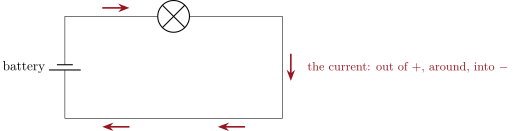
By worldwide convention, circuit diagrams mark the current as flowing outside the battery from the terminal, around the circuit, to the terminal. Every arrow on every diagram in the world obeys this convention — chosen long before anyone could ask the marchers themselves. (When physics finally could ask, the answer held a famous small joke, saved for a later year.)
Proposition 47.3 (The current is not consumed)
Devices do not eat the current. Whatever current enters a lamp, motor or buzzer leaves it entire, marching on: what the device takes is energy from the battery’s store, delivered by the passing march. In any series loop, one and the same current therefore flows through every device — as much arrives back at the battery as ever left it.
Example 47.4 (The misconception on trial)
The tempting error: “the first bulb uses up some current, so the second must glow weaker.” The circuit itself refutes it. Wire two identical bulbs in series and look: both glow with exactly equal brightness — and swapping them changes nothing. If current were consumed on the way, bulb two should always be the dim one, whichever bulb sits there. It never is. The current arrives whole; what the pair shares is the battery’s push, which is why both are dimmer than a lone bulb — equally dimmer.
47.2 The two families, as laws
Proposition 47.5 (The series law)
In a series circuit — one single loop — the same current flows through every device: one road, one march, no exceptions. Consequences, now explained: one gap stops the march everywhere at once; identical devices share the work equally, wherever they sit; and the order of devices on the loop cannot matter to a march that passes through all of them alike.
Proposition 47.6 (The parallel law)
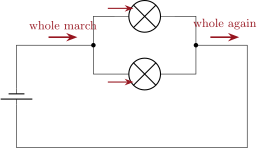
At a junction, the current divides: part of the march takes each branch, and the parts rejoin, complete, at the far junction — nothing lost, nothing gained. Each branch receives the battery’s full push, so each device works as if alone; and a blocked branch merely sends nobody, while the other branches march on.
Example 47.7 (Reading brightness like an electrician)
One battery, identical bulbs. Alone: full brightness — the reference. Two in series: both equally dim — one march, shared push. Two in parallel: both fully bright — each branch enjoys the whole push (and the battery empties roughly twice as fast: nothing is free). Three in series: dimmer still, all equal. The electrician’s glance: count the loop-mates for dimness, count the branches for battery bills.
Method 47.8 (Predicting any lamp’s fate)
Given a diagram, for each lamp:
- Existence: is there at least one unbroken loop from through this lamp to ? No loop, no light.
- Company on the road: which devices share every loop through this lamp? Those are its series companions — more companions, dimmer glow.
- Branch neighbors: which devices sit on other branches? They neither dim this lamp nor darken with it.
- Switches: an open switch kills exactly the loops it sits on — re-run step 1 with it removed.
Remark 47.9 (Why the misconception dies hard)
“Something must get used up — the battery empties!” True: the battery’s stored energy is spent, handed to lamps as light and warmth by the passing march. But the marchers themselves circulate unharmed, like ski-lift chairs delivering skiers uphill all day without a chair ever being consumed. Keep the two bookkeepings apart — current circulates, energy is delivered — and every circuit in this book stays honest. The instrument that counts the march itself joins us next year.
47.3 Exercises
Exercise 47.1 ★
What is the electric current? When does it exist in a circuit, and when not?
Exercise 47.2 ★
State the conventional direction of the current. On a diagram of a one-bulb loop, where do the arrows point?
Exercise 47.3 ★
Two identical bulbs in series glow exactly equally. What popular error does this equality refute, and how?
Solution
Solution of Exercise 47.3.
The error that devices consume current, so “downstream” bulbs should glow weaker. Equal brightness — surviving every swap — shows the same whole current passes through both: nothing is eaten en route.
Exercise 47.4 ★
In a series loop with a motor and a lamp, the current through the motor is compared with the current through the lamp. What does the series law say?
Solution
Solution of Exercise 47.4.
They are one and the same current: a single loop carries a single march through every device on it.
Exercise 47.5 ★
What happens to the current at a parallel circuit’s first junction? And at the second? What is true of each branch’s share of the battery’s push?
Exercise 47.6 ★
One battery, identical bulbs: rank the brightness of a bulb — alone; with one series companion; with one parallel neighbor; with two series companions.
Solution
Solution of Exercise 47.6.
Alone with one parallel neighbor (full brightness), then one series companion (dim), then two series companions (dimmer still).
Exercise 47.7 ★
Which arrangement empties the battery faster: two bulbs in series, or the same two in parallel? Why, in march-language?
Exercise 47.8 ★
Explain the ski-lift picture of Remark 47.9: what plays the chairs, what plays the skiers, and what is truly used up?
Exercise 47.9 ★★
A diagram: battery, switch, then lamp A; after A a junction sends two branches — lamp B on one, lamp C on the other — rejoining before returning to the battery. Using Method 47.8: who are A’s series companions? What does A’s glow do when C’s branch is cut?
Solution
Solution of Exercise 47.9.
Every loop through A passes the switch and then either B or C — so A’s series companions are the switch and the pair of branches as a whole, but neither B nor C alone. Cutting C’s branch sends the whole march through B: A keeps glowing (a little differently — one road instead of two — as next year’s instruments will measure).
Exercise 47.10 ★★
Decorative lights ask for a design: ten bulbs that all glow at full, independent brightness from one supply — but the whole set must obey a single master switch. Draw or describe the wiring, citing both laws.
Solution
Solution of Exercise 47.10.
One master switch on the common road just after the supply, then ten parallel branches, one bulb each. The parallel law grants full, independent brightness to every bulb; the series placement of the master — on the road every loop shares — lets one switch command all ten.
Exercise 47.11 ★★
In the two-bulb parallel circuit, bulb 1’s branch is thick copper wire while bulb 2’s branch includes a long, thin wire. Bulb 2 glows a little weaker. What does this suggest about how a branch’s road itself can throttle its share of the march? (Next year gives this throttling a name and a law.)
Exercise 47.12 ★★★
A battery feeds two parallel branches: branch one holds lamp X alone; branch two holds lamps Y and Z in series. Compare the three lamps’ brightnesses, in order, with reasons from both laws. Then predict every lamp’s fate if Z burns out — and if instead X burns out.
Solution
Solution of Exercise 47.12.
X, alone on its branch, gets the full push: brightest. Y and Z share their branch’s push in series: equally dim, both below X. If Z burns out, its loop is broken: Y darkens with it — X shines on, indifferent. If X burns out, only X’s branch dies: Y and Z continue, dim as before.
47.4 Problem: The Lighthouse Keeper’s Panel
Problem 47.1
Weekend problem — rewiring the old lighthouse; one battery bank, many duties; the keeper’s night of faults
The lighthouse’s battery bank must feed: the great lamp, a foghorn (a mighty buzzer), the keeper’s reading light, and a staircase light — and survive the keeper’s troubleshooting night.
Part I — Design.
- The great lamp must never dim because something else switches on. What wiring does this demand for the whole installation, and why would any series pairing betray the ships?
- Each duty needs its own switch, and the keeper wants one master cut-off for storms. Place all five switches.
- The foghorn and the staircase light must never be prevented from working by each other’s faults. Is this already guaranteed? By which law?
- Sketch or describe the full diagram: bank, master switch, four branches, four branch switches.
Part II — The keeper’s questions.
- The keeper worries: “Four duties drinking at once — does each branch still get the bank’s full push?” Answer with the parallel law.
- “And is current being used up as it works through the great lamp?” Set the keeper straight, with the ski-lift if it helps.
- On a foggy night everything runs at once. What is the cost of parallel generosity, and where in the lighthouse is it paid?
- The reading light alone is lit; measure-minded, the keeper follows the march: describe its full round trip, naming every component it passes and every one it avoids.
Part III — The night of faults.
- Midnight: the staircase bulb burns out. What else goes dark? Which law answers?
- One o’clock: a clumsy repair leaves a stretch of bare wire joining the two terminals of the bank directly, upstream of every branch. Name the event, and explain why every duty in the lighthouse now fails at once — where does the march go?
- Two o’clock, fault cleared: the keeper wants the great lamp protected so that such a shortcut can never again silence it. A second, independent battery bank is available. Propose the wiring.
- Dawn: write the keeper’s log — three sentences: which law kept ships safe tonight, which misconception the night refuted, and which single wire caused the worst hour.
Solution
Solution of Problem 47.1.
1. Four parallel branches, one duty each: in parallel, each branch works at full strength whatever the others do. Any series pairing would let a reading lamp’s switch or a burnt staircase bulb dim or darken the great lamp — unforgivable. 2. The master on the common road just after the bank; each of the four branch switches in series with its own duty, inside its branch. 3. Yes — the parallel law: a gap in one branch stops only that branch’s share; the others march on. 4. Bank, master switch, then a junction into four branches — (great lamp switch), (foghorn switch), (reading light switch), (staircase light switch) — rejoining and returning to the bank. 5. Yes: every branch spans the bank’s two sides, so each receives the full push regardless of how many neighbors drink alongside. 6. No: the current through the lamp leaves it whole — the chairs circulate uneaten. What the lamp takes is energy from the bank’s store, delivered by the passing march. 7. Four full marches at once: the bank’s energy drains four duties fast. The bill is paid in the battery room — in stored energy, never in lost current. 8. Out of the bank’s , through the master switch, to the junction; into the reading light’s branch, through its closed switch and the lamp; past the junction where the other three (dark) branches rejoin; back to the bank’s . It avoids the great lamp, foghorn and staircase branches entirely. 9. Nothing else — only the staircase branch dies with its bulb: the parallel law’s independence. 10. A short circuit upstream of every branch. The march abandons every working road for the effortless bare shortcut: the lamps and horn starve while the shortcut wire carries a wild, heating rush — every duty fails at once until the wire is removed. 11. Give the great lamp its own independent loop on the second bank: bank two, its own switch, the great lamp — sharing no wire with the general panel. A shortcut across bank one then silences everything except the ships’ light. 12. For example: “The parallel law kept each duty sovereign tonight. The night refuted, once more, the belief that lamps devour current — the march returned whole even as the banks drained. And one bare wire, shorting the bank, cost us our worst hour: every road empty while the shortcut burned.”