A quantity obeys a first-order linear equation with constant coefficients when
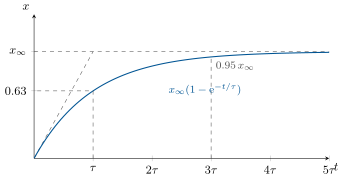
with the time constant and a constant (the value imposed by the source). Its steady state is ; the transient regime is the approach to it from the initial value .
 Coach
Log in
Start reading
Coach
Log in
Start reading
Physics · Glossary
A quantity obeys a first-order linear equation with constant coefficients when
with the time constant and a constant (the value imposed by the source). Its steady state is ; the transient regime is the approach to it from the initial value .