
Physics · Glossary

What is Mass defect and binding energy?

Also known as: mass defect · binding energy

Definition 33.5 High School Physics · Chapter 33 — Nuclear Energy: Fission, Fusion, E=mc2

Weigh a nucleus ZAX{}^{A}_{Z}\mathrm{X} (mass mm), then weigh its ZZ protons and AZA - Z neutrons separately: the parts are heavier than the whole. The difference

Δm=Zmp+(AZ)mnm>0,mp=1.00728u,  mn=1.00866u,\Delta m = Z\,m_p + (A - Z)\,m_n - m > 0, \qquad m_p = 1.007\,28\,\mathrm{u},\; m_n = 1.008\,66\,\mathrm{u},

is the mass defect; the binding energy Eb=Δmc2E_b = \Delta m\,c^2 is the energy needed to pull the nucleus apart into free nucleons — equally, the energy released when it is assembled. A bound nucleus sits below its parts.
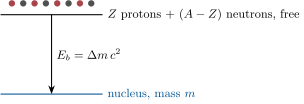
An energy ladder: the bound nucleus lies E_b below its separated nucleons — assembling it releases E_b, dismantling costs it.
An energy ladder: the bound nucleus lies EbE_b below its separated nucleons — assembling it releases EbE_b, dismantling costs it.

Examples

Example 33.6 (Helium-4)

The 24He{}^{4}_{2}\mathrm{He} nucleus has m=4.00151um = 4.001\,51\,\mathrm{u}; its parts: 2×1.00728+2×1.00866=4.03188u2 \times 1.00728 + 2 \times 1.00866 = 4.031\,88\,\mathrm{u}. So Δm=0.03037u\Delta m = 0.030\,37\,\mathrm{u} and Eb=0.03037×931.528.3MeVE_b = 0.03037 \times 931.5 \approx 28.3\,\mathrm{MeV}: the nucleus weighs 0.75%0.75\% less than its parts — the “one part in a thousand” of Example 33.4.

Read in context →