High School Physics · Grades 10–12
33Nuclear Energy: Fission, Fusion, E=mc2
A fuel pellet the size of a pencil eraser covers a household’s electricity for a year; the same service from coal takes three tonnes. Overhead, the Sun pays for daylight by vanishing — four million tonnes of itself a second. This chapter opens the account book behind both bargains: mass itself is energy, and nuclei (Chapter 19) are where it is cashed.
33.1 Mass is energy
Theorem 33.1 (Mass–energy equivalence)
A body of mass , merely by existing, holds the energy
Whenever a system loses mass , it releases the energy — whatever the mechanism.
Proof. Admitted at this level. ∎
Remark 33.2 (Einstein, 1905)
This is Einstein’s relation, admitted here; where it comes from is the business of the special-relativity chapter that closes this year (Chapter 35). Note the rate: — a rounding error of mass is a fortune of energy.
Definition 33.3 (Electron-volt and atomic mass unit)
Two units tailored to the nucleus. The electron-volt, the energy an electron gains crossing (Chapter 12): , — chemical bonds trade a few , nuclear reactions megaelectron-volts. The unified atomic mass unit, one twelfth of the mass of a carbon-12 atom: , of energy equivalent — .
Example 33.4 (The sleeping fortune)
One kilogram of anything, fully converted, is — three years of output of a large () power station. Nobody noticed before 1905 because ordinary physics barely touches mass: burning a kilogram of coal () lightens it by a third of a microgram. Nuclei, we shall see, move one part in a thousand: still small, but a million times chemistry.
33.2 The mass defect
Definition 33.5 (Mass defect and binding energy)
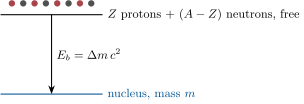
Weigh a nucleus (mass ), then weigh its protons and neutrons separately: the parts are heavier than the whole. The difference
is the mass defect; the binding energy is the energy needed to pull the nucleus apart into free nucleons — equally, the energy released when it is assembled. A bound nucleus sits below its parts.
Example 33.6 (Helium-4)
The nucleus has ; its parts: . So and : the nucleus weighs less than its parts — the “one part in a thousand” of Example 33.4.
Method 33.7 (Energy balance of a nuclear reaction)
- Balance the equation: total and conserved (Chapter 19).
- Add the masses before, then after, in — keep all five decimals.
- , then , carried off as kinetic energy of the products; negative means the reaction must be paid.
33.3 The curve that runs the universe
Definition 33.8 (Binding energy per nucleon)
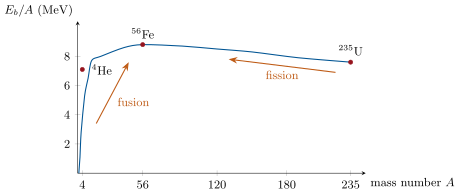
Cohesion is compared fairly by the binding energy per nucleon, , the average cost of extracting one nucleon: for helium-4.
Proposition 33.9 (The iron peak, and two roads down)
Plotted against , the binding energy per nucleon climbs steeply through the light nuclei, peaks near iron, , at about per nucleon, then slides gently to about at uranium: iron is the most tightly bound nucleus in nature. A reaction releases energy exactly when its products sit higher on the curve; two opposite strategies therefore both pay, and both walk toward iron — splitting the heaviest nuclei, and merging the lightest.
Proof. Admitted at this level. ∎
Remark 33.10 (Why a peak)
The tug-of-war of Chapter 13: strong glue binds only touching neighbours, Coulomb repulsion spans the whole nucleus — small nuclei are mostly surface, big ones mostly repulsion, iron the compromise. The honest accounting lives in the university volumes.
33.4 Fission and the chain reaction
Definition 33.11 (Fission)
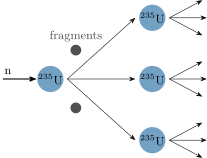
Fission is the splitting of a heavy nucleus into two mid-sized fragments. Uranium-235 is fissile: a slow neutron, absorbed, leaves the nucleus so agitated that it tears in two, spitting out two or three fresh neutrons — , the pair varying from fission to fission.
Example 33.12 (One fission, weighed)
One frequent route, by Method 33.7:
Before: . After: . Hence and ; counting the later decays of the radioactive fragments (Chapter 32), each fission is worth about — a few buys one atom of coal.
Definition 33.13 (Chain reaction and critical mass)
Each fission is lit by one neutron and frees two or three: in a large enough lump they strike other nuclei and the reaction feeds itself — a chain reaction. In a small lump most neutrons escape through the surface first; the minimum quantity sustaining the chain is the critical mass — below it the chain fizzles, above it every generation multiplies: the principle of the bomb.
Definition 33.14 (The reactor, tamed)
A power reactor holds the chain at exactly one neutron per fission. The fuel: uranium pellets modestly enriched in uranium-235. The moderator (ordinary water, usually) slows the fast fission neutrons by collisions — slow neutrons are far better at triggering the next fission; the control rods (boron, cadmium) devour neutrons — pushed in, the chain dies; drawn out, it quickens. The fragments’ agitation becomes heat, then steam, then electricity (Chapter 9).
Example 33.15 (A peppercorn against a truck)
One gram of uranium-235 holds nuclei; at each, fissioning them all yields about — the chemical energy of of coal: a peppercorn against three tonnes.
33.5 Fusion: the Sun’s own fire
Definition 33.16 (Fusion)
Fusion is the merging of two light nuclei into a heavier, more tightly bound one. The most accessible reaction weds deuterium and tritium, the heavy isotopes of hydrogen (Chapter 19):
Example 33.17 (D–T, weighed)
Before: ; after: ; so and , four fifths of it on the neutron — less than a fission, but from five nucleons instead of : about per kilogram of fuel, four times fission. Helium-4 (Example 33.6) is once again the ash.
Definition 33.18 (The Coulomb barrier)
Two nuclei are both positive: to touch, they must first climb the hill of their electric repulsion (Chapter 14) — the Coulomb barrier. Only near do collisions carry the energy to cross it; the fuel is then a plasma of bare nuclei and electrons. Fission pays no such toll: its trigger, the neutron, is neutral, and works cold.
Example 33.19 (The Sun runs on it)
The Sun’s core, at , fuses ordinary hydrogen step by step — the proton–proton chain, of net effect , about per helium: of the hydrogen’s mass leaves as energy. The sunlight whose spectrum we read in Chapter 2 is this mass, arriving eight minutes late; every star shines by walking the curve toward iron.
Remark 33.20 (ITER: bottling a star)
No solid can hold a plasma at ; a tokamak cages it in a magnetic field (Chapter 15), a doughnut of field lines the charged particles spiral along without touching the wall; ITER, built to release ten times its heating power, is the current step. Break the confinement and the plasma cools and stops in seconds: no chain reaction, no critical mass — the hard part is not stopping the fire but keeping it lit.
Example 33.21 (The energy ladder, per kilogram)
Energy per kilogram of fuel: coal, ; uranium-235 by fission, ; deuterium–tritium by fusion, ; total conversion (), . Six orders of magnitude separate chemistry from the nucleus — the reason a reactor is refuelled by the truck and a coal plant by the trainload.
33.6 Exercises
Exercise 33.1 ★
Convert: (a) and into joules; (b) the of one fission into joules; (c) check from that its energy equivalent is close to .
Solution
Solution of Exercise 33.1.
(a) ; . (b) . (c) — the of the course, up to our rounded .
Exercise 33.2 ★
A sugar cube has mass : compute its full value. A household draws a day — for how many years could the cube, fully converted, power it?
Solution
Solution of Exercise 33.2.
; days years — forty millennia on one sugar cube.
Exercise 33.3 ★
The carbon-12 nucleus has mass : compute its mass defect, its binding energy in , and its binding energy per nucleon (, ).
Exercise 33.4 ★
Complete each fission, giving , and the element (: krypton, : tellurium): (a) ; (b) .
Solution
Solution of Exercise 33.4.
(a) , : , krypton. (b) , : , tellurium.
Exercise 33.5 ★
Read the curve of Proposition 33.9: estimate for helium-4, carbon-12, iron-56 and uranium-235. Which is most tightly bound? Which could release energy by fission, and which by fusion?
Exercise 33.6 ★★
The deuteron has mass : compute its binding energy in . A chemical bond holds a few — by what factor does the nuclear “bond” beat it?
Solution
Solution of Exercise 33.6.
, so — about a million times the few of a chemical bond.
Exercise 33.7 ★★
Weigh the fission : masses (U), (Ba), (Kr), (n). Energy released, in and in joules?
Solution
Solution of Exercise 33.7.
Before: ; after: ; , so .
Exercise 33.8 ★★
Another fusion: , with . Compute the energy released. Why so much less than D–T? (Consider where each product sits on the curve.)
Solution
Solution of Exercise 33.8.
: . D–T makes helium-4, anomalously bound ( per nucleon); helium-3 sits far lower on the curve, so the step releases much less.
Exercise 33.9 ★★
Explain, a few lines each: (a) why fission needs no heating while fusion demands about ; (b) how the Sun manages at “only” (the crowd’s size, its fastest members); (c) why a fusion plant cannot run away like a chain reaction.
Solution
Solution of Exercise 33.9.
(a) The neutron is neutral: no Coulomb barrier, fission fires cold. Fusing nuclei are both positive and must climb the barrier, so only agitation gives collisions violent enough. (b) The core holds an astronomical number of protons; the rare fastest ones in the crowd do the fusing, and the Sun has billions of years to spare — a slow burn is exactly what a star wants. (c) There is no neutron avalanche: each fusion is bought by its own collision, and any loss of confinement cools the plasma and puts the fire out.
Exercise 33.10 ★★
The Sun’s net reaction turns four protons () into one helium-4 nucleus (): compute the energy per helium made, in , and the fraction of the initial mass converted.
Solution
Solution of Exercise 33.10.
, so ; fraction of the mass.
Exercise 33.11 ★★
In a water-moderated reactor: (a) what does the moderator do, and why does the chain need it? (b) the control rods? (c) the cooling water is the moderator: why does losing it tend to choke the chain rather than speed it up?
Solution
Solution of Exercise 33.11.
(a) It slows fission neutrons by collisions; slow neutrons are far more likely to fission uranium-235, so the chain needs them. (b) They absorb neutrons, holding the chain at one neutron per fission — pushed in, it dies. (c) No water, no moderation: the neutrons stay fast, miss, and the chain chokes — the design fails toward “off”.
Exercise 33.12 ★★★
An uncontrolled chain doubles at each generation. From one fission, about how many generations until the nuclei of one gram of uranium-235 have split ()? At roughly per generation, how long is that — and why, then, is criticality guarded so carefully?
Solution
Solution of Exercise 33.12.
Fissions double each generation, so after generations about have split; gives . Time: — a gram of fuel, three tonnes of coal’s worth, in under a microsecond: criticality is a cliff, not a slope.
Exercise 33.13 ★★★
Could we mine energy by fissioning iron? Weigh , with , . Compute and conclude, in terms of the curve, why iron is nuclear ash: fuel for nothing.
Exercise 33.14 ★★★
From and , compute for both (, ). Fission fragments sit near per nucleon: estimate from the two levels the energy of one fission, and compare with Example 33.12.
Solution
Solution of Exercise 33.14.
Fe: , , . U: , , . Repacking nucleons at instead of gains — the – of the worked example.
Exercise 33.15 ★★★
ITER aims at of fusion power. At per D–T reaction ( of fuel consumed), find the reactions per second, then the fuel burned per day. A coal furnace burns about a day: compare.
Solution
Solution of Exercise 33.15.
reactions per second; mass rate , i.e. about per day — against kilograms of coal: ten million to one.
33.7 Problem: Powering a City
Problem 33.1
Weekend problem — powering a city: one steady gigawatt for half a million people, bought four ways — uranium pellets, trainloads of coal, a pool of seawater, the Sun’s own substance — with the same kilogram of vanished mass hiding under all four
A city of inhabitants draws a steady electric power ; its plants, whatever the fuel, turn heat into electricity with efficiency (Chapter 9). Data: one uranium-235 fission, in all; coal, ; one D–T fusion, from of fuel; ; ; one year ; the Sun: , ; a cubic metre of seawater holds about of deuterium.
Part I — The fission plant.
- What thermal power must the reactor deliver?
- Express the energy of one fission in joules.
- How many fissions per second run the city?
- The mass of one uranium-235 nucleus (), then the uranium-235 consumed per second?
- Deduce the uranium-235 consumed in one year, in kilograms.
- The fuel is enriched to uranium-235: what mass does a year take, and does it fit on one truck?
Part II — The coal ledger.
- Compute the thermal energy the city consumes in one year.
- What mass of coal delivers it?
- Compute the ratio (coal mass)/(uranium-235 mass) for one year, and check it against the ladder of Example 33.21.
- A freight train hauls : how many trains per year, and per day? One sentence: picture the two supply lines.
Part III — The fusion dream.
- Express the energy of one D–T fusion in joules.
- Compute the energy released per kilogram of D–T fuel; compare with the ladder.
- What mass of D–T fuel covers the city’s year? What mass of that is deuterium ( of the )?
- What volume of seawater contains that deuterium? Compare with an Olympic pool, about . (Tritium is bred from lithium.)
- Why does this plant carry no critical mass and no chain reaction to fear? What, then, is the hard part?
Part IV — The star that pays in mass.
- From , what mass does the Sun convert each second?
- What mass per second, and per year, must any -thermal source convert? Check that all three fuels surrender this same mass.
- What total mass has the Sun radiated away in its years, and what fraction of the Sun is that?
- Fusion can tap about of the Sun’s mass (the burnable share of its core): estimate its total lifetime as a star, and what is left.
- Close the audit in three sentences: one year of the city in tonnes of coal, kilograms of uranium-235 and kilograms of D–T fuel — and the kilogram of mass that, in every scenario, became the city’s light.
Solution
Solution of Problem 33.1.
1. .
2. .
3. fissions per second.
4. ; — some forty micrograms a second.
5. : about tonnes of uranium-235 a year.
6. — some tonnes of fuel: one heavy truck, once a year.
7. .
8. : million tonnes of coal.
9. — the of the ladder, as it must be.
10. trains a year, roughly three a day: a coal train at dawn, noon and dusk for ever, against one truck each spring.
11. .
12. One pair weighs : — the ladder’s fusion rung.
13. of D–T; deuterium share .
14. of seawater — about a pool and a half for the whole city’s year.
15. Nothing multiplies: no neutron lights the next fusion, and losing confinement cools the plasma and stops it within seconds. The hard part is the opposite — holding together long enough to burn.
16. : four million tonnes a second.
17. , i.e. a year — and yes: , , . Every fuel surrenders the same kilogram; they differ only in how much cargo must carry it.
18. — only , three parts in ten thousand.
19. Convertible mass , worth ; at that lasts years — ten billion, of which some five billion remain.
20. One year of the city: million tonnes of coal, or kilograms of uranium-235, or kilograms of D–T drawn from a pool and a half of seawater. Under every ledger the same entry: one kilogram of mass, gone. does not care which fuel carries it — only how big a truck it takes.