Coach
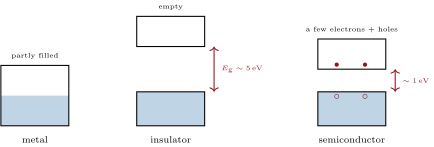
CoachFill the bands with the crystal’s electrons, two per state (Chapter 14), coldest first. If the topmost occupied band is partly filled, infinitesimal energy can shift electrons into net motion: a metal (sodium: one valence electron, half a band; divalent metals conduct through overlapping bands). If it is exactly full, with a wide gap above, no small push can rearrange anything: an insulator (diamond, ). If the gap is small — in silicon — thermal agitation hoists a few electrons across, each leaving a mobile hole below: a semiconductor, whose carrier count doubles every few degrees. Hence the great divide: metals conduct worse when heated (more vibrations to scatter off), semiconductors better (exponentially more carriers) — one sign flip that identifies a material’s class in a single measurement.