 Coach
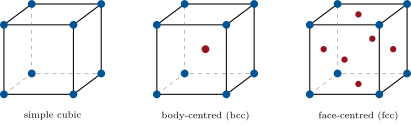
CoachA crystal is a repeating arrangement: a lattice (the grid of mathematical points , integers ) decorated by a basis (the atom or group hung identically on every point). The parallelepiped spanned by is a unit cell; its edge is the lattice constant, a few . Three cubic stackings carry most of this course: simple cubic (points at cube corners — rare: one atom per cell); body-centred cubic (bcc: corners centre, 2 atoms per cell — iron, chromium); face-centred cubic (fcc: corners face centres, 4 atoms per cell — copper, aluminium, silver, gold: the densest cubic packing, filling 74 % of space). Diamond is fcc with a two-atom basis; rock salt is fcc with an Na–Cl pair.
Examples
Example 23.2 (Weighing a unit cell)
Copper is fcc with . Its cell holds 4 atoms of molar mass , so
the handbook value. Run backwards, the same arithmetic turns a measured and a bench-top density into — the route by which X-rays first counted atoms (Exercise 23.6).