
Physics · Glossary

What is Microstates and macrostates?

Definition 16.1 University Physics — Year 3 · Chapter 16 — The Microcanonical Ensemble

A microstate is a complete microscopic specification of a system — every quantum number of every particle (or, classically, every position and momentum, counted in phase-space cells of h3h^3 per particle, Proposition 7.5). A macrostate is what thermodynamics can see: energy EE, volume VV, particle number NN, magnetisation… The multiplicity Ω(E,V,N)\Omega(E, V, N) is the number of microstates wearing the same macrostate.
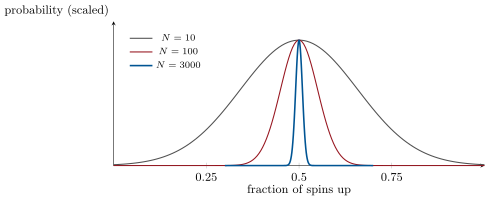
The multiplicity of the spin system against its up-fraction, for growing N: the peak sharpens as 1/√ N. At N 1020 the “distribution” is, for every practical purpose, a single value — macroscopic definiteness out of microscopic democracy.
The multiplicity of the spin system against its up-fraction, for growing NN: the peak sharpens as 1/N1/\sqrt N. At N1020N \sim 10^{20} the “distribution” is, for every practical purpose, a single value — macroscopic definiteness out of microscopic democracy.

Examples

Example 16.3 (A magnet of NN coins)

NN independent spins, each up or down: 2N2^N microstates. The macrostatenn up” has multiplicity Ω(n)=(Nn)\Omega(n) = \binom Nn, overwhelmingly peaked at n=N/2n = N/2 with relative width 1/N\sim1/\sqrt N. For N=100N = 100: the all-up state is one; the balanced macrostate holds 1×10291 \times 10^{29}. For N=1020N = 10^{20}, deviations of even 10810^{-8} in the up-fraction are suppressed by factors like e104\eu^{-10^4}: the system is at its peak, and what we call equilibrium is the macrostate with the most microstates.

Read in context →