Physics · Glossary

What is Perfect pivot?

Definition 1.11 University Physics — Year 2 · Chapter 1 — Rigid-Body Mechanics

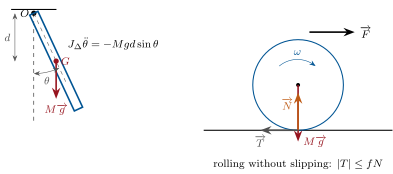
A solid rotates about a fixed axis Δ\Delta in a perfect pivot (an ideal bearing) when the contact forces of the bearing have zero moment about Δ\Delta; they then develop no power (vA=0\vect v_A = \vect 0 on the axis, MΔ=0\mathcal M_\Delta = 0). A real bearing adds a friction torque Γfsgnω-\Gamma_f\operatorname{sgn}\omega, or a viscous one hω-h\omega.

Left: the physical pendulum — the weight’s moment about the pivot drives the rotation, the pivot’s force has no moment. Right: the forces on a wheel rolling on a horizontal ground: weight, normal reaction N and tangential friction T at the contact point, whose magnitude is bounded by Coulomb’s law.
Left: the physical pendulum — the weight’s moment about the pivot drives the rotation, the pivot’s force has no moment. Right: the forces on a wheel rolling on a horizontal ground: weight, normal reaction N\vect N and tangential friction T\vect T at the contact point, whose magnitude is bounded by Coulomb’s law.

Examples

Example 1.13 (The metre rule)

A metre rule pivoted at one end: J=13M2J = \tfrac13M\ell^2 (Huygens from 112M2\tfrac1{12}M\ell^2), d=/2d = \ell/2, eq=23=0.667m\ell_{\text{eq}} = \tfrac23\ell = 0.667\,\mathrm{m} and T=1.64sT = 1.64\,\mathrm{s} — a whole-rule pendulum beats slower than a point mass hung at its centre (1.42s1.42\,\mathrm{s}) and faster than one at its end (2.0s2.0\,\mathrm{s}).

Example 1.9 (A flywheel)

A steel disk of 50kg50\,\mathrm{kg} and radius 30cm30\,\mathrm{cm}: J=12×50×0.09=2.25kgm2J = \tfrac12 \times 50 \times 0.09 = 2.25\,\mathrm{kg}\,\mathrm{m}^{2}; at 3000rpm3000\,\mathrm{rpm} (ω=314rad/s\omega = 314\,\mathrm{rad}/\mathrm{s}) it stores 12Jω2=111kJ\tfrac12J\omega^2 = 111\,\mathrm{kJ}, the kinetic energy of a small car at 50km/h50\,\mathrm{km}/\mathrm{h}. Energy-storage flywheels spin carbon-fibre rotors at 50000rpm50\,000\,\mathrm{rpm} in vacuum on magnetic bearings: the energy grows as ω2\omega^2, the limit is the tensile strength of the rim.

Read in context →