 Coach
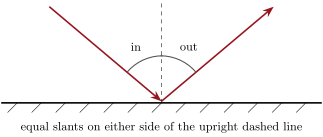
CoachWhen light strikes a surface and springs back instead of passing through or dying there, we call it reflection: the light is reflected. A mirror is a surface so smooth that it reflects light in a perfectly orderly way — polished metal behind glass, still water, a gleaming spoon.

Examples
Example 32.3 (Aiming a bounce)
Because the bounce is so orderly, it can be aimed: with a small mirror in the sunshine you can throw a spot of light onto any wall you choose — tilt the mirror, the spot obeys. Sailors and hikers in trouble use exactly this: a flashed mirror aimed at a far-off ship or helicopter is a signal visible for many kilometres, powered entirely by the Sun.
Example 32.4 (Why walls are not mirrors)
A white wall reflects plenty of light — the room would be gloomy otherwise — so why does it show no image? Up close, its surface is a landscape of tiny bumps: each arriving ray obeys the bounce rule on its own little slope, and the orderly army of rays is scattered to all directions. A mirror’s polish keeps the slopes flat, the army stays in step, and the picture survives the bounce. Order, not shininess alone, is what makes an image.
Example 32.6 (Why the image lives behind)
Your eye is a simple soul: it assumes every ray traveled straight. The bounced ray truly comes from the candle by way of the mirror — but the eye prolongs it backward through the glass, to where the ray seems to have started. All the bounced rays agree on that phantom starting point: one candle’s worth of rays, one crisp phantom candle. Nothing stands behind the wall, of course — the image is light’s most convincing illusion.