
সব বই

পেশাদার

1 Markets I: The Ecosystem and Exchange-Traded Marketsবাজার অনলাইন 2 Markets II: Rates, FX and Creditবাজার অনলাইন 3 Markets III: Commodities, Energy and Cryptoবাজার অনলাইন 4 Quantitative Methodsপদ্ধতি অনলাইন 5 Derivatives and Volatilityডেরিভেটিভস অনলাইন 6 Rates, Credit, XVA and Riskসুদহার, ঋণ ও ঝুঁকি অনলাইন 7 Research Craft: Predictors, Backtests, Measurement, Portfoliosগবেষণা অনলাইন 8 Strategies I: Equities and Futuresকৌশল অনলাইন 9 Strategies II: Volatility, Relative Value, Macro and the Bank Desksকৌশল অনলাইন 10 Microstructure and Executionএক্সিকিউশন অনলাইন 11 Market Making and High-Frequency Tradingমার্কেট মেকিং অনলাইন 12 Machine Learning for Marketsমেশিন লার্নিং অনলাইন 13 Low-Latency Softwareপ্রযুক্তি অনলাইন 14 Networks, Hardware and Trading Infrastructureপ্রযুক্তি অনলাইন 15 Research, Data and Risk Platformsপ্রযুক্তি অনলাইন 16 The Desk and the Firmপ্রতিষ্ঠান অনলাইন 17 The Industry: Firms, Roles and Careersক্যারিয়ার অনলাইন 18 Interviews I: Maths, Probability and Speedক্যারিয়ার অনলাইন 19 Interviews II: Markets, Trading Games and the Final Roundক্যারিয়ার অনলাইন 20 Interviews III: Codeক্যারিয়ার অনলাইন
অ্যাপ পরিচিতি Coach সাইন ইন পড়া শুরু করো

বইগুলো এখনো বাংলা ভাষায় পাওয়া যায় না — ইংরেজি সংস্করণ দেখানো হচ্ছে।

Physics · পরিভাষা

Reflection কী?

অন্য নাম: mirror

Definition 32.1 Primary & Middle School Physics · অধ্যায় 32 — Mirrors and Reflection

When light strikes a surface and springs back instead of passing through or dying there, we call it reflection: the light is reflected. A mirror is a surface so smooth that it reflects light in a perfectly orderly way — polished metal behind glass, still water, a gleaming spoon.
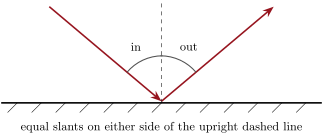

The bounce rule: the leaving ray mirrors the arriving one — equal angles either side of the upright.
A still lake is a mirror lying down: every ray bounces by the same rule, and the mountain appears again, upside down and exact.

উদাহরণ

Example 32.3 (Aiming a bounce)

Because the bounce is so orderly, it can be aimed: with a small mirror in the sunshine you can throw a spot of light onto any wall you choose — tilt the mirror, the spot obeys. Sailors and hikers in trouble use exactly this: a flashed mirror aimed at a far-off ship or helicopter is a signal visible for many kilometres, powered entirely by the Sun.

Example 32.4 (Why walls are not mirrors)

A white wall reflects plenty of light — the room would be gloomy otherwise — so why does it show no image? Up close, its surface is a landscape of tiny bumps: each arriving ray obeys the bounce rule on its own little slope, and the orderly army of rays is scattered to all directions. A mirror’s polish keeps the slopes flat, the army stays in step, and the picture survives the bounce. Order, not shininess alone, is what makes an image.

Example 32.6 (Why the image lives behind)

Your eye is a simple soul: it assumes every ray traveled straight. The bounced ray truly comes from the candle by way of the mirror — but the eye prolongs it backward through the glass, to where the ray seems to have started. All the bounced rays agree on that phantom starting point: one candle’s worth of rays, one crisp phantom candle. Nothing stands behind the wall, of course — the image is light’s most convincing illusion.

প্রসঙ্গসহ পড়ো →