Primary & Middle School Physics · Grades 1–9
32Mirrors and Reflection
Light, we proved, never bends around corners — and yet every morning a copy of you looks out of the bathroom wall, and last year we promised a trick to see around corners after all. The trick is not to bend the road but to fold it. Everything folds at one remarkable surface: the mirror.
32.1 The bounce
Definition 32.1 (Reflection)
When light strikes a surface and springs back instead of passing through or dying there, we call it reflection: the light is reflected. A mirror is a surface so smooth that it reflects light in a perfectly orderly way — polished metal behind glass, still water, a gleaming spoon.
Proposition 32.2 (The bounce rule)
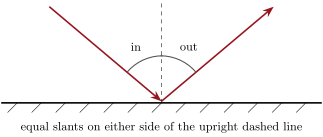
A ray of light bounces off a mirror the way a perfect ball bounces off a wall: it leaves exactly as steeply as it arrived, on the other side. Straight in — straight back out. Slanting in — slanting out at the matching slant. The two angles, arriving and leaving, are always equal.
Example 32.3 (Aiming a bounce)
Because the bounce is so orderly, it can be aimed: with a small mirror in the sunshine you can throw a spot of light onto any wall you choose — tilt the mirror, the spot obeys. Sailors and hikers in trouble use exactly this: a flashed mirror aimed at a far-off ship or helicopter is a signal visible for many kilometres, powered entirely by the Sun.
Example 32.4 (Why walls are not mirrors)
A white wall reflects plenty of light — the room would be gloomy otherwise — so why does it show no image? Up close, its surface is a landscape of tiny bumps: each arriving ray obeys the bounce rule on its own little slope, and the orderly army of rays is scattered to all directions. A mirror’s polish keeps the slopes flat, the army stays in step, and the picture survives the bounce. Order, not shininess alone, is what makes an image.

32.2 The person behind the glass
Proposition 32.5 (The image rule)
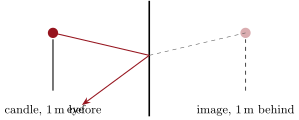
A flat mirror shows every object as an image standing behind the glass, exactly as far behind as the object stands in front, matching it in size, point for point. Step back, and your image steps back too; the mirror-world is a faithful, folded copy of ours.
Example 32.6 (Why the image lives behind)
Your eye is a simple soul: it assumes every ray traveled straight. The bounced ray truly comes from the candle by way of the mirror — but the eye prolongs it backward through the glass, to where the ray seems to have started. All the bounced rays agree on that phantom starting point: one candle’s worth of rays, one crisp phantom candle. Nothing stands behind the wall, of course — the image is light’s most convincing illusion.
Example 32.7 (The swapped world)
Hold a page of writing to the mirror: the letters come back reversed, left and right exchanged. That is why the word AMBULANCE is painted mirror-reversed on the front of ambulances: drivers ahead, glancing into their rear-view mirrors, see it swing back to plain reading — and pull aside. Two mirrors can undo the swap: a double bounce flips the flip.
32.3 Folding the road on purpose
Method 32.8 (Building a periscope)
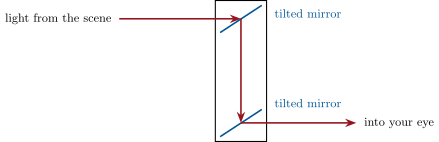
The promised corner-looker, delivered:
- take a tall, narrow box; cut a window near the top of one face and another near the bottom of the opposite face;
- fix a small mirror inside behind each window, each tilted at half a right angle, the two tilts parallel to each other;
- aim the top window over the wall (or around the corner), and look into the bottom window.
The light’s road folds twice: down the box between the mirrors, then out into your eye. Submarine crews watch the waves through exactly this — built long and watertight.
Remark 32.9 (Fun-house spoons)
Look into the bowl of a polished spoon: you hang upside down. Turn it over: you are right side up again, but stretched. Curved mirrors still obey the bounce rule at every point — but their slopes turn with the curve, so the orderly bounces gather or spread, and images shrink, grow, or somersault. Curved mirrors focus light too: a curved dish of sunlight can cook a pot — remember the solar cookers of the energy chapter. Their precise laws belong to a later year; the spoon is their honest preview.
32.4 Exercises
Exercise 32.1 ★
State the bounce rule. What does a ray arriving straight-on do?
Exercise 32.2 ★
A white wall reflects lots of light. Why does it show no image, while the polished mirror does?
Exercise 32.3 ★
You stand in front of a flat mirror. Where is your image, and how far is it from you?
Solution
Solution of Exercise 32.3.
Behind the glass, deep — so from you.
Exercise 32.4 ★
You walk toward your mirror image at a slow step. What does the image do, and how fast does the gap between you close?
Exercise 32.5 ★
Why is AMBULANCE painted backward on the front of ambulances? For whom does it read correctly, and through what?
Exercise 32.6 ★
In the periscope, how many times does the light’s road fold, and what does each fold? At what tilt do the mirrors stand?
Exercise 32.7 ★
How can a hiker with a pocket mirror signal a far-away helicopter? Which two chapter ideas are at work — name the rule that aims the flash and the store that powers it.
Solution
Solution of Exercise 32.7.
Tilt the mirror until the bounced sunbeam lands on the target — the bounce rule makes the flash aimable; the Sun is the energy store, delivering the light for free. A pocket-sized flash can be seen for kilometres.
Exercise 32.8 ★
Still water mirrors the mountains; wind ruffles the lake and the picture shatters into glitter. Explain both states with Example 32.4.
Solution
Solution of Exercise 32.8.
Still water is one smooth surface: bounces stay in step, and the mountains’ picture survives — a mirror. Wind breaks the surface into countless tilted patches; each patch bounces by the rule on its own slant, the army falls out of step, and the image shatters into dancing glitter.
Exercise 32.9 ★★
The eye “prolongs rays backward”. Use this to explain why your image stands behind the wall the mirror hangs on — in a place where certainly nobody stands. What do all the bounced rays from your nose agree about?
Solution
Solution of Exercise 32.9.
Each bounced ray reaches the eye from the mirror, but the eye prolongs it straight backward, through the glass. All the rays bounced from your nose, prolonged backward, cross at one and the same spot behind the wall — so the eye builds a phantom nose there, and phantom point by phantom point, a whole phantom you. Agreement among rays is what makes the illusion crisp.
Exercise 32.10 ★★
A shop wants a customer at the door to see around a blind corner into the aisle. One flat mirror must be mounted where the two corridors meet. How should it be tilted, and why does the same mounting let the aisle see the door? (Light’s roads work both ways.)
Solution
Solution of Exercise 32.10.
Mount it at half a right angle to both corridors (tilted across the corner, like the periscope’s mirrors). A ray from the aisle folds at the mirror and runs to the door — and since light’s roads work both ways, a ray from the door folds along the same path back into the aisle: each end sees the other in the same glass.
Exercise 32.11 ★★
Mirror writing comes back reversed; a double bounce “flips the flip”. Explain why the periscope of Method 32.8, with its two mirrors, shows the scene the right way around and not mirror-reversed.