
Physics · Glossary

What is Sound wave?

Also known as: compression · rarefaction · longitudinal wave

Definition 21.1 High School Physics · Chapter 21 — Sound and Acoustics

A sound wave is a mechanical pressure wave (Chapter 20): a vibrating surface creates traveling compressions (slight overpressure) and rarefactions (underpressure). Air parcels oscillate along the travel direction (sound is longitudinal), and a medium is needed: a bell under a vacuum jar falls silent (Chapter 8).
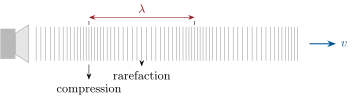
A loudspeaker drives a longitudinal wave: parcels bunch into compressions one wavelength = v/f apart.
A loudspeaker drives a longitudinal wave: parcels bunch into compressions one wavelength λ=v/f\lambda = v/f apart.

Examples

Example 21.4 (The sizes of sounds)

The relation λ=v/f\lambda = v/f sizes any sound: in air a 20Hz20\,\mathrm{Hz} rumble spans 340/20=17m340/20 = 17\,\mathrm{m} — a building — and a 20kHz20\,\mathrm{kHz} hiss fits in 1.7cm1.7\,\mathrm{cm}; the metre-sized ones bend easily around doors and corners.

Read in context →