High School Physics · Grades 10–12
20Mechanical Waves
Saturday evening, a full stadium: a ripple of standing spectators sweeps around the stands in under a minute, yet nobody leaves their seat. A pebble’s ring crosses the pond while the cork only bobs. This chapter studies the traveler itself — the wave — and the four numbers that tame it: speed, delay, period, wavelength — enough to read an earthquake off a strip of paper.
20.1 The disturbance travels, the medium stays
Definition 20.1 (Mechanical wave)
A mechanical wave is a disturbance propagating through a material medium — rope, water, air, rock — carrying energy without transporting matter: each piece of the medium swings briefly in place, hands the motion on, and settles back.
Example 20.2 (No matter transport)
In the stadium wave the “medium” is the crowd: what travels is the act of standing up, while every spectator keeps their seat. On the pond, the ring expands but a floating cork only bobs in place.
Definition 20.3 (Transverse and longitudinal waves)
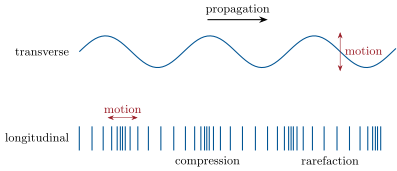
A wave is transverse when the medium moves perpendicular to the propagation: a hump races along a flicked rope while each point moves only up and down. It is longitudinal when the medium moves along the propagation: a zone of squeezed coils travels down a pushed spring, each coil swinging in place.
Remark 20.4 (Sound is longitudinal)
Sound is the longitudinal wave par excellence: compressed air — higher pressure (Chapter 7) — travels from source to eardrum; Chapter 21 is devoted to it. Earthquakes send both kinds: P waves compress the rock, S waves shake it sideways.
20.2 Speed and delay
Definition 20.5 (Propagation speed)
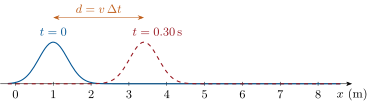
The propagation speed of a wave is the distance covered by the disturbance divided by the time taken: . It is the speed of the traveling shape, not of the medium.
Proposition 20.6 (The medium sets the speed)
For small disturbances, the propagation speed depends only on the medium, not on the shape or size of the disturbance. On a stretched rope, increases with tension and decreases with mass per metre: taut and light is fast, slack and heavy is slow.
Proof. Admitted at this level. ∎
Remark 20.7 (Where the formula lives)
The rope’s exact speed formula is derived in the Year 1 volume; this year the experimental facts above suffice.
Example 20.8 (Sound speeds)
Sound travels at in air, in water, in steel — the stiffer, the faster. Hence the western-movie ear on the rail: steel announces the train first.
Definition 20.9 (Delay)
A wave of speed reaches a point at distance after the delay : two points a distance apart repeat the same motion, the farther lagging by — the echo ranging of Chapter 8, read backwards.
Proposition 20.10 (Superposition without interaction)
Where two waves overlap, the displacement of the medium is at every instant the sum of the displacements each would cause alone; after crossing, each wave continues unchanged — derived in the Year 2 volume from the linearity of the equations of motion.
Proof. Admitted at this level. ∎
Example 20.11 (Crossing pulses)
Send an upward hump from each end of a rope: where they meet, the rope briefly rises to the sum of the two heights; then two intact humps emerge — as two crossing conversations reach their listeners.
20.3 Periodic waves: the double periodicity
Definition 20.12 (Periodic wave)
When the source repeats its motion with period and frequency (Chapter 8), it feeds the medium a periodic wave: every point repeats its own motion with period , each lagging its neighbors by the travel delay.
Definition 20.13 (Wavelength)
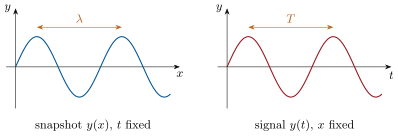
A snapshot of a periodic wave shows a pattern repeating in space; its spatial period — crest to crest — is the wavelength , in metres. A periodic wave is doubly periodic: period in time at each point, period in space at each instant.
Theorem 20.14 (The wave relation)
A periodic wave of speed , period and frequency has wavelength .
Proof. During one period the pattern slides forward by ; but the source — hence every point — is then back in its starting state, so the slid pattern coincides with the original: the repeat distance is . ∎
Remark 20.15 (The frequency belongs to the source)
Passing from one medium into another — sound from air into water — a wave keeps its frequency, which the source dictates, while its speed changes; by the wavelength changes with it.
Example 20.16 (Concert A, in air and underwater)
The concert A of Chapter 8 has wavelength in air and in water: same note, stretched by the faster medium.
Definition 20.17 (In phase, in phase opposition)
Two points separated by a whole number of wavelengths, , move identically at every instant: they are in phase. Points separated by always move oppositely — crest against trough: they are in phase opposition.
Method 20.18 (Reading the double periodicity)
- On a recording at a fixed point, read crest to crest; .
- On a snapshot at a fixed instant, read crest to crest.
- Deduce ; check against a direct timing when available.
- Never confuse the two graphs: one axis carries seconds, the other metres.
20.4 Wavefronts and attenuation
Definition 20.19 (Wavefront)
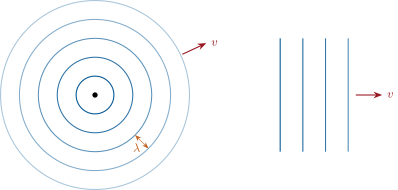
A wavefront is a line (or surface) of points that the wave reaches at the same instant — a crest line on the pond. From a point source the wavefronts are expanding circles; far from any source they are nearly straight. The wave propagates perpendicular to its wavefronts, successive crests apart.
Definition 20.20 (Attenuation)
The decrease of a wave’s amplitude as it propagates is its attenuation. Two causes add up: the energy of a circular wavefront is shared over an ever-longer crest, and the medium absorbs a little in passing. Straight wavefronts escape the first cause — how a distant storm’s swell can cross an ocean.
20.5 Exercises
Exercise 20.1 ★
A stadium wave runs the ring of the stands in . (a) Compute its speed. (b) Does any spectator travel around the ring? What does? (c) Each spectator stands after their neighbor away: check the consistency.
Solution
Solution of Exercise 20.1.
(a) . (b) No spectator moves along the ring: the disturbance (the act of standing) travels, not the crowd. (c) — consistent.
Exercise 20.2 ★
Transverse or longitudinal? (a) a pulse on a rope shaken up and down; (b) a compression sent along a spring; (c) sound in air; (d) a pond ripple (surface bobs vertically, ring travels horizontally); (e) seismic P waves (compress along the travel) and S waves (shake sideways).
Solution
Solution of Exercise 20.2.
(a) transverse; (b) longitudinal; (c) longitudinal; (d) transverse; (e) P longitudinal, S transverse.
Exercise 20.3 ★
Thunder reaches you after the flash. (a) How far is the strike ()? (b) A diver hears the same delay between a flash and an underwater boom (): how far is that source? (c) What must you know before turning delay into distance?
Exercise 20.4 ★
Compute the wavelength of a sound in air and in water. When the sound crosses from air into water, which of , , change, and which stays fixed?
Solution
Solution of Exercise 20.4.
: in air, in water. The frequency stays fixed (the source dictates it); and both change.
Exercise 20.5 ★
On a pond, adjacent ripple crests are apart and the rings advance at . Find the wavelength, the period and the frequency of the wave.
Solution
Solution of Exercise 20.5.
; ; .
Exercise 20.6 ★★
A pulse on a long rope is photographed twice, apart: its crest sits at , then . (a) The speed? (b) When does the pulse reach the wall at ? (c) A ribbon knotted at : its motion as the pulse passes?
Solution
Solution of Exercise 20.6.
(a) . (b) From the first photo the crest has to go: after it. (c) The ribbon rises then falls, purely transversely, and stays at : the rope does not travel.
Exercise 20.7 ★★
Two upward pulses, of heights and , travel toward each other at each, crests apart. (a) When do the crests coincide? (b) The rope’s maximal height then? (c) Same if the small pulse is downward. (d) The rope just after?
Solution
Solution of Exercise 20.7.
(a) Closing speed , gap : . (b) Superposition: . (c) . (d) Two intact pulses emerge and continue unchanged, as if they had never met.
Exercise 20.8 ★★
(a) Two clotheslines carry the same tension; a pulse is sent down each. Which is faster: the thin one or the thick one? Why? (b) A guitarist tightens a string: what happens to the wave speed? (c) Does flicking twice as hard (a taller pulse) make the pulse travel faster?
Exercise 20.9 ★★
A worker strikes a rail away; you listen with one ear on the steel. Compute the arrival times through the rail () and the air (), and the gap between the two bangs.
Solution
Solution of Exercise 20.9.
Rail: ; air: ; gap .
Exercise 20.10 ★★
A rope carries a periodic wave of wavelength . In phase, in phase opposition, or neither, for point separations (a) ; (b) ; (c) ; (d) ; (e) ?
Solution
Solution of Exercise 20.10.
With : (a) , in phase; (b) , opposition; (c) , opposition; (d) , neither; (e) , neither.
Exercise 20.11 ★★
An earthquake sends P waves at and S waves at , both of period . Compute both wavelengths, compare them with a building, and explain why a whole neighborhood rises and falls nearly together.
Solution
Solution of Exercise 20.11.
; — hundreds of times a building’s size. Points much closer than are nearly in phase, so the whole neighborhood moves together.
Exercise 20.12 ★★★
A recording of the water height at a buoy shows crests every ; an aerial photograph shows crests apart. (a) Find and . (b) Find . (c) Deduce the speed. (d) The buoy rides a crest at : when next? (e) Is a point away in phase with the buoy, in phase opposition, or neither?
Solution
Solution of Exercise 20.12.
(a) , . (b) . (c) . (d) At . (e) wavelengths : phase opposition.
Exercise 20.13 ★★★
An anchored buoy completes full oscillations in on a regular swell whose crests are apart. (a) Find the period and frequency. (b) Find the speed of the swell, in and . (c) How long does a crest now at the buoy take to reach the beach away? (d) Does the buoy drift ashore with it?
Solution
Solution of Exercise 20.13.
(a) , . (b) . (c) . (d) No: waves transport no matter — the anchored buoy only bobs.
Exercise 20.14 ★★★
Two identical pulses, one upward and one downward, travel toward each other at each, centers apart. (a) When do their centers coincide, and what does the rope look like then? (b) Is the rope then at rest? Where has the energy gone? (c) What happens next? (d) Why does “momentarily flat” not mean “nothing there”?
Solution
Solution of Exercise 20.14.
(a) Closing at over : ; the opposite displacements cancel — the rope is momentarily flat. (b) No: its points are moving (the transverse velocities add, not cancel); the energy is all kinetic. (c) The two pulses reappear and continue unchanged. (d) The flat rope carries velocity, hence energy: the wave is momentarily stored in motion, not in shape.
Exercise 20.15 ★★★
A pebble’s ripple spreads on a still pond. (a) Compute the crest length at and ; growth factor? (b) The crest’s energy is roughly conserved: what happens to the energy per metre, and to the amplitude? (c) Why does a straight-fronted swell attenuate far less? (d) And the stadium wave, not at all?
Solution
Solution of Exercise 20.15.
(a) : and — . (b) Energy per metre falls by , so the amplitude drops (the energy grows with the amplitude). (c) Straight fronts do not lengthen: only absorption remains. (d) The medium is active: each spectator stands on their own muscle energy, resupplying the wave.
20.6 Problem: Reading a Seismogram
Problem 20.1
Weekend problem — reading a seismogram: two waves race out of a broken fault, three circles pin the epicenter, and a slow third wave gives a coastline its warning
Night shift at a seismological observatory. At 09:14:32 the needle of station A jumps: sharp fast wiggles, then slower, wider swings. An earthquake has broken rock somewhere; two waves race out through the crust: P waves, compressions at , and S waves, a sideways shaking at .
Part I — Two waves, one clock.
- From the descriptions above, classify P and S waves as transverse or longitudinal.
- Which wave arrives first at every station? Compute the travel times of both over .
- Show that the P–S arrival gap is and compute it for .
- Deduce the seismologist’s ranging rule and show the coefficient is about per second of gap.
- Why does the gap grow with distance — and why is that a gift to a station that never saw the quake start?
Part II — Circles on the map.
- Station A measures . How far is the epicenter from A?
- Explain why this one reading places the epicenter on a circle, not at a point.
- Stations B and C measure and : their distances to the epicenter?
- Explain how the three circles together pin the epicenter down.
- The P wave reached A at 09:14:32. Compute its travel time from the epicenter, and the origin time of the quake.
Part III — The wave that crosses the ocean. The three circles meet offshore: the fault broke under the sea floor and set the water column moving. Long waves on deep water travel at a speed set by the depth — about in the open ocean, about near a beach (admitted here; the formula is derived in the Year 1 volume). A port lies from the epicenter.
- Convert to and name a vehicle with a comparable cruising speed.
- How long does the tsunami take to reach the port?
- The port’s own seismometer feels the P wave first. After how long? If the alarm sounds at that instant, how much warning time does the coast get before the tsunami?
- At sea the tsunami’s period is about . Compute its wavelength there, and explain why a ship does not notice it.
- Nearing the beach the speed falls to while the period stays fixed. Compute the new wavelength. What must happen to the wave as it bunches up?
Part IV — Energy, and the report. A strong quake releases on the order of , carried away by the waves.
- Compute the length of a circular wavefront from the epicenter, then ; by what factor has it grown?
- Deduce why shaking weakens with distance even in a lossless crust — and name the second cause a real crust adds.
- A liquid cannot resist shear. Far-side stations record the P wave but no S wave: what does that reveal about Earth’s core?
- The high-speed train of the previous year’s energy chapter (Chapter 18) carries about of kinetic energy: how many such trains is worth?
- The report, in two sentences: where and when was the quake, and how much warning did the port get? Give the three numbers.
Solution
Solution of Problem 20.1.
1. P compress along the travel: longitudinal; S shake sideways: transverse.
2. P, the faster, arrives first everywhere. ; .
3. ; for : .
4. Solve for : per second of gap.
5. : one station’s own recording gives its distance to the epicenter without knowing the origin time.
6. .
7. The gap gives a distance, not a direction: the epicenter lies somewhere on the circle of radius around A.
8. ; .
9. Two circles meet in two points; the third selects one: the common intersection is the epicenter.
10. : the quake began at .
11. — a cruising jet airliner.
12. .
13. . Warning: .
14. : a metre or so of rise spread over — the ship climbs an imperceptible slope over several minutes.
15. : the wave bunches up twentyfold, its energy crams into a shorter length, so its height must grow — the tsunami rears up at the shore.
16. : , then — .
17. The same energy is shared over a longer front, so the amplitude drops even in a lossless crust; a real crust adds absorption.
18. S waves, transverse shear, cannot cross a liquid: the S-wave shadow shows the (outer) core is liquid.
19. : about seven hundred thousand trains at full speed.
20. The quake struck at , offshore at the crossing of the three circles, from station A. The port’s P-wave alarm sounded after the origin, about before the tsunami arrived.