Physics · Glossary

What is Spherical mirror?

Definition 3.5 University Physics — Year 1 · Chapter 3 — Mirrors and Thin Lenses

A spherical mirror is a reflecting spherical cap of center CC and vertex SS (its intersection with the axis). It is concave if the light meets the hollow side (CC on the side of the incoming light), convex otherwise. Its focus FF is the image of a point at infinity on the axis; its focal length is f=SFf = \overline{SF}.

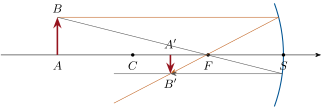
A concave mirror (C, focus F at mid-radius). For an object AB beyond C, the ray parallel to the axis returns through F and the ray through F returns parallel: they cross at B' — a real, inverted, reduced image between F and C.
A concave mirror (CC, focus FF at mid-radius). For an object ABAB beyond CC, the ray parallel to the axis returns through FF and the ray through FF returns parallel: they cross at BB' — a real, inverted, reduced image between FF and CC.

Examples

Example 3.9 (Shaving mirror, rear-view mirror)

A concave mirror of radius 60cm60\,\mathrm{cm} (f=30cmf = -30\,\mathrm{cm}) with a face at 20cm20\,\mathrm{cm}: 1/SA=1/30+1/20=1/601/\overline{SA'} = -1/30 + 1/20 = 1/60, SA=+60cm\overline{SA'} = +60\,\mathrm{cm} — behind the mirror, virtual — and γ=60/(20)=+3\gamma = -60/(-20) = +3: upright, three times larger, the shaving mirror. A convex mirror of radius 2.0m2.0\,\mathrm{m} (f=+1.0mf = +1.0\,\mathrm{m}) with a car 20m20\,\mathrm{m} behind: 1/SA=1+1/201/\overline{SA'} = 1 + 1/20, SA=0.95m\overline{SA'} = 0.95\,\mathrm{m} (virtual, behind), γ=+0.048\gamma = +0.048: upright, twenty times smaller, and therefore a wide field — the rear-view mirror, with its warning that objects are closer than they appear.

Read in context →