সব বই

পেশাদার

1 Markets I: The Ecosystem and Exchange-Traded Marketsবাজার অনলাইন 2 Markets II: Rates, FX and Creditবাজার অনলাইন 3 Markets III: Commodities, Energy and Cryptoবাজার অনলাইন 4 Quantitative Methodsপদ্ধতি অনলাইন 5 Derivatives and Volatilityডেরিভেটিভস অনলাইন 6 Rates, Credit, XVA and Riskসুদহার, ঋণ ও ঝুঁকি অনলাইন 7 Research Craft: Predictors, Backtests, Measurement, Portfoliosগবেষণা অনলাইন 8 Strategies I: Equities and Futuresকৌশল অনলাইন 9 Strategies II: Volatility, Relative Value, Macro and the Bank Desksকৌশল অনলাইন 10 Microstructure and Executionএক্সিকিউশন অনলাইন 11 Market Making and High-Frequency Tradingমার্কেট মেকিং অনলাইন 12 Machine Learning for Marketsমেশিন লার্নিং অনলাইন 13 Low-Latency Softwareপ্রযুক্তি অনলাইন 14 Networks, Hardware and Trading Infrastructureপ্রযুক্তি অনলাইন 15 Research, Data and Risk Platformsপ্রযুক্তি অনলাইন 16 The Desk and the Firmপ্রতিষ্ঠান অনলাইন 17 The Industry: Firms, Roles and Careersক্যারিয়ার অনলাইন 18 Interviews I: Maths, Probability and Speedক্যারিয়ার অনলাইন 19 Interviews II: Markets, Trading Games and the Final Roundক্যারিয়ার অনলাইন 20 Interviews III: Codeক্যারিয়ার অনলাইন
অ্যাপ পরিচিতি Coach সাইন ইন পড়া শুরু করো

বইগুলো এখনো বাংলা ভাষায় পাওয়া যায় না — ইংরেজি সংস্করণ দেখানো হচ্ছে।

Physics · পরিভাষা

Spherical mirror কী?

Definition 3.5 University Physics — Year 1 · অধ্যায় 3 — Mirrors and Thin Lenses

A spherical mirror is a reflecting spherical cap of center CC and vertex SS (its intersection with the axis). It is concave if the light meets the hollow side (CC on the side of the incoming light), convex otherwise. Its focus FF is the image of a point at infinity on the axis; its focal length is f=SF‾f = \overline{SF}.

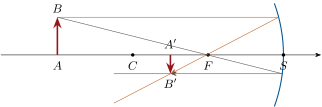
A concave mirror (C, focus F at mid-radius). For an object AB beyond C, the ray parallel to the axis returns through F and the ray through F returns parallel: they cross at B' — a real, inverted, reduced image between F and C.
A concave mirror (CC, focus FF at mid-radius). For an object ABAB beyond CC, the ray parallel to the axis returns through FF and the ray through FF returns parallel: they cross at B′B' — a real, inverted, reduced image between FF and CC.

উদাহরণ

Example 3.9 (Shaving mirror, rear-view mirror)

A concave mirror of radius 60 cm60\,\mathrm{cm} (f=−30 cmf = -30\,\mathrm{cm}) with a face at 20 cm20\,\mathrm{cm}: 1/SA′‾=−1/30+1/20=1/601/\overline{SA'} = -1/30 + 1/20 = 1/60, SA′‾=+60 cm\overline{SA'} = +60\,\mathrm{cm} — behind the mirror, virtual — and γ=−60/(−20)=+3\gamma = -60/(-20) = +3: upright, three times larger, the shaving mirror. A convex mirror of radius 2.0 m2.0\,\mathrm{m} (f=+1.0 mf = +1.0\,\mathrm{m}) with a car 20 m20\,\mathrm{m} behind: 1/SA′‾=1+1/201/\overline{SA'} = 1 + 1/20, SA′‾=0.95 m\overline{SA'} = 0.95\,\mathrm{m} (virtual, behind), γ=+0.048\gamma = +0.048: upright, twenty times smaller, and therefore a wide field — the rear-view mirror, with its warning that objects are closer than they appear.

প্রসঙ্গসহ পড়ো →