University Physics — Year 1 · Bachelor Year 1
3Mirrors and Thin Lenses
A make-up mirror shows a face twice its size; the back of a spoon shows it tiny and upright, the bowl shows it tiny and upside down; a magnifying glass held at arm’s length turns the room on its head, held close it enlarges a stamp; a phone lens the size of a lentil paints the whole street onto a sensor. One algebraic relation between three distances governs every one of these images, and this chapter establishes it — for curved mirrors first, then for the thin lens that almost all optical instruments are built from.
3.1 Images and the conditions of Gauss
Definition 3.1 (Object, image, stigmatism)
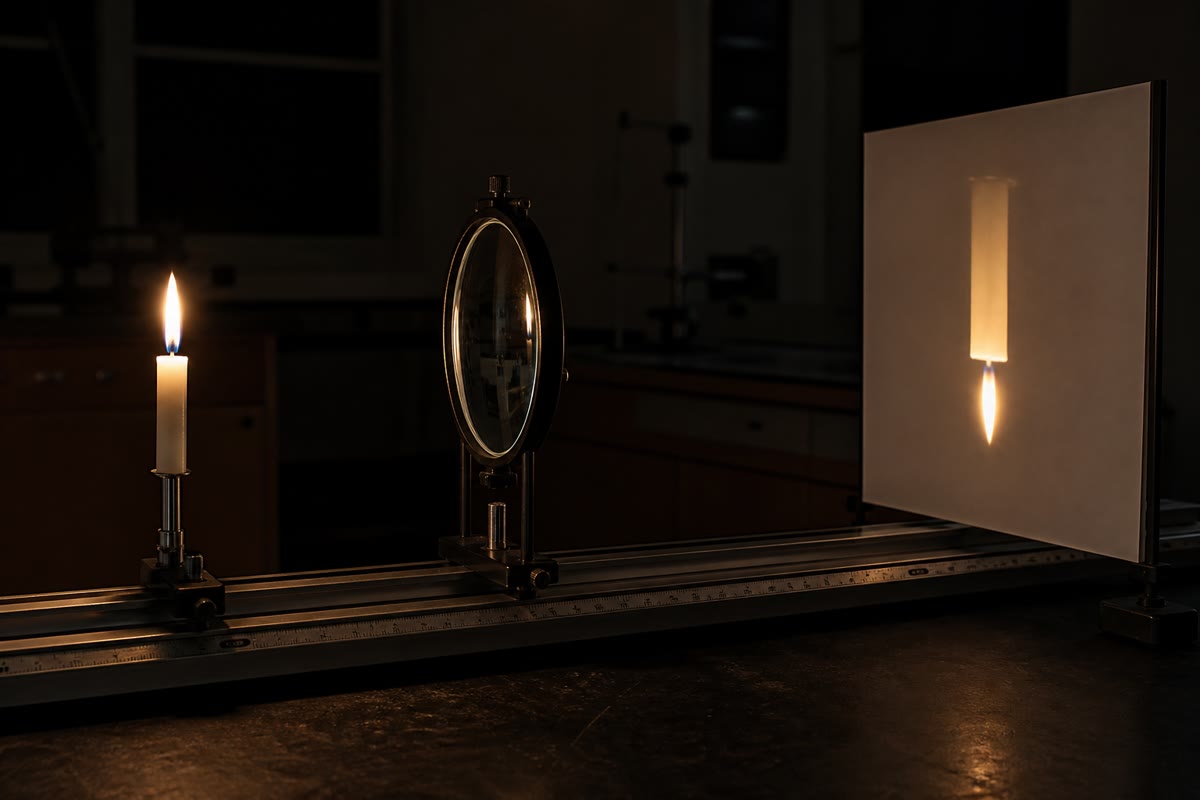
An optical system receives rays from a point (the object point). If all the emerging rays pass through one point , or all seem to come from one point , the system is stigmatic for and is the image of . The image is real if the emerging rays actually cross at (it can be caught on a screen), virtual if only their backward extensions do (it is seen through the system, not projected). Likewise the object is real if the incoming rays diverge from , virtual if they converge toward behind the system’s entrance. The pair is conjugate.
Definition 3.2 (Centered system; Gauss conditions)
A centered system has an axis of rotational symmetry, the optical axis. Rays that stay close to the axis and make small angles with it are paraxial; a system used with paraxial rays only is said to work under the Gauss conditions. Under those conditions a centered system is approximately stigmatic for every point, and an object plane perpendicular to the axis has an image plane perpendicular to the axis (aplanatism).
Proof. Admitted at this level. ∎
Remark 3.3 (Why small angles)
The plane mirror is the only simple system that is rigorously stigmatic for every point. A spherical mirror or lens is stigmatic only to the extent that : that approximation is what turns Snell’s law into linear relations between distances. Outside it the image of a point is a blur (aberrations), and the designer’s job — stops, combinations of lenses, aspheric surfaces — is to push the blur below what the eye or the sensor can resolve.
Notation 3.4 (Algebraic measures and magnification)
The optical axis is oriented in the direction of the incoming light; the transverse direction is oriented upward. For points , on the axis, denotes the algebraic measure ( if is downstream of ); for an object perpendicular to the axis and its image , the transverse magnification is
negative for an inverted image, of absolute value greater than for an enlarged one.
3.2 Spherical mirrors
Definition 3.5 (Spherical mirror)
A spherical mirror is a reflecting spherical cap of center and vertex (its intersection with the axis). It is concave if the light meets the hollow side ( on the side of the incoming light), convex otherwise. Its focus is the image of a point at infinity on the axis; its focal length is .
Proposition 3.6 (Focus of a spherical mirror)
Under the Gauss conditions, the focus is the midpoint of : . A concave mirror has (real focus, in front); a convex one has (virtual focus, behind).
Proof. A ray parallel to the axis at height meets the mirror at ; the normal at is the radius , making an angle with the axis, . Reflected at the same angle to the normal, the ray crosses the axis at ; triangle has equal angles at and at , so and, projecting, . For paraxial rays and : all such rays cross the axis at the same point, the midpoint of . Sign: for a concave mirror and lie in front (upstream), . ∎
Theorem 3.7 (Conjugation for a spherical mirror)
Under the Gauss conditions, the image of a point on the axis satisfies
Proof. Take a concave mirror and a real object beyond ; the algebraic form then covers every case. A ray from hits the mirror at (height ) and returns to on the axis. Call , , the angles of , and with the axis; paraxially , , (distances). The law of reflection says the normal bisects the angle between and : , i.e. , i.e. ; with , , all negative this is the displayed relation. For the magnification, the ray reflected at the vertex makes equal angles with the axis: in lengths, and the image is inverted, . ∎
Method 3.8 (Constructing an image in a mirror)
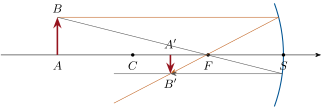
For an object point off the axis, draw two of the four remarkable rays; their intersection (or that of their extensions) is :
- parallel to the axis reflected through ;
- through reflected parallel to the axis;
- through reflected back on itself;
- to the vertex reflected symmetrically about the axis.
Then is the foot of the perpendicular from to the axis.
Example 3.9 (Shaving mirror, rear-view mirror)
A concave mirror of radius () with a face at : , — behind the mirror, virtual — and : upright, three times larger, the shaving mirror. A convex mirror of radius () with a car behind: , (virtual, behind), : upright, twenty times smaller, and therefore a wide field — the rear-view mirror, with its warning that objects are closer than they appear.
3.3 Thin lenses
Definition 3.10 (Thin lens)
A lens is a transparent medium bounded by two spherical (or plane) surfaces; it is thin when its thickness is negligible against the radii and against the distances in play, so that the two vertices merge into one point, the optical center . A ray through is not deviated. The image focus is the image of a point at infinity on the axis; the object focus is the point whose image is at infinity; both are at the same distance from : , the focal length. The lens is converging if ( real, downstream; edges thinner than the center), diverging if . Its vergence is measured in diopters ().
Theorem 3.11 (Conjugation for a thin lens)
Under the Gauss conditions, the image of a point on the axis satisfies the relation of Descartes
and, equivalently, the relation of Newton
Partial proof. The key fact is that a thin lens deviates a ray crossing it at height by the angle toward the axis, whatever the ray’s direction — each zone of the lens acts as a thin prism (Remark 2.21) whose apex angle grows linearly with for spherical surfaces; this linearity, exact for paraxial rays, is admitted here and derived from Snell’s law at two spherical surfaces in the Year 2 volume. Granting it: a ray from (at distance for a real object) reaching the lens at height arrives with slope , is bent by and leaves with slope ; it crosses the axis at with , i.e. , independently of : all rays from meet at . The ray through the center is straight, so . Newton’s form follows by substituting and . ∎
Method 3.12 (Constructing an image through a thin lens)
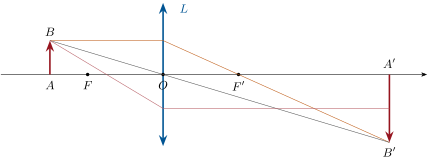
Three remarkable rays from :
- through : undeviated;
- parallel to the axis: emerges through ;
- through : emerges parallel to the axis.
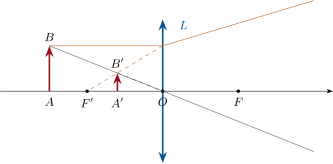
Two suffice; for a diverging lens, use the extensions (the ray aimed at behind the lens emerges parallel; the parallel ray emerges as if from in front).
Example 3.13 (The same lens, three ways)
A converging lens, . Stamp at : , , virtual, : the magnifier. Lamp at : , real, : a reduced inverted image on a card. Window away: , tiny inverted image in the focal plane — the camera. Three uses, one relation.
Proposition 3.14 (Longitudinal magnification)
If the object moves along the axis by , the image moves by , in the same direction.
Proof. Differentiate Descartes’s relation at fixed : , so . ∎
Remark 3.15 (Depth of focus)
A projector with has : a slide that buckles by under the lamp’s heat throws its image out of the screen plane. Conversely a camera () tolerates large object displacements for a tiny image shift — the depth of field.
3.4 Measuring a focal length
Method 3.16 (Autocollimation)
Place a plane mirror right behind the lens and move a lit object (a cross on a frosted glass) along the axis until its image, reflected back through the lens, forms sharp on the object itself, inverted and the same size. The object is then in the focal plane: rays leave the lens parallel, return parallel from the mirror, and are refocused in the focal plane. The object–lens distance is .
Proposition 3.17 (Bessel’s method)
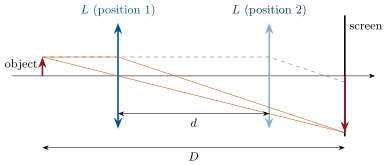
An object and a screen are fixed a distance apart. A converging lens forms a sharp real image on the screen for exactly two positions if , for one if , for none if . The two positions are a distance apart with
At (Silbermann) the single position gives .
Proof. Let be the object–lens distance; then and Descartes gives , i.e. : discriminant , positive iff . The two roots add up to (the positions are symmetric: object and image distances are exchanged) and differ by ; solve for . At , and . ∎
3.5 Two thin lenses
Proposition 3.18 (Lenses in contact; afocal doublet)
Two thin lenses in contact behave as one thin lens of vergence . Two lenses placed so that form an afocal system: a parallel beam emerges parallel, and a beam inclined by emerges inclined by with the angular magnification .
Proof. The image given by is the object for . In contact, : and ; add. Afocal: a parallel beam at angle focuses in the common focal plane at height from the axis (ray through ); seen from this point is in its object focal plane, so the beam emerges parallel, at the angle of the ray from the point through : . ∎
Example 3.19 (A telescope in one line)
, : ; the Moon, half a degree wide, becomes a disk — the astronomical telescope of the next chapter. With a diverging eyepiece, , : upright, Galileo’s spyglass.
3.6 Exercises
Exercise 3.1 ★
A concave mirror has . Find the image of an object placed at , and from the vertex: position, real or virtual, magnification.
Solution
Solution of Exercise 3.1.
; . At : , real, . At : , real, . At : , behind the mirror, virtual, (upright, enlarged).
Exercise 3.2 ★
A converging lens has . Find the image of an object at , then at ; sketch the constructions.
Solution
Solution of Exercise 3.2.
: , , real inverted, . : , , virtual upright, .
Exercise 3.3 ★
Give the vergence of a lens of focal length ; the focal length of a lens; the focal length of a and a lens in contact.
Solution
Solution of Exercise 3.3.
; ; , .
Exercise 3.4 ★
With and an object in front of , use Newton’s relation to locate the image and find ; check with Descartes’s relation.
Solution
Solution of Exercise 3.4.
: past , i.e. ; . Descartes: , , , .
Exercise 3.5 ★★
A convex rear-view mirror has . A car high is behind it: find the image position, its height, and explain the warning “objects in mirror are closer than they appear”.
Solution
Solution of Exercise 3.5.
, : , behind the mirror (virtual, upright); , image height . The brain judges distance from apparent size: a car shown twenty times smaller at is read as a car far away — farther than .
Exercise 3.6 ★★
A camera lens, , focuses on a subject away. By how much must the lens move from its infinity setting? What is the magnification? How far back must the photographer stand for a person to fit the height of the sensor?
Exercise 3.7 ★★
A projector must show a wide slide as a wide picture on a screen from the lens. Find the required focal length and the slide–lens distance. Why is the slide inserted upside down?
Solution
Solution of Exercise 3.7.
; , ; , . The image is inverted (), top–bottom and left–right: the slide goes in rotated by .
Exercise 3.8 ★★
Explain, with a ray diagram, why autocollimation locates the focal plane exactly, and why the returned image is inverted and the same size as the object. What happens to the returned image if the mirror is tilted slightly?
Solution
Solution of Exercise 3.8.
Object in the focal plane rays from each point leave the lens parallel; the plane mirror sends them back parallel (symmetric direction); the lens focuses a parallel beam in its focal plane, at the point symmetric about the axis of the source point: image in the object plane, inverted, . Tilting the mirror by turns the returning beam by and shifts the image sideways by , still sharp in the same plane.
Exercise 3.9 ★★
Object and screen are apart; sharp images are obtained for two lens positions apart. Find . What is the shortest object–screen distance at which this lens can still project a sharp image, and with what magnification?
Solution
Solution of Exercise 3.9.
. Shortest distance , with .
Exercise 3.10 ★★★
A converging lens () is followed, further, by a diverging lens (). Locate the image of an object at infinity. Show that a distant object of angular size gives an image of height , and compare with the length of the arrangement: the principle of the telephoto lens.
Solution
Solution of Exercise 3.10.
images infinity at , past , i.e. past : a virtual object, . : final image past . Intermediate image height (cm); , so : equivalent focal length , in a barrel long — a telephoto.
Exercise 3.11 ★★★
A concave mirror forms, on a screen from a lamp filament, an image of the filament three times its size. Find the positions of the mirror and its radius of curvature.
Solution
Solution of Exercise 3.11.
gives ; both real, in front: , , and screen–lamp distance : . Mirror from the lamp, from the screen; : .
Exercise 3.12 ★★★
The Sun subtends . A converging lens of diameter and focal length forms its image on a sheet of paper. Compute the image diameter, the power collected (solar irradiance ) and the irradiance in the image; compare with the Sun’s direct irradiance and conclude.
3.7 Problem: The slide projector
Problem 3.1
Weekend problem — one lens, measured on a bench, then asked to throw a 35-mm slide across a hall: how a projector is designed, focused, and fitted with a long-throw converter
A projection lens is a converging thin lens of unknown focal length . The slide is high and wide.
Part I — The lens on the bench.
- State Descartes’s relation and the magnification for a thin lens, with the sign conventions.
- Object and screen are fixed a distance apart. Show that a real image on the screen requires .
- Show that, when , the two lens positions giving a sharp image are symmetric with respect to the midpoint of object and screen, and that with their separation.
- With and , compute .
- The lens sits in a thick barrel whose optical center cannot be located precisely. Why does this not affect the method?
- The distances carry and . Compute and write the result.
- Give the magnification at each of the two positions. Which one corresponds to a projector?
- What is the smallest for which a sharp image exists, and the magnification then (Silbermann)?
Part II — Throwing the picture. The picture on the screen must be wide. Take .
- What magnification is required (with its sign)?
- Compute the lens–screen distance and the slide–lens distance.
- Why is the slide inserted upside down and mirror-reversed?
- The screen is moved to . By how much, and in which direction, must the lens be moved relative to the slide to refocus? How wide is the picture now?
Part III — Focus tolerance and light.
- Show that a small displacement of the slide shifts the image by .
- The film buckles by under the lamp’s heat. By how much does the image plane move (screen at )? Comment.
- The lens aperture is in diameter. If the screen sits off the image plane, what is the diameter of the blur spot of a point of the slide? Seen from , does the eye (angular resolution about ) notice?
- The slide receives of light, all of which reaches the screen. Compute the irradiance (power per unit area) on the slide and on the screen, and show that their ratio is .
Part IV — The long-throw converter. In a larger hall the screen is away. A diverging lens , , is clipped on behind ; the screen is from .
- For the final image to be real and on the screen, where (from ) must the intermediate image given by lie? Is it a real or a virtual object for ?
- Deduce the slide position .
- Compute , and the total magnification.
- Give the picture width, and compare with what alone would give on the same screen ( from ).
For an object at infinity, show that the system is equivalent to a single lens of focal length with
, in the sense that a beam inclined by focuses at height from the axis. Compute .
- Check that the ratio of picture widths (with/without converter) is close to . Why only approximately?
- Why must the intermediate image lie less than beyond for the final image to be real?
- With the same lamp, by what factor does the screen irradiance change when the converter is fitted (same screen distance)?
- Summarize: the converter multiplies the focal length by which factor, and what does it do to picture size and brightness at a given throw?
Solution
Solution of Problem 3.1.
1. , ; axis oriented along the light, distances algebraic from .
2. , : , i.e. ; real roots iff , i.e. .
3. The roots sum to : , so — object and image distances swap, the positions are symmetric about the midpoint. , hence .
4. .
5. Only the displacement of the barrel between the two sharp settings and the object–screen distance enter: neither requires knowing where sits inside the barrel.
6. , ; so and : .
7. or : (slide near the lens, enlarged: the projector) and .
8. , .
9. .
10. ; .
11. : the real image is rotated by about the axis, so the slide is inserted rotated by (upside down and mirror-reversed).
12. : , : the lens moves toward the slide. : picture wide.
13. Differentiating Descartes: , so .
14. : the image drifts out of focus as the film warms — hence glass-mounted slides or an autofocus that tracks the film.
15. Similar triangles from the aperture to the image point: blur ; from this subtends : not noticed.
16. Slide area : ; screen area times larger, : ; same power, areas in ratio .
17. : , : the intermediate image lies beyond — a virtual object for (the rays from converge toward it).
18. ; , .
19. ; ; .
20. Width . alone: , width .
21. Beam at : focuses it at height in its focal plane, which is from ; images this point at with and magnifies by , so and , whose inverse is the stated formula. , .
22. and . Only approximately because the slide is at finite distance and the two throws are measured from different lenses; for an object at infinity the ratio would be exact.
23. Virtual object at beyond a diverging lens: , positive (real image) iff .
24. Same power on a picture of area times smaller: irradiance .
25. The converter multiplies the focal length by ; at a given throw the picture is times smaller in each direction and times brighter — a long-throw lens.