 Coach
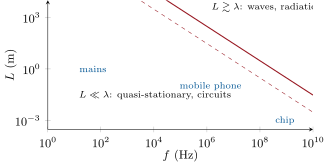
CoachA system of size driven at frequency is quasi-stationary when : the time the fields need to cross it is negligible compared with the period, and all its points "see" the sources at the same instant. Two limits are used:
- the magnetic quasi-stationary regime (circuits with currents, coils, transformers, induction): the displacement current is dropped from Ampère’s law, (so and currents flow in closed circuits), while Faraday’s law is kept in full;
- the electric quasi-stationary regime (a charging capacitor): Faraday’s term is dropped, is the electrostatic field of the instantaneous charges, while the displacement current is kept to find .
Examples
Example 11.13 (Circuits and antennas)
A mains circuit at () is quasi-stationary up to the size of a country — it is why Kirchhoff’s laws and the transformer work. A circuit is quasi-stationary up to some ; at () its wires are antennas, currents differ along a wire, and the circuit radiates: the domain of Chapter 17 and of microwave design, where a track on a board is a transmission line.