University Physics — Year 2 · Bachelor Year 2
17Dipole Radiation and Scattering
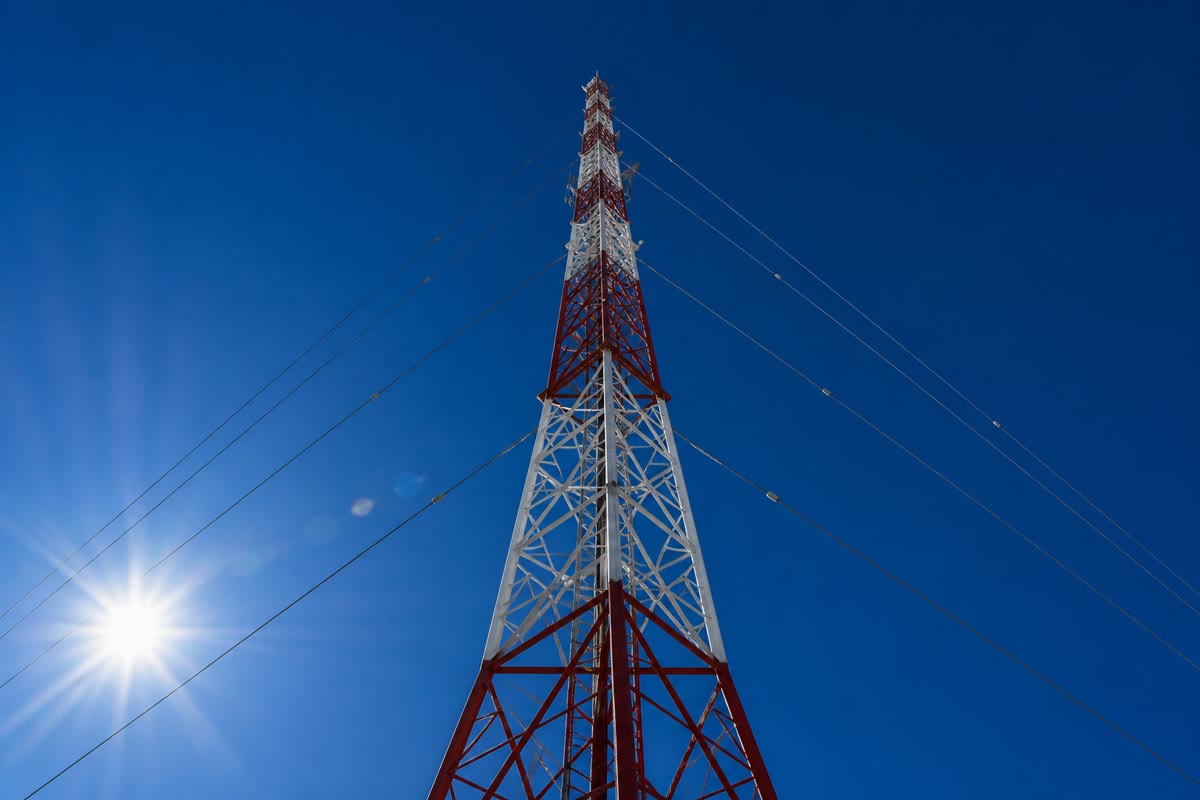
Why is the sky blue, and why is it bluest at right angles to the Sun — and polarized there, as bees and photographers know? Why does a radio mast have to be tens of metres tall, and why does it radiate nothing straight up? Both questions have the same answer: an oscillating electric charge radiates electromagnetic waves, with a power that grows as the fourth power of the frequency and a pattern that vanishes along the axis of oscillation. This chapter states the field of the oscillating dipole, the simplest radiating system, draws from it the antenna and the radiation of an accelerated charge, and applies it to the molecules of the air, each a tiny antenna re-emitting the sunlight: Rayleigh scattering.
17.1 The field of an oscillating dipole
Theorem 17.1 (Radiation field of an electric dipole)
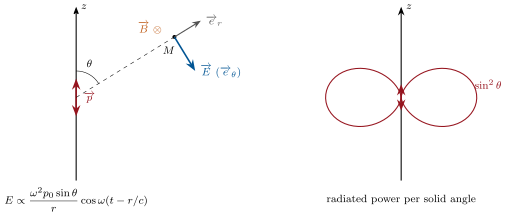
A dipole of moment , of size , at the origin, radiates. In the radiation zone — at distances — its field, in spherical coordinates about the dipole’s axis, is
a spherical wave, locally plane — a right-handed triad with — retarded by the travel time , of amplitude falling as , proportional to the acceleration of the dipole and to : maximal in the equatorial plane, zero along the axis; polarized in the plane containing the axis.
Proof. Admitted at this level. ∎
Remark 17.2 (Reading the formula)
The exact solution of Maxwell’s equations (from the retarded potentials, beyond this volume) contains also terms in and ; the last is the quasi-static dipole field of the Year 1 volume, , which dominates in the near zone ; at the two are comparable, beyond it only the term survives. Each factor has a reason. : the power through a sphere, , must not depend on . : the field of a charge at rest or in uniform motion is not radiative; it is the acceleration that radiates. : an observer on the axis sees the charge come and go along the line of sight, with no transverse acceleration; in the equatorial plane the whole acceleration is transverse. Retardation: the field at at time reflects what the dipole did at .
17.2 Radiated power
Proposition 17.3 (Power of a dipole; Larmor’s formula)
The mean Poynting vector of the dipole’s field is radial,
and the total mean power radiated is
For a single charge with acceleration (non-relativistic), the instantaneous power is (Larmor).
Proof. with ; integrate over the sphere:
Larmor: , so ; replacing the mean by the instantaneous gives . ∎
Example 17.4 (An antenna and a wire)
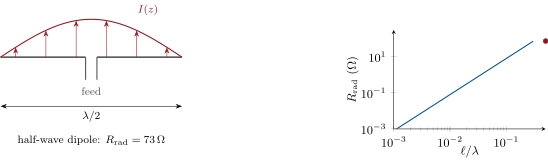
A short wire of length carrying the current is a dipole with , i.e. : it radiates with the radiation resistance — the power leaves the circuit as if through a resistor, without heating anything. A wire at (): , less than its copper resistance, a poor antenna; at : (the short-dipole formula is stretched here), a good one. The half-wave dipole, with a sinusoidal current distribution, has (admitted) and a pattern close to the elementary dipole’s — the standard antenna, from radio masts to the rabbit ears on old televisions. A mains wire at : — the quasi-stationary circuits of Chapter 11 radiate nothing.
Example 17.5 (An electron that radiates)
In an X-ray tube an electron of () stops in of tungsten: , Larmor power over : , about of its energy radiated as the "braking radiation" (bremsstrahlung) of the tube — the rest is heat, and the anode is cooled. The classical electron of a hydrogen atom, accelerated at , would radiate and spiral into the nucleus in : classical physics forbids atoms, and Chapter 30 rescues them.
17.3 Rayleigh scattering: the blue sky
Proposition 17.6 (Scattering by a bound electron)
A wave of amplitude and frequency falls on an atom modelled as an elastically bound electron of resonance (Chapter 14): the electron oscillates with amplitude , the atom becomes a dipole in phase with the field, and re-radiates the power . The ratio of that power to the incident intensity is the scattering cross-section
Rayleigh’s law, . For a free electron () the cross-section is , independent of frequency (Thomson scattering).
Proof. From the Lorentz model with and negligible damping, ; insert into the power and divide by ; collects the constants. For the free electron, (in antiphase), , and the cancel. ∎
Example 17.7 (Blue sky, red sunset, white clouds)
Violet light () is scattered times more than red: the sky, lit by scattered sunlight, is blue (not violet: the Sun emits less violet and the eye sees it poorly). At sunset the direct light crosses forty times more air than at noon and loses its blue to the sky of other places: it reddens. Each air molecule scatters with at ; with the mean free path is : a tenth of the green light is scattered on its way down through the atmosphere, a third of the violet. Cloud droplets, far larger than , are not Rayleigh scatterers: they scatter all colours alike — white.
Proposition 17.8 (Polarization by scattering)
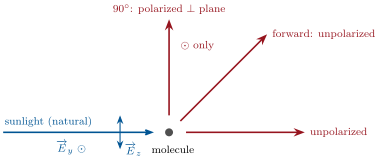
Natural light travelling along induces dipoles in the plane. An observer looking along (at from the beam) receives no radiation from the dipole components along (his line of sight) and full radiation from those along : the scattered light is linearly polarized along , perpendicular to the plane containing the beam and the line of sight. At other angles it is partially polarized, with the degree for the scattering angle .
Proof. The incident natural light has with equal mean components along and ; the dipole along does not radiate toward (), the one along radiates . At angle the component’s contribution is reduced by in intensity. ∎
Remark 17.9 (Why the blue light reaches us at all)
In a perfectly uniform medium the waves scattered by neighbouring molecules would interfere destructively in every direction but forward (the index of refraction is that forward-scattered wave). It is the fluctuations of the density of air — molecules are not on a lattice — that leave a net scattered intensity, proportional to the number of molecules, as computed above for one (Einstein, 1910). The same randomness makes the sky’s light incoherent from point to point.
Method 17.10 (Radiation estimates)
(1) Identify the dipole: amplitude, or for a wire. (2) Field at distance : ; power: . (3) For an accelerated charge use Larmor; for an antenna the radiation resistance. (4) For scattering, compute the induced dipole from the medium’s response (Lorentz model) and divide the radiated power by the incident intensity. (5) Remember the zeros: nothing along the axis of oscillation, hence the polarization at and the Brewster angle of Chapter 15.
17.4 Exercises
Exercise 17.1 ★
A short antenna of carries (amplitude) at . Dipole amplitude ; field amplitude at in the equatorial plane and at from the axis; radiated power; radiation resistance.
Solution
Solution of Exercise 17.1.
; : at , at ; ; .
Exercise 17.2 ★
Radiation resistance of a wire at , , , ; compare with its copper resistance ( diameter, with the skin effect at the higher frequencies, at ); efficiency (radiated over total) in each case. Why do long-wave transmitters have masts hundreds of metres tall?
Solution
Solution of Exercise 17.2.
: , , , . Copper: , , , (skin effect): efficiencies , , , . At long wavelengths only a mast that is a fair fraction of has a radiation resistance above its losses.
Exercise 17.3 ★
Ratio of the Rayleigh scattering of , and light; of the and radar wavelengths by raindrops (if they were small enough — they are not quite); why does weather radar use short wavelengths to see rain and long ones to see through it?
Solution
Solution of Exercise 17.3.
. : the radar sees small drops a hundred times better; the one looks through the rain to what is behind.
Exercise 17.4 ★
Degree of polarization of skylight at , , , from the Sun; where in the sky should a photographer point a polarizer for the darkest blue, and what happens when the Sun is overhead? Why is the real maximum only about (think of multiple scattering and of what the ground reflects)?
Solution
Solution of Exercise 17.4.
: , , , . Point from the Sun (a great circle across the sky); with the Sun overhead, the whole horizon is at and polarized along it. Multiple scattering, the ground’s reflection and the molecules’ anisotropy add unpolarized light: about at best.
Exercise 17.5 ★★
(a) Integrate the Poynting vector of the dipole over a sphere and check . (b) Fraction of the power radiated within of the equatorial plane. (c) Half-power angle: at what is the intensity half its maximum? (d) The "gain" of the dipole, maximum intensity over the isotropic average: show it is .
Solution
Solution of Exercise 17.5.
(a) . (b) . (c) : , a beam wide. (d) Maximum against the average : .
Exercise 17.6 ★★
Near and far. (a) Write the quasi-static field of a dipole at , , and the radiative one; at what distance are their amplitudes equal? Express in terms of . (b) For a antenna, ; which field does a receiver at feel, at ? (c) A mobile phone at held from the head: near or far zone? (d) Why does the near field carry no net power away?
Solution
Solution of Exercise 17.6.
(a) at . (b) : at the quasi-static field, at the radiated one. (c) : the head is in the near zone. (d) Near-zone and are in quadrature: the Poynting vector averages to zero, energy is stored and returned, as in a capacitor.
Exercise 17.7 ★★
Thomson and the corona. (a) Compute . (b) The solar corona has over m: fraction of the photospheric light scattered toward us; why is the corona white and only visible during eclipses? (c) X-rays of on a carbon atom ( electrons, binding energies below ): why do the electrons scatter as if free, and what is the atom’s cross-section? (d) Why does a medical X-ray of bone differ from flesh mostly through absorption, not Thomson scattering?
Solution
Solution of Exercise 17.7.
(a) . (b) : a millionth of the photosphere, colourless because Thomson scattering is, and drowned by the sky’s scattered sunlight except at eclipse. (c) : the electrons respond as free, . (d) Photoelectric absorption grows as and singles out calcium; scattering is the same per electron in bone and flesh.
Exercise 17.8 ★★
Sunset. The optical depth of the atmosphere for Rayleigh scattering at the zenith is (the direct light is attenuated by ). (a) Transmission at the zenith for , , . (b) At sunset the path is times longer: transmissions; ratio red/blue. (c) Why does the Moon turn red during a lunar eclipse? (d) Why is the sky near the horizon whitish rather than deep blue?
Solution
Solution of Exercise 17.8.
(a) , , : , , . (b) , , : , , ; red over blue . (c) The Earth’s atmosphere bends sunset light into the shadow, reddened by the same scattering. (d) Near the horizon the path is long: the blue is scattered out of the scattered light itself, and multiple scattering adds white.
Exercise 17.9 ★★
Two antennas. Two vertical dipoles a distance apart along are fed with the same amplitude. (a) In phase, : in which horizontal directions do their far fields add, in which cancel? (broadside array). (b) In antiphase, : the same (end-fire). (c) In quadrature, : show the array radiates toward one side only. (d) Why do AM broadcast stations use several masts, and how does a phased-array radar steer its beam without moving?
Solution
Solution of Exercise 17.9.
(a) Along the line of the pair the path difference gives cancellation; broadside, addition. (b) Antiphase: the reverse — radiation along the line (end-fire), none broadside. (c) Toward : path delay plus feed phase , in phase; toward : , cancelling: a cardioid, one-sided. (d) Masts shape the coverage and protect neighbours; a phased array steers by changing the feed phases, in microseconds.
Exercise 17.10 ★★★
Radiation damping. The Lorentz electron (Chapter 14) oscillating at with amplitude radiates by Larmor’s formula. (a) Mean radiated power; energy of the oscillator ; show that the energy decays with the rate . (b) Value of for the sodium line (): compare with the used in Exercise 14.9. (c) Lifetime and the natural width of the line, . (d) Quality factor of the atomic oscillator.
Solution
Solution of Exercise 17.10.
(a) , : . (b) : — the value used. (c) ; , a hundredth of a picometre (). (d) .
Exercise 17.11 ★★★
The mast. An AM station radiates at from a vertical mast of height on a conducting ground (which acts as a mirror, making the mast half of a half-wave dipole: , and the power goes into the upper half-space only). (a) Height; current at the base. (b) Field amplitude at in the horizontal plane (use the dipole pattern, over the upper hemisphere ; take at the horizon as a fair estimate). (c) Emf in a receiving whip there. (d) Why does the ground’s conductivity matter, and why are radial copper wires buried under the mast?
Solution
Solution of Exercise 17.11.
(a) ; . (b) , . (c) . (d) The return currents flow in the ground; a resistive soil adds losses and spoils the mirror; buried radials give them a copper path.
Exercise 17.12 ★★★
Scattering and the index. For a dilute gas the forward-scattered waves of all molecules add coherently and build the refractive index, with the polarizability; the Rayleigh cross-section is . (a) Express in terms of , and : . (b) For air (, ) at : and the mean free path . (c) Vertical optical depth of the atmosphere (equivalent height ); compare with the of Exercise 17.8. (d) Why did this relation (Rayleigh, 1899) give a value of Avogadro’s number?
Solution
Solution of Exercise 17.12.
(a) gives ; with and : . (b) : , mean free path . (c) . (d) is measured from the sky’s attenuation, is known: follows, hence Avogadro’s number.
17.5 Problem: The mast, the sky and the electron
Problem 17.1
Weekend problem — three antennas: a broadcasting mast, an air molecule in sunlight, and a free electron
Part I — The mast. A medium-wave station at radiates from a quarter-wave mast on a conducting ground (, pattern of a vertical dipole over the upper half-space, as in Exercise 17.11).
- Wavelength and height of the mast; current amplitude at its base; voltage across .
- Equivalent dipole moment amplitude, treating the mast as a short dipole with , for the quarter-wave mast (admitted).
- Mean intensity at and in the horizontal plane (take the upper-hemisphere pattern, maximal at the horizon, ); field amplitudes.
- Emf in a vertical whip at ; in a ferrite rod antenna (a coil of turns, , effective permeability ) facing the wave’s : compare.
- Power received by a matched receiver with an antenna of effective area (the dipole’s) at .
- The mast’s conductors have a total loss resistance of : efficiency; power lost as heat.
- Is a receiver at in the radiation zone? One at from the mast?
- Why do medium-wave signals reach farther by night? (Recall the D layer of Chapter 14.)
Part II — The sky. Air at sea level: , Rayleigh cross-section ; sunlight at the ground; the atmosphere’s equivalent thickness at sea-level density is .
- Cross-section at and ; ratio.
- Mean free path of the three colours; vertical optical depth ; fraction of each colour scattered out of the direct beam at the zenith.
- Power scattered per cubic metre of air at the ground by the green light (take of sunlight around ); into what solid angle, with what pattern?
- A column of air of section viewed at from the Sun: estimate the intensity of skylight arriving at the observer from that column (power scattered toward him per unit solid angle, over the ), and compare with the direct Sun; is the sky’s brightness of the right order (about of the Sun’s)?
- Degree of polarization of the light from that column; why is it lower in reality, and how do some insects use it?
- At sunset the path is atmospheres: transmitted fractions of blue and red; colour of the Sun; why the sky overhead stays blue.
- Why is the sky black on the Moon even in full daylight?
- On Mars the air is a hundred times thinner but full of fine dust (grains of a micrometre): why is the Martian sky butterscotch and its sunset blue?
Part III — The electron.
- Thomson cross-section from .
- In an X-ray tube an electron of (, treat it non-relativistically) is stopped over in tungsten: acceleration, Larmor power, duration, energy radiated and its fraction of the kinetic energy.
- Shortest wavelength the tube can emit (a photon taking the electron’s whole energy).
- The tube runs at : radiated power; heat in the anode; why the anode rotates.
- A classical electron circling a proton at the Bohr radius (, speed ): acceleration, Larmor power, and the time to radiate away its — the classical atom’s lifetime.
- Real atoms last forever: name what classical physics misses here, and what Chapter 30 will say about a stationary state.
- An electron in a synchrotron of radius at : the non-relativistic Larmor formula gives what power? (The true power is times larger, with : the synchrotron light source.)
- The same electron at rest in the of sunlight: power it re-radiates (Thomson); number of such electrons needed to scatter a watt.
- Summarize the three antennas in a table: dipole moment, frequency, power, pattern.
Solution
Solution of Problem 17.1.
1. , ; ; .
2. : .
3. : and ; and .
4. Whip: . Rod: — less, but compact and selective.
5. : .
6. ; of heat.
7. at : radiation zone; at , : the transition region, where the quasi-static field still counts.
8. By day the D layer absorbs the wave that would otherwise reach the reflecting layers; at night it is gone and the sky wave carries the station hundreds of kilometres.
9. , : ratio .
10. Mean free paths , , ; , , : , , scattered.
11. , into with the pattern for natural light.
12. The column scatters of its (); spread over the hemisphere, the sky delivers some , against the Sun’s : a millionth per steradian — the right order.
13. Fully polarized at in single scattering; multiple scattering and the ground reduce it to some ; bees and ants read the pattern to find the Sun behind clouds.
14. : blue (), red (): a deep red Sun; overhead, the light arrives after a short path and is blue.
15. No atmosphere, nothing to scatter: the sky is black beside the Sun.
16. Micrometre dust scatters like Mie particles: forward and red, giving a butterscotch sky; near the setting Sun the forward-scattered light is blue.
17. .
18. ; during : , of — the real yield is near , because the braking happens in violent close encounters with nuclei, not in a gentle uniform deceleration.
19. .
20. in the beam, about of X-rays; two kilowatts of heat in a spot — the anode rotates to spread it.
21. , ; gone in .
22. Classical charges in bound motion radiate continuously; quantum mechanics has stationary states that do not, and a lowest one with nowhere to fall.
23. : by Larmor, times more in reality: tens of kilowatts of synchrotron light from a stored beam.
24. ; electrons for a watt.
25. Mast: at , , a vertical doughnut. Molecule: at , , a doughnut about the field. Free electron: Thomson, in sunlight, the same pattern.