
Physics · Glossary

What is Traction and the stress tensor?

Definition 3.3 University Physics — Year 3 · Chapter 3 — Continuum Mechanics and Elasticity

Cut the solid, in thought, along a small surface  ⁣dS\dd S of normal n\vect n: the material on the +n+\vect n side pulls on the other side with a force  ⁣dF=σ(n) ⁣dS\dd\vect F = \boldsymbol\sigma(\vect n)\,\dd S — the traction. This force depends linearly on n\vect n (Cauchy), so it is encoded by the stress tensor σij\sigma_{ij}:

 ⁣dFi=jσijnj ⁣dS,\dd F_i = \sum_j \sigma_{ij}\,n_j\,\dd S ,

in pascals. σxx\sigma_{xx} is a pull (>0> 0: tension) or push (<0< 0: compression) across a face normal to xx; σxy\sigma_{xy} is a force along xx carried by a face normal to yy — a shear stress. A fluid at rest is the special case σij=pδij\sigma_{ij} = -p\,\delta_{ij}: pressure pushes equally on every face and shears on none, which is why fluids flow — they cannot carry static shear.
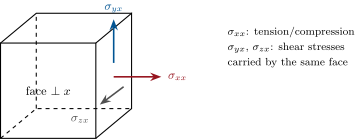
The three components of the traction on one face of a material cube: one normal (tension or compression), two tangential (shear). The nine components over the three faces form the stress tensor.
Read in context →