Physics · Glossary

What is Travelling wave, celerity?

Definition 5.5 University Physics — Year 1 · Chapter 5 — Signal Propagation: Travelling and Standing Waves

A signal s(x,t)s(x, t) defined along an axis is a travelling wave moving in the +x+x direction at celerity cc if

s(x,t)=f ⁣(txc)=F(xct)s(x, t) = f\!\left(t - \frac{x}{c}\right) = F(x - ct)

for some function ff (or FF): the shape is carried along unchanged, shifted by cΔtc\,\Delta t in time Δt\Delta t. A wave moving toward x-x is g(t+x/c)g(t + x/c). A medium in which every shape propagates undeformed at the same cc is non-dispersive.

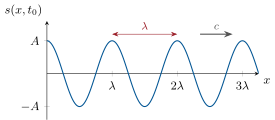
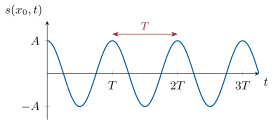
The double periodicity of a sinusoidal travelling wave: a snapshot at fixed time repeats every wavelength  and slides at speed c; the signal at a fixed point repeats every period T, with = cT. The double periodicity of a sinusoidal travelling wave: a snapshot at fixed time repeats every wavelength  and slides at speed c; the signal at a fixed point repeats every period T, with = cT.
The double periodicity of a sinusoidal travelling wave: a snapshot at fixed time repeats every wavelength λ\lambda and slides at speed cc; the signal at a fixed point repeats every period TT, with λ=cT\lambda = cT.

Examples

Example 5.7 (Celerities)

Sound in air, 340m/s340\,\mathrm{m}/\mathrm{s}: thunder 3s3\,\mathrm{s} after the flash puts the strike 1km1\,\mathrm{km} away. Sound in water, 1500m/s1500\,\mathrm{m}/\mathrm{s}; in steel, 5000m/s5000\,\mathrm{m}/\mathrm{s}. Transverse waves on a string of tension FF and mass per unit length μ\mu: c=F/μc = \sqrt{F/\mu}, as dimensional analysis predicted (Exercise 1.5) — 140m/s140\,\mathrm{m}/\mathrm{s} for a guitar string. Light in vacuum, c=3.00×10⁸m/sc = 3.00 \times 10^{8}\,\mathrm{m}/\mathrm{s}; in glass, c/nc/n. The celerity is a property of the medium, not of the source: a whisper and a shout arrive together.

Read in context →