University Physics — Year 1 · Bachelor Year 1
5Signal Propagation: Travelling and Standing Waves
Pluck a guitar string and a whole hall hears a note; hold a finger lightly at its midpoint and the note jumps an octave. Stand between two loudspeakers playing the same tone and, walking slowly, you cross spots of near silence every few decimeters. Light from two pinholes paints stripes on a screen. Nothing is carried from one place to another in any of these — no air, no string, no glass travels — yet something propagates: a signal. This chapter describes how a signal moves, what a sinusoidal wave is, and what happens when two waves meet: the mathematics of superposition, interference, and standing waves, which every later wave chapter — acoustics, optics, and quantum physics — will reuse.
5.1 Signals
Definition 5.1 (Signal; sinusoidal signal)
A signal is a physical quantity that varies in time and carries information: the acoustic overpressure at a microphone, the voltage at an antenna, the transverse displacement of a point of a string. The sinusoidal signal
has amplitude , angular frequency (), frequency , period and initial phase ; is its phase at time .
Remark 5.2 (Spectrum)
Any periodic signal of period is a sum of sinusoids of frequencies (the fundamental) and its multiples (the harmonics); the list of their amplitudes is the signal’s spectrum. A flute and a violin playing the same note share the fundamental and differ in the spectrum — that is timbre. The decomposition (Fourier’s) is stated and used in Chapter 9; here it matters because sinusoids propagate simply, and whatever holds for each sinusoid holds, by addition, for any signal.
Proposition 5.3 (Beats)
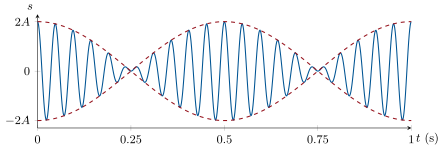
The sum of two sinusoids of equal amplitude and close frequencies ,
is a sinusoid at the mean frequency whose amplitude swells and fades at the beat frequency .
Proof. . The slow factor vanishes twice per period of its own, so the envelope has frequency . ∎
Example 5.4 (Tuning by ear)
A tuning fork at and a string at sounded together throb three times a second; tightening the string slows the throb, and when it stops the string is in tune. The ear hears the mean frequency () as the pitch and the envelope as loudness wobbling: beats make a frequency difference of less than one percent audible.
5.2 Travelling waves
Definition 5.5 (Travelling wave, celerity)
A signal defined along an axis is a travelling wave moving in the direction at celerity if
for some function (or ): the shape is carried along unchanged, shifted by in time . A wave moving toward is . A medium in which every shape propagates undeformed at the same is non-dispersive.
Proposition 5.6 (Delay)
The signal received at is the signal emitted at , delayed by : .
Proof. . ∎
Example 5.7 (Celerities)
Sound in air, : thunder after the flash puts the strike away. Sound in water, ; in steel, . Transverse waves on a string of tension and mass per unit length : , as dimensional analysis predicted (Exercise 1.5) — for a guitar string. Light in vacuum, ; in glass, . The celerity is a property of the medium, not of the source: a whisper and a shout arrive together.
Proposition 5.8 (Sinusoidal travelling wave)
A sinusoidal source launches
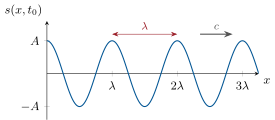
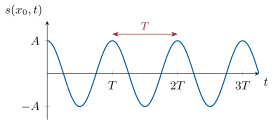
The wave is periodic in time (period ) and in space (period the wavelength ); is the wavenumber; two points a distance apart oscillate with a phase difference — in phase if , in opposite phase if . The speed at which a crest moves, , is the phase velocity; here .
Proof. Substitute into . At fixed the signal repeats after ; at fixed it repeats after with . Two points , : the phases differ by . A crest () moves at . ∎
Definition 5.9 (Dispersion)
A medium is dispersive when the phase velocity depends on the frequency. A non-sinusoidal signal, a sum of sinusoids, then deforms as it travels, its components drifting apart. Sound in air and light in vacuum are non-dispersive; light in glass (Chapter 2) and waves on deep water are dispersive — the long swell from a distant storm arrives a day before the short chop.
5.3 Superposition and interference
Theorem 5.10 (Superposition)
In a linear medium, when several waves propagate together, the resulting signal at each point and time is the sum of the signals each wave would produce alone.
Proof. Admitted at this level. ∎
Remark 5.11 (Linearity)
Superposition is a statement about the equations of the medium (linear in the signal), true as long as amplitudes stay small: sound below the threshold of pain, light below laser-cutting intensities, a string plucked gently. Two beams of light cross without disturbing each other; two ripples pass through one another and emerge intact. What is observed where they overlap is the subject of interference.
Theorem 5.12 (Two sinusoidal signals of the same frequency)
At a point where two sinusoidal signals of the same frequency arrive, and , the sum is a sinusoid of the same frequency whose amplitude satisfies
For waves whose intensity (power per unit area) is proportional to , the intensities obey Fresnel’s formula
The interference is constructive () when , destructive () when , .
Proof. Expand: with . Geometrically: is the length of the sum of two vectors of lengths , making the angle (the law of cosines). ∎
Proposition 5.13 (Two sources in phase; path difference)
Two sources emitting in phase at wavelength , at distances and from a point , arrive at with , where is the path difference. Interference at is constructive if , destructive if .
Proof. Each wave arrives with the phase lag of its journey (Proposition 5.8); the difference is . Apply Theorem 5.12. ∎
Example 5.14 (Two loudspeakers)
Two speakers apart play the same tone in phase (). On the perpendicular bisector : loud everywhere. Along the segment joining them, changes by per wavelength of displacement, so quiet spots () sit every — a standing wave, the subject of the next section. Move one speaker’s wire so it plays in opposite phase, and loud and quiet exchange places.
Example 5.15 (Young’s holes)
Two pinholes , a distance apart, lit by one monochromatic source (so that they emit in phase), send light to a screen at distance . At a point of the screen at height from the axis, the path difference is
(for : , and subtract). Bright fringes at : the fringe spacing is
With , , : — a ruler measures the wavelength of light. In a medium of index the path difference to use is the optical path length, since .
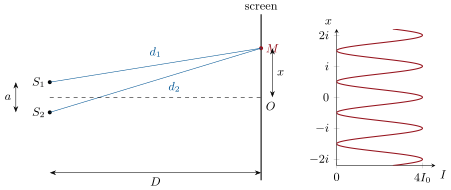
Remark 5.16 (Coherence)
Fresnel’s formula assumes a fixed phase difference. Two separate lamps have phases that jump at random billions of times per second; the average of is zero and the intensities simply add: no fringes. Interference needs coherent sources — in practice, two waves issued from one source, by two holes, two slits, a thin film’s two faces, or a beam splitter. Two loudspeakers driven by one generator are coherent; two singers are not.
5.4 Standing waves
Theorem 5.17 (Standing wave)
Two sinusoidal waves of the same amplitude and frequency travelling in opposite directions add up to
a standing wave: every point oscillates in phase (or in opposite phase) with an amplitude that depends on position — zero at the nodes , maximal at the antinodes ; nodes are apart. Nothing propagates: the variables and are separated.
Proof. with , . ∎
Proposition 5.18 (Modes of a string fixed at both ends)
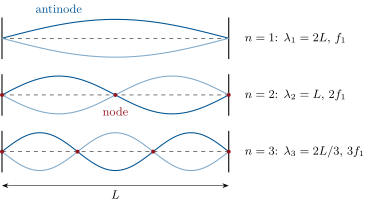
A string of length , celerity , fixed at and , can sustain a sinusoidal standing wave only if is a whole number of half-wavelengths:
These are its modes; is the fundamental, the its harmonics. Driven at one end at a frequency close to , the string resonates in the shape of mode (Melde’s experiment); plucked, it vibrates in a superposition of modes, and the ear hears as the pitch.
Proof. A fixed end is a node. The wave reflected at travels back and superposes with the incident one into a standing wave; for its node to fall at too, must be replaced by (shift the origin) and : , , and . ∎
Example 5.19 (A guitar string)
, tuned to : ; with the tension is — ten kilograms hanging from each string. A finger pressed at the twelfth fret halves and doubles : the octave. A finger merely touching the midpoint forces a node there and kills every odd mode: the string rings at , the “harmonic” of guitarists.
Remark 5.20 (Pipes, and a preview)
The air column of a flute, open at both ends, has pressure nodes at both ends and the same modes ; a pipe closed at one end has a node at the closed end and an antinode at the open one, so and only odd harmonics sound — the clarinet’s hollow timbre. Confining a wave between two walls thus quantizes its frequencies; when the wave is the matter wave of an electron in an atom, the same counting of half-wavelengths quantizes its energy (Chapter 30).
5.5 Exercises
Exercise 5.1 ★
Thunder arrives after the flash: how far is the strike? A sonar ping returns after in water (): how deep is the seabed?
Solution
Solution of Exercise 5.1.
. Round trip: depth .
Exercise 5.2 ★
A sound wave travels in air (). Compute its wavelength, the phase difference between two microphones apart along the direction of propagation, and the distances at which two points oscillate in phase.
Exercise 5.3 ★
A string has tension and mass per unit length : compute , and the wavelength of a wave on it.
Solution
Solution of Exercise 5.3.
; .
Exercise 5.4 ★
A fork and a string at : how many beats per second? What is the period of the envelope? The string is loosened, and the beats slow to : what is its frequency now (two answers in principle — which one, and how would you check)?
Solution
Solution of Exercise 5.4.
beats per second; envelope period . Loosening lowers the string: (reaching would have meant passing through silence at ); check by loosening a little more: the beats must vanish, then return.
Exercise 5.5 ★★
A string long, , is fixed at both ends. Give the first three mode frequencies and the node positions of the third mode. Where should the string be touched to make it sound at ?
Solution
Solution of Exercise 5.5.
; , . Third mode: nodes at , , , . Touch at (or ) from an end: a node there keeps only , and the string sounds at .
Exercise 5.6 ★★
Two loudspeakers apart emit in phase (). Locate the quiet spots on the segment joining them, and say what a listener hears who walks along the perpendicular bisector. What changes if one speaker is wired in opposite phase?
Solution
Solution of Exercise 5.6.
. On the segment, at distance from speaker 1, ; silence for : m, every ; the midpoint is loud. On the bisector : loud all along (only the decay). Opposite phase: loud and quiet swap — silence at the midpoint and every from it.
Exercise 5.7 ★★
Young’s holes: , , sodium light . Compute the fringe spacing; then for blue light at ; how many bright fringes fit in around the center with the sodium lamp?
Solution
Solution of Exercise 5.7.
; blue: . In : fringes at , , mm — five.
Exercise 5.8 ★★
Two coherent waves of intensities and interfere: give and . Same question for and . Define the contrast and compute it in both cases.
Solution
Solution of Exercise 5.8.
Equal: , , contrast . and : , ; contrast .
Exercise 5.9 ★★
A pipe long (). Give its first three resonance frequencies if it is closed at one end, then if it is open at both. Which is the clarinet, which the flute?
Solution
Solution of Exercise 5.9.
Closed–open: , , (odd harmonics only: the clarinet). Open–open: , , (the flute).
Exercise 5.10 ★★★
On deep water the phase velocity of a sinusoidal wave is . Compute it for and . A storm away raises both: which swell reaches the coast first, and by how long? Why does this make the sea “dispersive”?
Solution
Solution of Exercise 5.10.
and for . The long swell first: against , two days earlier. Speed depends on wavelength: a mixed sea sorts itself by wavelength as it travels — dispersion.
Exercise 5.11 ★★★
Show that touching a string lightly at a point from one end leaves only the modes of frequency , and that plucking a string at its midpoint excites no even mode. (Hint: what does a node, or a maximum displacement, at that point require of each mode’s ?)
Solution
Solution of Exercise 5.11.
Mode has shape . A node forced at requires , i.e. a multiple of : frequencies Plucking at gives the string a maximum displacement there, which mode can contribute to only if : even modes, which have a node at , receive nothing.
Exercise 5.12 ★★★
A radio receiver at distance in front of a metal wall gets the direct wave from a distant transmitter and the wave reflected by the wall, which travels farther and gains an extra phase of at the reflection. At , find the distances at which the signal vanishes and those at which it is strongest. How does this explain the “dead spots” of a car radio in a tunnel?
Solution
Solution of Exercise 5.12.
. Phase difference ; destructive when it equals : , m; constructive when : m. Tunnel walls and roof reflect the wave: a standing pattern with dead spots every half-wavelength along the car’s path.
5.6 Problem: Melde’s string and the guitar
Problem 5.1
Weekend problem — a vibrating string on a bench, a pulley and some weights, then a guitar: how the counting of half-wavelengths fixes every note on the fretboard
A string of mass per unit length is stretched horizontally with a tension between a small electromagnetic vibrator at (which shakes it transversally with a tiny amplitude at frequency ) and a fixed point at ; transverse waves on it travel at (derived in the Year 2 volume).
Part I — Waves on the string.
- Check by dimensional analysis that is a speed.
- The vibrator sends toward the wave . Why the sign ? Give in terms of and .
- For , and , compute , and .
- Two points of the string are apart. What is the phase difference between their motions for this travelling wave?
- For , what is the maximum transverse velocity of a point of the string? Compare with .
Part II — Reflection and standing wave. At the fixed end the wave is reflected with its sign reversed: .
- Why must the reflected wave have in its phase, and why is the amplitude reversed (think of what the total signal must be at )?
- Show that .
- Locate the nodes and antinodes; give the distance between two neighboring nodes.
- The vibrator’s own amplitude is so small that is practically a node. Deduce the condition on for a large standing wave (resonance), and the allowed frequencies .
- With and the data of question 3, how many half-wavelengths (“spindles”) appear? Is the string at resonance?
- Keeping and , what tensions give resonances with and with spindles?
- Conversely, one counts the spindles to measure : with , spindles at on , compute .
- The tension is set with a hanging mass over a pulley, , known to out of , and to . Which measurement limits , and what is its relative uncertainty?
Part III — The guitar. Six strings of vibrating length are tuned to (low E), , , , and (high E).
- Which mode does the ear take as the pitch? Express on each string from and the pitch, and compute it for both E strings.
- The low E string has , the high E : compute their tensions. Why are the bass strings wound with metal rather than simply pulled tighter?
- Western music divides the octave into twelve equal semitones: each fret multiplies the frequency by . Show that the -th fret must sit at a distance from the nut, and compute the positions of frets , , and .
- The fret spacing shrinks up the neck: by what factor from one fret to the next?
- A capo clamped at fret shortens every string: by what factor does it raise each pitch, and what is the new vibrating length?
- Touching (not pressing) the low E string above fret , then above fret (at ), gives two “harmonics”: which frequencies, and which modes survive?
- Plucking near the bridge sounds brighter than plucking over the sound hole. Explain with the mode shapes.
- Two strings are tuned a fifth apart (). Playing them together, a listener hears a faint beat at between the third harmonic of the lower string and the second harmonic of the upper: what is the actual ratio , if ?
Part IV — Tuning with a fork.
- The A string () is tuned against the fork. Which harmonic of the string beats against the fork? If one hears beats per second, what are the two possible string frequencies?
- Turning the peg raises the tension slightly and the beats quicken: which of the two was it, and by what relative amount must the tension change to reach the correct pitch?
- Show that a relative change of tension changes the frequency by .
- Summarize the chain of results: how the string’s length, tension and mass fix its fundamental, how frets fix the scale, and how beats tune it — and name the single relation behind all of it.
Solution
Solution of Problem 5.1.
1. : a squared speed.
2. A wave toward depends on , i.e. on ; .
3. ; ; .
4. .
5. , fifty times less than : the string’s points move slowly while the shape races along.
6. It travels toward : phase . At the fixed end the total displacement vanishes at all times: .
7. , so .
8. Nodes: , ; antinodes ; neighboring nodes apart.
9. : , i.e. .
10. : four spindles, an integer — resonance.
11. spindles: , , . spindles: , , .
12. , .
13. : ; the mass limits.
14. The fundamental. : low E ; high E .
15. : low E ; high E — comparable tensions. Lowering by a factor at fixed and would need times less tension: a floppy, buzzing string. Winding raises instead.
16. and : , distance from the nut : fret 1 , fret 5 , fret 7 , fret 12 .
17. Each spacing is times the previous one.
18. Factor (three semitones); length .
19. Touching at : even modes only, pitch ; at : multiples of , pitch .
20. Near an end, grows with : high modes are excited relatively more — bright. Over the sound hole (near the middle) even modes are weak and the fundamental dominates — mellow.
21. beats at with : or , ratio or (the equal-tempered fifth is ).
22. The fourth harmonic, . Three beats: or , or .
23. Beats quicken when tightening, so the string was sharp: . It must drop by , i.e. the tension by .
24. , so and .
25. : the length fixes , tension and mass fix , frets scale by , beats reveal . Behind all of it, one relation: , with the standing-wave condition .