Physics · Glossary

What is Universal gravitation?

Definition 16.3 University Physics — Year 1 · Chapter 16 — Central Forces: Planets and Satellites

A point mass MM at OO attracts a point mass mm at MM with

F=GMmr2er,Ep=GMmr(Ep0 at infinity),\vect F = -\frac{GMm}{r^2}\,\vect e_r, \qquad E_p = -\frac{GMm}{r} \quad (E_p \to 0 \text{ at infinity}),

G=6.67×10¹¹Nm2/kg2G = 6.67 \times 10^{-11}\,\mathrm{N}\,\mathrm{m}^{2}/\mathrm{kg}^{2}. A spherically symmetric body attracts outside itself as if its mass were at its center (admitted; a consequence of Gauss’s theorem, Chapter 26).
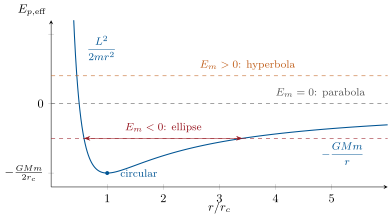

The effective potential of Newtonian gravitation: the attraction -GMm/r plus the centrifugal barrier L2/2mr2. Below zero energy the radial motion is trapped between two turning points (perigee, apogee); at the minimum the orbit is circular; at or above zero the body escapes.
The effective potential of Newtonian gravitation: the attraction GMm/r-GMm/r plus the centrifugal barrier L2/2mr2L^2/2mr^2. Below zero energy the radial motion is trapped between two turning points (perigee, apogee); at the minimum the orbit is circular; at or above zero the body escapes.
Read in context →