Thirty-one satellites circle the Earth twice a day, each one a clock and a radio, and a phone that hears four of them knows where it is to a few meters. Halley’s comet falls toward the Sun for thirty-eight years, swings round it in a few weeks, and climbs away again for thirty-eight more. A probe bound for Mars leaves Earth at exactly the speed that will make its path just kiss the orbit of Mars. All of this is the motion of a body attracted toward a fixed point by a force that falls as the inverse square of the distance, and all of it follows from two conserved quantities — energy and angular momentum — plus a single new idea, the effective potential. This chapter derives the orbits’ shapes and speeds, Kepler’s three laws, and the arithmetic of putting a satellite where one wants it.
16.1 Central conservative forces
Definition 16.1(Central force; central conservative force)
A force is central with center O if it is always directed along OM: F=F(M)er. It is central conservative if its magnitude depends only on r=OM: F=F(r)er, which derives from a potential energyEp(r) with F(r)=−dEp/dr.
Theorem 16.2(Motion under a central conservative force)
The radial motion is thus that of a one-dimensional particle in the effective potentialEp,eff: the radial turning points are the roots of Ep,eff(r)=Em, the motion is bound if it is trapped between two of them, and circular if r sits at a minimum of Ep,eff.
Proof. Part 1 is Corollary 15.5. The force is conservative and no other force acts, so Em is conserved; in the plane, v2=r˙2+r2θ˙2 and r2θ˙2=C2/r2. The term mC2/2r2, the kinetic energy of the angular motion, acts as a repulsive centrifugal barrier in the radial problem, to which the one-dimensional analysis of Chapter 13 applies. ∎
16.2 Newtonian gravitation
Definition 16.3(Universal gravitation)
A point mass M at O attracts a point mass m at M with
F=−r2GMmer,Ep=−rGMm(Ep→0 at infinity),
G=6.67×10⁻¹¹Nm2/kg2. A spherically symmetric body attracts outside itself as if its mass were at its center (admitted; a consequence of Gauss’s theorem, Chapter 26).
Proposition 16.4(The effective potential of gravitation)
For Ep=−GMm/r,
Ep,eff(r)=−rGMm+2mr2L2
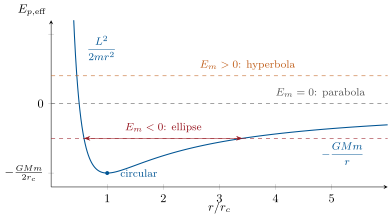
tends to +∞ at r→0 (for L=0), to 0− at infinity, and has one minimum at rc=L2/GMm2, of value −G2M2m3/2L2. Hence: Em<0 — bound motion between a minimum and a maximum radius (perigee and apogee); Em≥0 — unbound, the body comes from and returns to infinity; Em equal to the minimum — circular orbit of radius rc.
Proof. Limits by inspection; Ep,eff′=GMm/r2−L2/mr3=0 at rc; substitute. The circular case is r˙=0 forever, possible only at the minimum. ∎
The effective potential of Newtonian gravitation: the attraction −GMm/r plus the centrifugal barrierL2/2mr2. Below zero energy the radial motion is trapped between two turning points (perigee, apogee); at the minimum the orbit is circular; at or above zero the body escapes.
GM⊕=3.99×10¹⁴m3/s2. Low orbit (r=6770km, 400km up): v=7.7km/s, T=92min. Geostationary (T=86164s, one sidereal day): r=(GMT2/4π2)1/3=42200km, v=3.1km/s. The Moon (r=384000km): T=27.4d — and its centripetal accelerationv2/r=2.7×10−3m/s2 is g/3600 at sixty Earth radii: the inverse square, checked by Newton himself.
16.3 Kepler’s laws and the shape of orbits
Theorem 16.7(Trajectories in a Newtonian field)
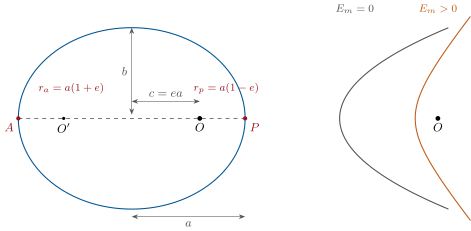
The trajectory of a body in the field of a fixed mass M is a conic with O at one focus: an ellipse if Em<0, a parabola if Em=0, a hyperbola if Em>0. For the ellipse of semi-major axis a and eccentricity e:
(Kepler I) the center of force is at a focus; perigee and apogee are at rp=a(1−e) and ra=a(1+e);
(Kepler II) the areal velocity is constant (the law of areas);
(Kepler III) the period obeys T2=4π2a3/GM;
the energy depends on a alone, Em=−GMm/2a, so that the speed at distance r is given by
v2=GM(r2−a1).
Proof.Admitted at this level.∎
Remark 16.8(What is proved and what is admitted)
Kepler II and the energy classification were proved above. That the bound orbits are exactly ellipses with O at a focus, with Kepler III and Em=−GMm/2a in general, needs the integration of the radial equation (the Year 2 volume does it); for circular orbits (a=r, e=0) every statement reduces to Theorem 16.5, which is the check we can make here. The relation v2=GM(2/r−1/a) follows from Em=21mv2−GMm/r=−GMm/2a once that energy formula is granted.
Left: an elliptical orbit about the focus O — semi-major axis a, semi-minor b, focal distance c=ea; the body is fastest at the perigee P and slowest at the apogee A. Right: a hyperbola (positive energy) and a parabola (zero energy) about the same focus — the unbound paths of comets and probes.
Example 16.9(Halley’s comet)
Perihelion 0.586AU, aphelion 35.1AU: a=17.8AU, e=0.967, T=17.83=75years (Kepler III in astronomical units and years, where T2=a3 for the Sun). With GM⊙=1.33×10²⁰m3/s2, the speed at perihelion is GM(2/rp−1/a)=54km/s and at aphelion 0.9km/s — sixty times slower, as the law of areas demands (rpvp=rava).
From the surface of a body of mass M and radius R, the minimum launch speed to reach infinity is ve=2GM/R=2vc, where vc=GM/R is the circular speed at ground level: 11.2km/s for the Earth. A geostationary satellite orbits in the equatorial plane with the Earth’s sidereal period, at r=42200km (35800km above ground).
Proof.Em≥0: 21mve2−GMm/R=0. Kepler III with T=86164s. ∎
Proposition 16.11(Hohmann transfer)
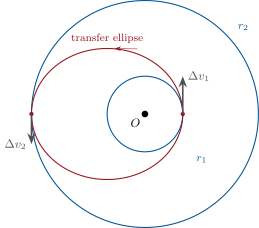
To move a satellite from a circular orbit of radius r1 to a coplanar circular orbit of radius r2>r1 with two brief burns, fire at r1 to enter the transfer ellipse of perigee r1 and apogee r2 (a=(r1+r2)/2), coast half a period, and fire again at r2 to circularize:
Proof. Speeds on the transfer ellipse from v2=GM(2/r−1/a) at r1 and r2; subtract the circular speeds; half the period of Theorem 16.7. ∎
A Hohmann transfer between two circular orbits: a first burn at the inner orbit raises the apogee to r2; half an ellipse later a second burn raises the perigee — the least-fuel two-burn route, and the one that takes a probe to Mars.
Example 16.12(Low orbit to geostationary)
r1=6770km, r2=42200km: Δv1=2.4km/s, Δv2=1.5km/s, coast 5.3h. The total, 3.9km/s, is half what the launch to low orbit already cost: the “last mile” to a high orbit is expensive, and satellites carry their own engine for it.
Remark 16.13(Repulsive centers)
For a repulsive inverse-square force (two like charges, Chapter 26) the effective potential has no well: every trajectory is a hyperbola, the particle approaches, is deflected and leaves. Aiming an α particle straight at a gold nucleus, its distance of closest approach follows from energy alone, Ek=2Ze2/4πε0rmin — Rutherford’s way of bounding the size of the nucleus (Exercise 16.11).
16.5 Exercises
Exercise 16.1★
The International Space Station orbits at 400km altitude (R⊕=6370km, GM⊕=3.99×10¹⁴m3/s2). Speed, period, number of sunrises its crew sees per day.
Solution
Solution of Exercise 16.1.
r=6770km: v=GM/r=7.7km/s; T=2πr/v=5.5×103s=92min; 1440/92≈16 sunrises a day.
Escape velocity from the Earth and from the Moon (GM=4.90×10¹²m3/s2, R=1740km). Why does the Moon keep no atmosphere?
Solution
Solution of Exercise 16.3.
ve=2GM/R: Earth 11.2km/s; Moon 2×4.90×1012/1.74×106=2.4km/s. Gas molecules at a few hundred meters per second have a tail of their speed distribution above 2.4km/s; over geological times the Moon’s gas leaked away.
Exercise 16.4★
Mars has a=1.524AU, Jupiter 5.20AU: their years, from Kepler’s third law. A body at 30AU (Neptune)?
Solution
Solution of Exercise 16.4.
T=a3/2 (years, AU): Mars 1.88yr; Jupiter 11.9yr; 30AU: 164yr.
Exercise 16.5★★
Energy needed to place 1000kg on the ISS orbit starting from rest at the surface (ignore the Earth’s rotation and the air). Compare with the chemical energy of gasoline (46MJ/kg).
Solution
Solution of Exercise 16.5.
ΔE=21mv2+GMm(1/R−1/r)=2.94×1010+3.99×1017×(1.570−1.477)×10−7=2.94×1010+0.37×1010=3.3×1010J — 33MJ/kg, the energy of 0.7kg of gasoline per kilogram placed in orbit (rockets need far more, having to lift their own fuel).
Exercise 16.6★★
Halley’s comet: perihelion 0.586AU, aphelion 35.1AU. Compute a, e, the period, and the speeds at perihelion and aphelion (GM⊙=1.33×10²⁰m3/s2, 1AU=1.496×10¹¹m).
Solution
Solution of Exercise 16.6.
a=(0.586+35.1)/2=17.8AU; e=(35.1−0.586)/35.7=0.967; T=17.83/2=75yr. vp2=GM(2/rp−1/a) with rp=8.77×10¹⁰ m, a=2.67×10¹² m: vp=54km/s; va=vprp/ra=0.91km/s.
a=24490km. v1=7.67km/s; on the ellipse at r1: GM(2/r1−1/a)=10.07km/s: Δv1=2.4km/s. At r2: GM(2/r2−1/a)=1.62km/s, circular 3.07km/s: Δv2=1.45km/s. Total 3.85km/s; duration πa3/GM=1.9×104s=5.3h.
Exercise 16.8★★
Show that the minimum of Ep,eff sits at rc=L2/GMm2, and that small radial oscillations about it have the angular frequencyGM/rc3 — the orbital frequency itself. What does this say about a slightly disturbed circular orbit?
Solution
Solution of Exercise 16.8.
Ep,eff′=GMm/r2−L2/mr3=0 at rc=L2/GMm2. Ep,eff′′=−2GMm/r3+3L2/mr4; at rc, L2=GMm2rc gives E′′=GMm/rc3, so ωr2=E′′/m=GM/rc3=ωorb2. A small radial disturbance oscillates exactly once per revolution: the orbit closes on itself — a slightly eccentric ellipse, not a rosette.
Exercise 16.9★★
Astronauts aboard the ISS float. Explain with the forces; what is the value of g at their altitude, and why does it not contradict the floating?
Solution
Solution of Exercise 16.9.
Only gravity acts on station and crew alike; both fall on the same orbit, so no contact force is needed between them — no floor pushes, hence “weightlessness”. g=GM/r2=3.99×1014/(6.77×106)2=8.7m/s2: gravity is almost full strength; weight is not absent, it is entirely spent bending the path.
Exercise 16.10★★★
Newton’s “Moon test”: compute the Moon’s centripetal acceleration from r=3.84×10⁸m and T=27.3d, and compare with g(R/r)2. Conclude.
Solution
Solution of Exercise 16.10.
a=4π2r/T2=39.5×3.84×108/(2.36×106)2=2.7×10−3m/s2; g(R/r)2=9.81/60.32=2.7×10−3m/s2: the same force law that drops an apple holds the Moon, diluted as 1/r2.
Exercise 16.11★★★
An α particle (q=2e, Ek=5.0MeV) is fired straight at a gold nucleus (Z=79), taken fixed. Using energy conservation with Ep=2Ze2/4πε0r (1/4πε0=8.99×109SI), find the distance of closest approach; compare with the nuclear radius, about 7fm. What energy would be needed to touch the nucleus?
Solution
Solution of Exercise 16.11.
Ek=2Ze2/4πε0rmin: rmin=8.99×109×2×79×(1.60×10−19)2/8.0×10−13=4.5×10−14m=45fm, six times the nuclear radius: the α turns back before touching. To reach 7fm: Ek≈32MeV.
Exercise 16.12★★★
A satellite in low orbit is slowed by the residual atmosphere, so its mechanical energy decreases. Show with Em=−GMm/2r and v=GM/r that it then moves faster. Where does the energy go, and what fraction of the lost potential energy becomes heat?
Solution
Solution of Exercise 16.12.
Em=−GMm/2r decreases ⇒r decreases ⇒v=GM/r increases. The kinetic energyGMm/2r rises by ∣ΔE∣ while the potential energy−GMm/r falls by 2∣ΔE∣: half of the potential energy released becomes kinetic, half is dissipated as heat by the drag.
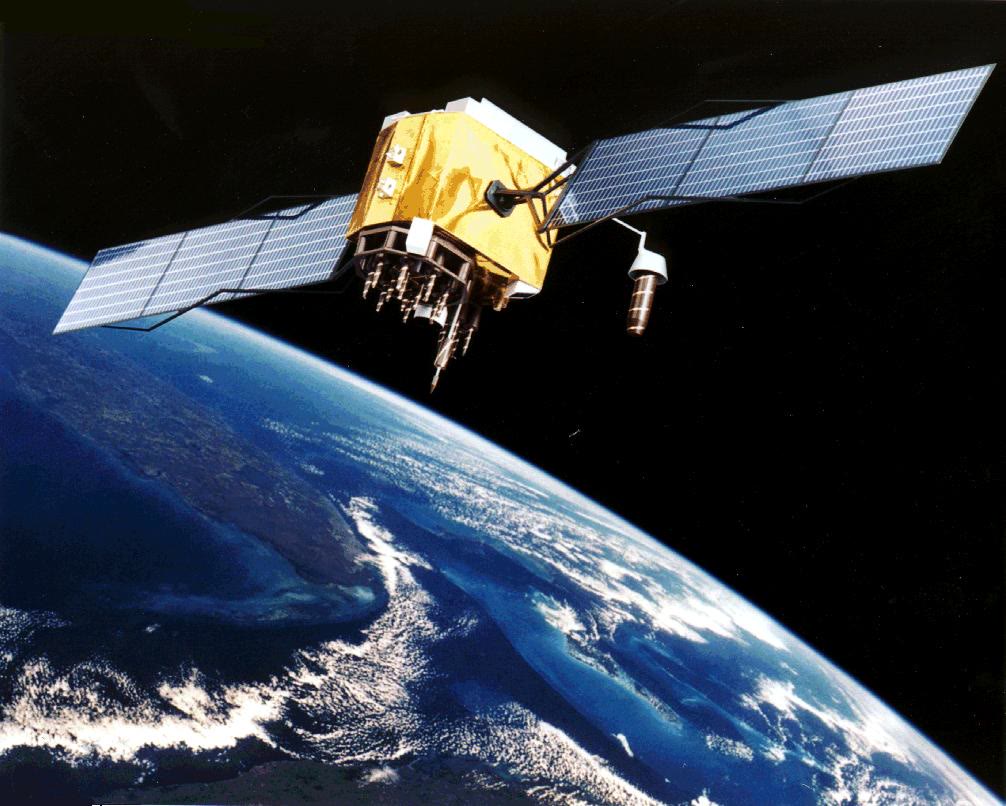
A GPS satellite (NASA artist’s view): one of the thirty-odd in the 20200km constellation of the weekend problem, each a clock in a Keplerian orbit.
16.6 Problem: The satellites that tell you where you are
Problem 16.1
Weekend problem — a navigation constellation twenty thousand kilometers up: its orbit, the fuel to get there, how many satellites a phone can see, and why their clocks must be told to run slow
Data: GM⊕=3.986×10¹⁴m3/s2, R⊕=6371km, sidereal day 86164s, c=2.998×10⁸m/s. The satellites circle the Earth in exactly half a sidereal day on circular orbits.
Compute the satellite’s acceleration and compare it with g at the surface.
Compute the mechanical energy per kilogram, and the kinetic and potential parts.
Why choose half a sidereal day rather than half a solar day? What does a ground observer see repeat?
Seen from a satellite, what angle does the Earth’s disk subtend?
Compare the orbit’s radius with the geostationary one; which is higher, and by what factor?
Part II — Getting there.
Energy per kilogram to go from rest at the surface to the final orbit (ignore the air and the Earth’s spin).
The launcher first reaches a low circular orbit at 400km. Speed there?
Hohmann transfer from that orbit to the final one: the two burns and their sum.
Duration of the transfer.
Compare the sum of the burns with the escape velocity from low orbit: how far from “leaving the Earth” is this mission?
The upper stage and satellite mass 2000kg before the transfer; the engine’s exhaust speed is 3.0km/s and the rocket equation gives Δv=uln(m0/m1). Propellant needed for the two burns?
Part III — Coverage and timing.
A satellite is visible from every point of the Earth that lies within the cone of half-angle θ with cosθ=R/r about the Earth–satellite line. Compute θ and the fraction (1−cosθ)/2 of the Earth’s surface it covers.
With 24 satellites spread uniformly, how many are visible on average from one point? Is the minimum of 4 needed for a fix plausible?
Light travel time from a satellite at the zenith; at the horizon.
To locate the receiver to 3m, to what precision must the signals be timed?
The receiver’s own clock is a cheap quartz, wrong by milliseconds: why are four satellites needed instead of three?
The satellites’ clocks are atomic. Give the relative stability needed for a 3m error after one day.
Part IV — Relativity, briefly. Two effects shift the satellite clocks relative to ground clocks (formulas admitted, from the Year 3 volume): motion slows a clock by the fraction v2/2c2; height speeds it up by GM(1/R−1/r)/c2.
Compute the slowing due to speed, in microseconds per day.
Compute the speeding-up due to altitude, in microseconds per day.
Net effect, and the position error it would cause per day if uncorrected.
The satellite clocks are set before launch to 10.22999999543MHz instead of 10.23MHz. Check that this compensates the net effect.
The orbits are not exactly Keplerian: name three perturbations and say how the system copes.
Summarize the chain: two conservation laws, one orbit, one constellation, and the one correction nobody would have guessed.
5. The Earth turns once per sidereal day relative to the stars (the frame of the orbit); after two orbits the satellite is back over the same ground point: the ground tracks repeat every sidereal day.
6.sinβ=R/r=0.240: β=13.9∘, a disk 28∘ wide.
7. Geostationary 42200km: 1.59 times higher; the navigation orbit is below it.
10.a=16665km; at r1: GM(2/r1−1/a)=9.69km/s, Δv1=2.0km/s; at r2: 2.47km/s against circular 3.87km/s, Δv2=1.4km/s; total 3.4km/s.
11.πa3/GM=1.07×104s≈3.0h.
12. Escape from low orbit: (2−1)×7.67=3.2km/s: the mission’s 3.4km/s exceeds it — reaching this orbit costs about as much as leaving the Earth altogether.
13.m0/m1=e3.4/3.0=3.1: m1=640kg, propellant 1360kg — two thirds of the mass.
14.cosθ=0.240, θ=76∘; fraction (1−0.240)/2=0.38.
15.24×0.38=9 on average; four is comfortably exceeded almost always.
18. The receiver’s clock offset is a fourth unknown besides its three coordinates: four distances, four equations.
19.10−8s/86400s≈1×10−13.
20.v2/2c2=(3874)2/(2×8.99×1016)=8.3×10−11: 8.3×10−11×86400=7.2µs per day, slow.
21.GM(1/R−1/r)/c2=3.986×1014×1.19×10−7/8.99×1016=5.3×10−10: 45.7µs per day, fast.
22. Net +38.5µs per day; c×38.5×10−6=11.5km of error per day.
23.(10.23−10.22999999543)/10.23=4.47×10−10, matching the net 4.5×10⁻¹⁰ (38.5µs over 86400s).
24. The Earth’s equatorial bulge, the Moon’s and Sun’s attraction, solar radiation pressure (and small thruster firings): the ground segment measures the orbits continuously and uploads fresh ephemerides, which the satellites broadcast.
25. Energy and angular momentum fix a circular orbit from its period; Kepler III places it; geometry fixes coverage and light times; and the clocks — the heart of the system — must be corrected for relativity by 38µs a day, or the fix drifts by ten kilometers by nightfall.