 Coach
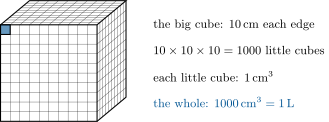
CoachThe volume of a thing is the amount of room it takes up. Solids, liquids and gases all have volume: the brick takes its room, the lemonade takes the bottle’s inside, the air takes the rest. Volume is measured in cubic centimetres () — the room of a little cube one centimetre along each edge — and in litres ().
Examples
Example 38.3 (Volumes to know by heart)
A teaspoon holds about ; a drinking glass about , a quarter litre; the milk carton, ; a bathtub, around ; a sugar cube takes about ; a die about . Anchors like these make the judging step of every measurement possible.
Example 38.7 (The crown in the bathtub)
The old story: a king suspected his goldsmith had thinned the royal crown’s gold with silver, and asked the scientist Archimedes to find out without harming the crown. Stepping into a full bath, Archimedes watched the water slosh over the rim — and saw in a flash that the overflow measured his own body’s volume, lumps and all. Legend says he ran through the streets shouting “Eureka!” — I have found it! How the crown’s volume unmasked the fraud needs one more idea, two chapters ahead; the bathtub gave him the volume of anything.
Example 38.8 (Same volume, different mass)
Fill two identical glasses, one with water, one with honey, and weigh them (subtracting the glasses): the honey glass holds noticeably more grams in the very same room. Same volume, different mass. And a litre of air weighs hardly more than a gram, in the room where a litre of water weighs a full kilogram. Room and stuff are truly different bookkeepers — hold that thought firmly: it becomes a law, with a name, in the last chapter of this year.