Primary & Middle School Physics · Grades 1–9
38Mass and Volume
How much lemonade fits in the bottle, and how heavy is the crate of bottles? Two different questions — room and stuff — that everyday talk cheerfully tangles into one word, “big”. Science untangles them: volume for the room a thing takes, mass for the stuff it holds. Measuring the second, you are an old hand; today we learn to measure the first — even for a pebble with no shape a ruler could love.
38.1 Volume: the room a thing takes
Definition 38.1 (Volume)
The volume of a thing is the amount of room it takes up. Solids, liquids and gases all have volume: the brick takes its room, the lemonade takes the bottle’s inside, the air takes the rest. Volume is measured in cubic centimetres () — the room of a little cube one centimetre along each edge — and in litres ().
Proposition 38.2 (The litre in cubes)
The two families of volume units are one family:
A litre is exactly the room inside a cube ten centimetres along each edge: little cubes.
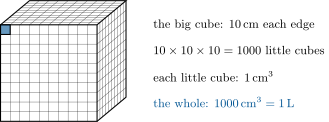
Example 38.3 (Volumes to know by heart)
A teaspoon holds about ; a drinking glass about , a quarter litre; the milk carton, ; a bathtub, around ; a sugar cube takes about ; a die about . Anchors like these make the judging step of every measurement possible.
38.2 Measuring liquids
Method 38.4 (Reading a measuring cylinder)
The laboratory’s jug is the measuring cylinder: tall, narrow, finely graduated.
- set the cylinder on a flat table — never read it in your hand;
- find the graduation value, as with every scale;
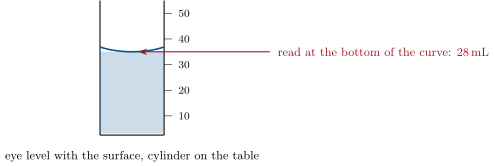
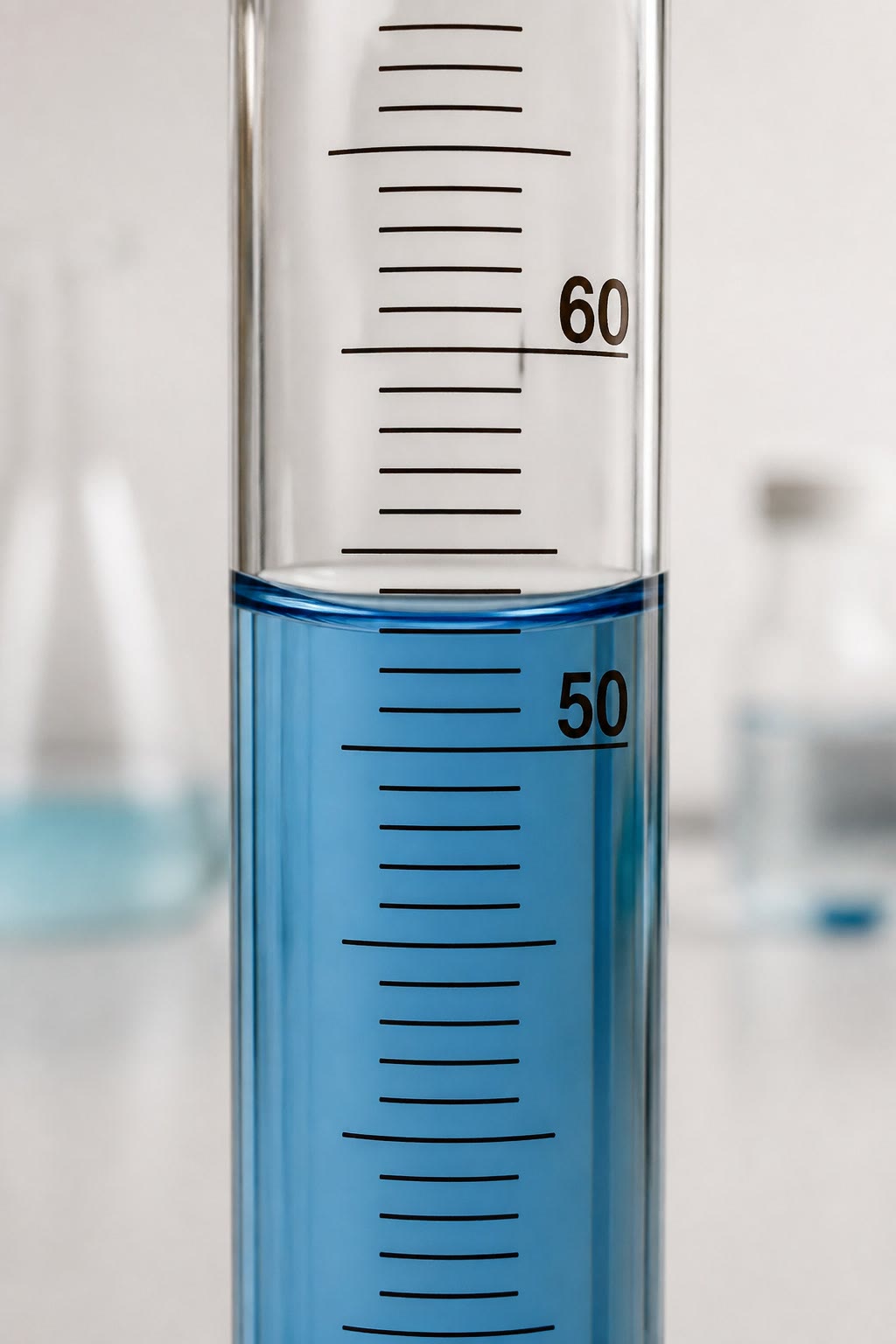
- bring your eye level with the liquid’s surface: the surface is not flat but slightly curved — a meniscus — climbing a little up the glass walls;
- read at the bottom of the curve, straight across.
Eye too high or too low, and the curve lies to you by a step or two — the slanted-view mistake in its favorite disguise.
38.3 Measuring solids — even lumpy ones
A brick-shaped solid surrenders to the ruler: length times width times height gives its volume in , as your mathematics course showed. But what of a pebble, a key, a plum? No ruler fits a lump. The answer is two thousand years old, and it came out of a bathtub.
Proposition 38.5 (Displacement)
A solid lowered completely underwater pushes aside — displaces — exactly its own volume of water. The water level’s rise measures the intruder: lumpy or smooth, the water molds itself to every dent and bump.
Method 38.6 (Volume by the rise of water)
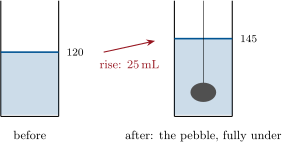
- pour water into a measuring cylinder — enough to cover the object — and read the volume: say ;
- tie a thread to the object and lower it gently until fully underwater, no splash, no touching the walls;
- read again: say ;
- subtract: — the object’s volume is (millilitres of rise, centimetre-cubes of stone: the same thing).
Example 38.7 (The crown in the bathtub)
The old story: a king suspected his goldsmith had thinned the royal crown’s gold with silver, and asked the scientist Archimedes to find out without harming the crown. Stepping into a full bath, Archimedes watched the water slosh over the rim — and saw in a flash that the overflow measured his own body’s volume, lumps and all. Legend says he ran through the streets shouting “Eureka!” — I have found it! How the crown’s volume unmasked the fraud needs one more idea, two chapters ahead; the bathtub gave him the volume of anything.
38.4 Mass and volume are different answers
Example 38.8 (Same volume, different mass)
Fill two identical glasses, one with water, one with honey, and weigh them (subtracting the glasses): the honey glass holds noticeably more grams in the very same room. Same volume, different mass. And a litre of air weighs hardly more than a gram, in the room where a litre of water weighs a full kilogram. Room and stuff are truly different bookkeepers — hold that thought firmly: it becomes a law, with a name, in the last chapter of this year.
Remark 38.9 (Weighing what cannot stand alone)
How to weigh flour without weighing its bowl? Modern balances have a button for it: set the empty bowl on the pan, press — the display resets to zero — then pour: the balance now reports the flour alone. The maneuver is called taring. Without the button, weigh twice and subtract: bowl-with-flour minus empty bowl. Either way, it is the fair-start rule again: begin from an honest zero.
38.5 Exercises
Exercise 38.1 ★
What question does volume answer, and what question does mass answer? Give the two chief units of each.
Exercise 38.2 ★
Convert: to ; to ; to litres; half a litre to millilitres.
Solution
Solution of Exercise 38.2.
; ; ; .
Exercise 38.3 ★
Why must a measuring cylinder be read at eye level, on the table, at the bottom of the meniscus? Name the mistake each rule prevents.
Exercise 38.4 ★
A cylinder reads ; with a plum lowered in, it reads . What is the plum’s volume, in ?
Exercise 38.5 ★
Why does the rise method work even for a lumpy pebble, when no ruler could measure it? Which proposition answers?
Solution
Solution of Exercise 38.5.
The water molds itself to every dent and bump, so the pushed-aside water equals the pebble’s volume exactly — the displacement proposition. The ruler needs straight edges; the water needs none.
Exercise 38.6 ★
A brick-shaped eraser measures by by . Its volume? Check-plan: how would you confirm it with the rise method?
Solution
Solution of Exercise 38.6.
. Check: lower it into a cylinder — the reading should rise by exactly .
Exercise 38.7 ★
To weigh rice: empty bowl ; bowl with rice . How much rice? What button does the same job in one step?
Solution
Solution of Exercise 38.7.
of rice. The tare button: zero the balance with the empty bowl on it, then pour.
Exercise 38.8 ★
Which has the greater volume, a kilogram of feathers or a kilogram of iron? Which has the greater mass? (Answer both carefully.)
Exercise 38.9 ★★
The rise method fails for a cork: it floats. Propose a fix that still uses the cylinder — and say what must be subtracted if your fix uses a helper object.
Exercise 38.10 ★★
A juice carton claims . Poured out, it fills a glass three times, and the fourth glass only up to the mark. Was the claim honest? By how much?
Solution
Solution of Exercise 38.10.
Poured out: . The claim missed by — a twentieth of a litre short.
Exercise 38.11 ★★
A necklace is lowered into a cylinder reading ; it rises to . The jeweler claims the necklace contains of gold. Could the claim be true? What, exactly, did the water measure?
Exercise 38.12 ★★★
Design a bathtub-style check of Proposition 38.5 itself, using a brick-shaped object whose volume the ruler already knows. Describe the steps, predict the two cylinder readings for a centimetre block lowered into , and state what result would prove the proposition wrong.
Solution
Solution of Exercise 38.12.
The ruler promises . Lower the block (thread, no splash, fully under, not touching the walls) into : the prediction is a rise from to . If the water rose by anything other than — outside the cylinder’s honest step or two — the displacement proposition would stand refuted. (It never has been.)
38.6 Problem: Bottling Day at the Orchard
Problem 38.1
Weekend problem — pressing day at the orchard; litres into bottles, crates onto scales; the pebble in the jug
The orchard presses its apples today, and every helper gets a measuring job.
Part I — Juice by the litre. The press has filled a barrel.
- How many cubic centimetres is ?
- The juice is bottled in bottles. How many full bottles does the barrel give?
- How much juice is left over after the last full bottle, in centilitres?
- The leftover is poured into glasses of . How many glasses does it fill?
Part II — Crates on the scale.
- An empty bottle has mass . Using Part I, what is the mass of the juice in one full bottle, if a litre of juice has a mass of about ? (Work in grams.)
- So what does one full bottle weigh altogether?
- A wooden crate weighs empty and carries six full bottles. Total mass of a loaded crate?
- The van may carry of crates. How many loaded crates may it take? (Whole crates only.)
Part III — The pebble in the jug. Little Tom drops a pebble into a full jug of juice, and juice overflows onto the table.
- The mopped-up overflow measures . What did the spill measure about the pebble, and by which proposition?
- After the pebble is fished out, how much juice remains in the jug?
- Tom protests: “The pebble is small — look, it hides in my fist!” His sister answers with a measuring cylinder: she puts the pebble in of water. What reading proves the spill told the truth?
- Bonus bookkeeping: the pebble weighs on the kitchen scale. Without any new idea, can you yet say whether pebble-stuff is heavier or lighter than juice-stuff for the same room taken? Compare of pebble in with what mass of juice would fill those same — and keep your conclusion warm for the density chapter.
Solution
Solution of Problem 38.1.
1. . 2. ; full bottles (with remainder). 3. , so remain. 4. glasses, exactly. 5. , and a litre weighs about : the juice is about . 6. — . 7. of bottles plus of crate: . 8. : crates would be , would be — too much. The van takes crates. 9. The spill is the juice the pebble displaced: the pebble’s volume is , by the displacement proposition. 10. of juice remain. 11. The cylinder should climb from to — a rise, matching the spill. Fists measure nothing; water tells the truth. 12. Those , filled with juice, would hold about of juice — the pebble packs into the same room: pebble-stuff is heavier than juice-stuff for equal room, more than twice over. The density chapter will give this comparison its proper name and number.