সব বই

পেশাদার

1 Markets I: The Ecosystem and Exchange-Traded Marketsবাজার অনলাইনইংরেজি 2 Markets II: Rates, FX and Creditবাজার অনলাইনইংরেজি 3 Markets III: Commodities, Energy and Cryptoবাজার অনলাইনইংরেজি 4 Quantitative Methodsপদ্ধতি অনলাইনইংরেজি 5 Derivatives and Volatilityডেরিভেটিভস অনলাইনইংরেজি 6 Rates, Credit, XVA and Riskসুদহার, ঋণ ও ঝুঁকি অনলাইনইংরেজি 7 Research Craft: Predictors, Backtests, Measurement, Portfoliosগবেষণা অনলাইনইংরেজি 8 Strategies I: Equities and Futuresকৌশল অনলাইনইংরেজি 9 Strategies II: Volatility, Relative Value, Macro and the Bank Desksকৌশল অনলাইনইংরেজি 10 Microstructure and Executionএক্সিকিউশন অনলাইনইংরেজি 11 Market Making and High-Frequency Tradingমার্কেট মেকিং অনলাইনইংরেজি 12 Machine Learning for Marketsমেশিন লার্নিং অনলাইনইংরেজি 13 Low-Latency Softwareপ্রযুক্তি অনলাইনইংরেজি 14 Networks, Hardware and Trading Infrastructureপ্রযুক্তি অনলাইনইংরেজি 15 Research, Data and Risk Platformsপ্রযুক্তি অনলাইনইংরেজি 16 The Desk and the Firmপ্রতিষ্ঠান অনলাইনইংরেজি 17 The Industry: Firms, Roles and Careersক্যারিয়ার অনলাইনইংরেজি 18 Interviews I: Maths, Probability and Speedক্যারিয়ার অনলাইনইংরেজি 19 Interviews II: Markets, Trading Games and the Final Roundক্যারিয়ার অনলাইনইংরেজি 20 Interviews III: Codeক্যারিয়ার অনলাইনইংরেজি
অ্যাপ পরিচিতি Coach সাইন ইন পড়া শুরু করো

বইগুলো এখনো বাংলা ভাষায় পাওয়া যায় না — Français সংস্করণ দেখানো হচ্ছে।

Physique · পরিভাষা

Gradient, divergence, rotationnel, laplacien কী?

Définition 11.1 Physique universitaire — 2e année · অধ্যায় 11 — Les équations de Maxwell

Pour un champ scalaire ff et un champ de vecteurs A→\vect A, en coordonnées cartésiennes avec le vecteur symbolique ∇→=(∂x,∂y,∂z)\vect\nabla = (\partial_x, \partial_y, \partial_z) :

grad→⁡f=∇→f=(∂xf, ∂yf, ∂zf),div⁡A→=∇→⋅A→=∂xAx+∂yAy+∂zAz,curl→⁡A→=∇→∧A→=(∂yAz−∂zAy, ∂zAx−∂xAz, ∂xAy−∂yAx),Δf=div⁡grad→⁡f=∂x2f+∂y2f+∂z2f,\begin{align*} \operatorname{\vect{grad}}f &= \vect\nabla f = (\partial_xf,\ \partial_yf,\ \partial_zf) ,\\ \operatorname{div}\vect A &= \vect\nabla\cdot\vect A = \partial_xA_x + \partial_yA_y + \partial_zA_z ,\\ \operatorname{\vect{curl}}\vect A &= \vect\nabla\wedge\vect A = (\partial_yA_z - \partial_zA_y,\ \partial_zA_x - \partial_xA_z,\ \partial_xA_y - \partial_yA_x) ,\\ \Delta f &= \operatorname{div}\operatorname{\vect{grad}}f = \partial_x^2f + \partial_y^2f + \partial_z^2f , \end{align*}

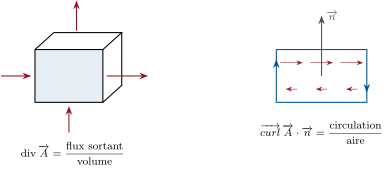
et ΔA→\Delta\vect A est le laplacien pris sur chaque composante cartésienne. Leur sens ne dépend pas des coordonnées : grad→⁡f⋅ ⁣dl→= ⁣df\operatorname{\vect{grad}}f \cdot\dd\vect l = \dd f est la variation de ff selon  ⁣dl→\dd\vect l ; div⁡A→\operatorname{div} \vect A est le flux sortant de A→\vect A à travers la surface d’un petit volume, par unité de volume ; curl→⁡A→⋅n→\operatorname{\vect{curl}}\vect A\cdot\vect n est la circulation de A→\vect A autour d’un petit contour de normale n→\vect n, par unité d’aire.

Les deux opérateurs des équations de Maxwell, lus géométriquement : la divergence mesure combien un champ sort d’un petit volume, le rotationnel combien il circule autour d’un petit contour.

প্রসঙ্গসহ পড়ো →