সব বই

পেশাদার

1 Markets I: The Ecosystem and Exchange-Traded Marketsবাজার অনলাইনইংরেজি 2 Markets II: Rates, FX and Creditবাজার অনলাইনইংরেজি 3 Markets III: Commodities, Energy and Cryptoবাজার অনলাইনইংরেজি 4 Quantitative Methodsপদ্ধতি অনলাইনইংরেজি 5 Derivatives and Volatilityডেরিভেটিভস অনলাইনইংরেজি 6 Rates, Credit, XVA and Riskসুদহার, ঋণ ও ঝুঁকি অনলাইনইংরেজি 7 Research Craft: Predictors, Backtests, Measurement, Portfoliosগবেষণা অনলাইনইংরেজি 8 Strategies I: Equities and Futuresকৌশল অনলাইনইংরেজি 9 Strategies II: Volatility, Relative Value, Macro and the Bank Desksকৌশল অনলাইনইংরেজি 10 Microstructure and Executionএক্সিকিউশন অনলাইনইংরেজি 11 Market Making and High-Frequency Tradingমার্কেট মেকিং অনলাইনইংরেজি 12 Machine Learning for Marketsমেশিন লার্নিং অনলাইনইংরেজি 13 Low-Latency Softwareপ্রযুক্তি অনলাইনইংরেজি 14 Networks, Hardware and Trading Infrastructureপ্রযুক্তি অনলাইনইংরেজি 15 Research, Data and Risk Platformsপ্রযুক্তি অনলাইনইংরেজি 16 The Desk and the Firmপ্রতিষ্ঠান অনলাইনইংরেজি 17 The Industry: Firms, Roles and Careersক্যারিয়ার অনলাইনইংরেজি 18 Interviews I: Maths, Probability and Speedক্যারিয়ার অনলাইনইংরেজি 19 Interviews II: Markets, Trading Games and the Final Roundক্যারিয়ার অনলাইনইংরেজি 20 Interviews III: Codeক্যারিয়ার অনলাইনইংরেজি
অ্যাপ পরিচিতি Coach সাইন ইন পড়া শুরু করো

বইগুলো এখনো বাংলা ভাষায় পাওয়া যায় না — Français সংস্করণ দেখানো হচ্ছে।

Physique · পরিভাষা

Unités de base du SI কী?

অন্য নাম: unité dérivée

Définition 1.2 Physique universitaire — 1re année · অধ্যায় 1 — Unités, dimensions et mesure

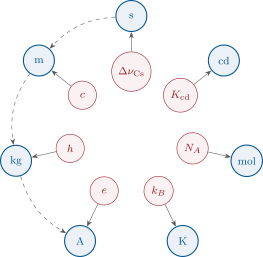
Le Système international d’unités (SI) repose sur sept unités de base : la seconde (s\mathrm{s}), le mètre (m\mathrm{m}), le kilogramme (kg\mathrm{kg}), l’ampère (A\mathrm{A}), le kelvin (K\mathrm{K}), la mole (mol\mathrm{mol}) et la candela (cd\mathrm{cd}). Depuis 2019, chacune est définie en fixant la valeur numérique d’une constante de la nature : la fréquence hyperfine du césium ΔνCs=9 192 631 770 Hz\Delta\nu_{\mathrm{Cs}} = 9\,192\,631\,770\,\mathrm{Hz} définit la seconde ; la vitesse de la lumière c=299 792 458 m/sc = 299\,792\,458\,\mathrm{m}/\mathrm{s} définit alors le mètre ; la constante de Planck h=6.626 070 15×10−34 J sh = 6.626\,070\,15 \times 10^{-34}\,\mathrm{J}\,\mathrm{s} définit le kilogramme ; la charge élémentaire e=1.602 176 634×10−19 Ce = 1.602\,176\,634 \times 10^{-19}\,\mathrm{C} l’ampère ; la constante de Boltzmann kB=1.380 649×10−23 J/Kk_B = 1.380\,649 \times 10^{-23}\,\mathrm{J}/\mathrm{K} le kelvin ; la constante d’Avogadro NA=6.022 140 76×1023 mol−1N_A = 6.022\,140\,76 \times 10^{23}\,\mathrm{mol}^{-1} la mole ; et une efficacité lumineuse fixée KcdK_{\mathrm{cd}} la candela. Toute autre unité est une unité dérivée, produit de puissances d’unités de base : 1 N=1 kg m/s21\,\mathrm{N} = 1\,\mathrm{kg}\,\mathrm{m}/\mathrm{s}^{2}, 1 J=1 N m1\,\mathrm{J} = 1\,\mathrm{N}\,\mathrm{m}, 1 W=1 J/s1\,\mathrm{W} = 1\,\mathrm{J}/\mathrm{s}, 1 V=1 W/A1\,\mathrm{V} = 1\,\mathrm{W}/\mathrm{A}, 1 Pa=1 N/m21\,\mathrm{Pa} = 1\,\mathrm{N}/\mathrm{m}^{2}.

Les sept unités de base (anneau extérieur) et les sept constantes qui les définissent (anneau intérieur). Une constante fixée ne définit son unité qu’avec des unités déjà définies (en pointillés) : c convertit les secondes en mètres, h a besoin du mètre et de la seconde pour définir le kilogramme, e a besoin de la seconde pour définir l’ampère.
Les sept unités de base (anneau extérieur) et les sept constantes qui les définissent (anneau intérieur). Une constante fixée ne définit son unité qu’avec des unités déjà définies (en pointillés) : cc convertit les secondes en mètres, hh a besoin du mètre et de la seconde pour définir le kilogramme, ee a besoin de la seconde pour définir l’ampère.

উদাহরণ

Exemple 1.4 (Décomposer une unité dérivée)

Le volt : V=W/A=J/(A s)=kg m2/(A s3)\mathrm{V} = \mathrm{W}/\mathrm{A} = \mathrm{J}/(\mathrm{A}\,\mathrm{s}) = \mathrm{kg}\,\mathrm{m}^{2}/(\mathrm{A}\,\mathrm{s}^{3}). L’ohm : Ω=V/A=kg m2/(A2 s3)\Omega = \mathrm{V}/\mathrm{A} = \mathrm{kg}\,\mathrm{m}^{2}/(\mathrm{A}^{2}\,\mathrm{s}^{3}). Le farad : F=C/V=A s/V=A2 s4/(kg m2)\mathrm{F} = \mathrm{C}/\mathrm{V} = \mathrm{A}\,\mathrm{s}/\mathrm{V} = \mathrm{A}^{2}\,\mathrm{s}^{4}/(\mathrm{kg}\,\mathrm{m}^{2}). Cette décomposition est la vérification la plus sûre qu’une formule a été correctement retenue — la section suivante la rend systématique.

প্রসঙ্গসহ পড়ো →