সব বই

পেশাদার

1 Markets I: The Ecosystem and Exchange-Traded Marketsবাজার অনলাইনইংরেজি 2 Markets II: Rates, FX and Creditবাজার অনলাইনইংরেজি 3 Markets III: Commodities, Energy and Cryptoবাজার অনলাইনইংরেজি 4 Quantitative Methodsপদ্ধতি অনলাইনইংরেজি 5 Derivatives and Volatilityডেরিভেটিভস অনলাইনইংরেজি 6 Rates, Credit, XVA and Riskসুদহার, ঋণ ও ঝুঁকি অনলাইনইংরেজি 7 Research Craft: Predictors, Backtests, Measurement, Portfoliosগবেষণা অনলাইনইংরেজি 8 Strategies I: Equities and Futuresকৌশল অনলাইনইংরেজি 9 Strategies II: Volatility, Relative Value, Macro and the Bank Desksকৌশল অনলাইনইংরেজি 10 Microstructure and Executionএক্সিকিউশন অনলাইনইংরেজি 11 Market Making and High-Frequency Tradingমার্কেট মেকিং অনলাইনইংরেজি 12 Machine Learning for Marketsমেশিন লার্নিং অনলাইনইংরেজি 13 Low-Latency Softwareপ্রযুক্তি অনলাইনইংরেজি 14 Networks, Hardware and Trading Infrastructureপ্রযুক্তি অনলাইনইংরেজি 15 Research, Data and Risk Platformsপ্রযুক্তি অনলাইনইংরেজি 16 The Desk and the Firmপ্রতিষ্ঠান অনলাইনইংরেজি 17 The Industry: Firms, Roles and Careersক্যারিয়ার অনলাইনইংরেজি 18 Interviews I: Maths, Probability and Speedক্যারিয়ার অনলাইনইংরেজি 19 Interviews II: Markets, Trading Games and the Final Roundক্যারিয়ার অনলাইনইংরেজি 20 Interviews III: Codeক্যারিয়ার অনলাইনইংরেজি
অ্যাপ পরিচিতি Coach সাইন ইন পড়া শুরু করো

বইগুলো এখনো বাংলা ভাষায় পাওয়া যায় না — Nederlands সংস্করণ দেখানো হচ্ছে।

Scheikunde · পরিভাষা

Evenwichtstoestand, kwantitatieve reactie কী?

অন্য নাম: evenwichtstoestand · kwantitatieve reactie

Definitie 7.21 Universitaire scheikunde — jaar 1 · অধ্যায় 7 — Een chemisch systeem beschrijven: voortgang, activiteiten, Q en K

De eindtoestand is een evenwichtstoestand wanneer alle deeltjes van de reactie aanwezig zijn en Q=K∘Q = K^\circ. De reactie is kwantitatief (of aflopend) wanneer de beperkende beginstof in de eindtoestand praktisch verdwenen is, ξf≈ξmax⁡\xi_f \approx \xi_{\max}; dat gebeurt wanneer K∘K^\circ zeer groot is.

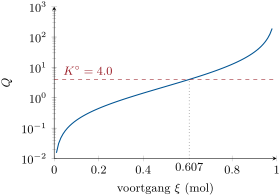
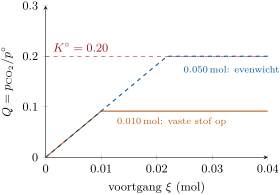
Links: het quotiënt van CO + H2O <=> CO2 + H2 stijgt met de voortgang en bereikt K één keer (weekendprobleem). Rechts: voor CaCO3(s) <=> CaO(s) + CO2(g) in een gesloten vat van 10\, L groeit Q = p_ CO2/p met ; met 0.050\, mol carbonaat bereikt het K = 0.20 (evenwicht), met 0.010\, mol is het carbonaat eerst op en is de eindtoestand geen evenwicht. Links: het quotiënt van CO + H2O <=> CO2 + H2 stijgt met de voortgang en bereikt K één keer (weekendprobleem). Rechts: voor CaCO3(s) <=> CaO(s) + CO2(g) in een gesloten vat van 10\, L groeit Q = p_ CO2/p met ; met 0.050\, mol carbonaat bereikt het K = 0.20 (evenwicht), met 0.010\, mol is het carbonaat eerst op en is de eindtoestand geen evenwicht.
Links: het quotiënt van CO+HX2O⇌COX2+HX2\ce{CO + H2O <=> CO2 + H2} stijgt met de voortgang en bereikt K∘K^\circ één keer (weekendprobleem). Rechts: voor CaCOX3(s)⇌CaO(s)+COX2(g)\ce{CaCO3(s) <=> CaO(s) + CO2(g)} in een gesloten vat van 10 L10\,\mathrm{L} groeit Q=pCOX2/p∘Q = p_{\ce{CO2}}/p^\circ met ξ\xi; met 0.050 mol0.050\,\mathrm{mol} carbonaat bereikt het K∘=0.20K^\circ = 0.20 (evenwicht), met 0.010 mol0.010\,\mathrm{mol} is het carbonaat eerst op en is de eindtoestand geen evenwicht.

উদাহরণ

Voorbeeld 7.24 (Een kwantitatieve reactie)

Voor A+B⇌C+D\mathrm{A + B \rightleftharpoons C + D} in oplossing met [A]0=[B]0=0.10 mol/L[\ce{A}]_0 = [\ce{B}]_0 = 0.10\,\mathrm{mol}/\mathrm{L} en K∘=106K^\circ = 10^6: in de veronderstelling dat de reactie aflopend is, is [C]=[D]=0.10[\ce{C}] = [\ce{D}] = 0.10; dan geeft 0.102/ε2=1060.10^2/\varepsilon^2 = 10^6 de waarde ε=1.0×10⁻⁴ mol/L\varepsilon = 1.0 \times 10^{-4}\,\mathrm{mol}/\mathrm{L}, 0.1 % van de beginhoeveelheid: de hypothese is gerechtvaardigd.

প্রসঙ্গসহ পড়ো →