এই বইটি এখনো বাংলা ভাষায় পাওয়া যায় না। সংস্করণ: English।
High School Economics · শ্রেণি 10–12
16Monopoly
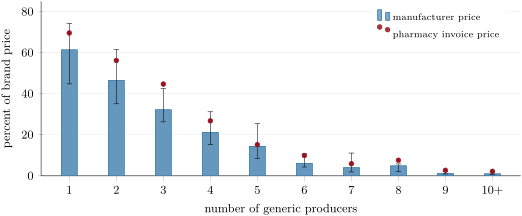
When a medicine’s patent runs out, other firms may sell copies of it, called generics. In the United States, for drugs whose first generic copy reached the market between 2015 and 2017, the median price of the generic, when a single firm made it, was 61.4 % of the brand’s price before the copy arrived. With two generic makers it was 46.5 %, with four 21.2 %, and with ten or more, 1.0 %: one hundredth of the price that the patent holder had charged.
A patent gives one firm the right to be the only seller of a product for some years. This chapter asks what price such a firm charges, why that price is above its marginal cost, what that costs buyers and the economy, and what brings the price down: competitors, the threat of them, and the law.
You already know
From the grades 6–9 volume: a monopoly is a market with a single seller; a barrier to entry keeps other sellers out; a patent gives an inventor the sole right to sell an invention for some years; a natural monopoly is a market in which one firm can supply everything more cheaply than several. From Chapter 13: marginal revenue and the marginal rule. From Chapter 7: the price elasticity of demand. From Chapter 9: the deadweight loss.
16.1 Marginal revenue below the price
Definition 16.1 (Market power)
A firm has market power when it can raise its price above its marginal cost without losing all its buyers.
A price-taking firm has none: if it asked more than the market price, it would sell nothing. A monopoly faces the whole demand curve. To sell one more unit it must lower its price, and not only on that unit: on all the units it was already selling.
Proposition 16.2 (Marginal revenue of a demand line)
If the inverse demand is with , the revenue is and the marginal revenue is : a line with the same intercept and twice the slope. For , marginal revenue is below the price.
Proof. , so , which is less than when . ∎
The gap is the price cut on the units already sold. Selling the 41st unit with demand brings in its price, 59, but costs 1 dalen on each of the first 40: marginal revenue is , close to .
16.2 The monopoly’s price
Definition 16.3 (Monopoly output)
The monopoly output is the quantity at which the monopoly’s marginal revenue equals its marginal cost; the monopoly price is the price at which buyers take that quantity.
Example 16.4 (A monopoly with a demand line)
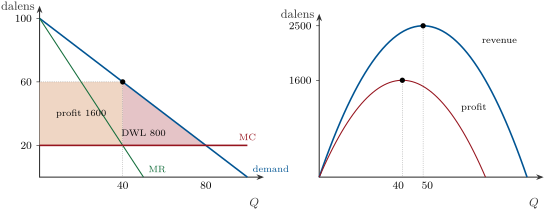
With demand and a marginal cost of 20, marginal revenue equals 20 at , and the price is . The profit, with no fixed cost, is . A competitive industry with the same marginal cost would sell where price equals 20, that is 80 units.
Definition 16.5 (Markup and Lerner index)
A firm’s markup is the ratio of its price to its marginal cost, . Its Lerner index
is the share of the price above marginal cost, .
Proposition 16.6 (The markup and the elasticity)
Let be the price elasticity of demand at the monopoly output. Then , and at the monopoly output .
Proof. , since . At the monopoly output , so . ∎
In the example, at and , , and . The fewer good substitutes buyers have, the less elastic the demand and the higher the markup. A monopoly never sells where demand is inelastic: there marginal revenue is negative, and selling less would raise its revenue and cut its costs.
16.3 What a monopoly costs
In the example, the units from 40 to 80 are worth more to buyers than they cost to make (their demand price runs from 60 down to 20), yet they are not produced. The lost surplus is the triangle : the deadweight loss of the monopoly. The profit of 1600 is not a loss to the economy: it is surplus moved from buyers to the firm’s owners. The loss is the 800 that nobody gets.
16.4 Where market power comes from
Market power lasts only as long as something keeps rivals out. Patents and copyrights do it by law, for a time; so do licences that limit the number of sellers. Control of a scarce input does it, and so do network effects, when each buyer wants the product that most others use. Costs can do it too.
Proposition 16.7 (One firm is cheaper than two)
If every firm has the cost with , then for any total output and any split between two producing firms, .
Proof. . ∎
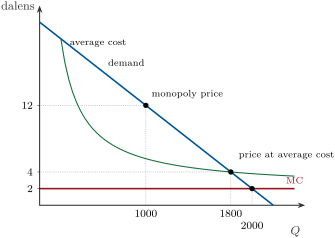
Water pipes, power lines and railway tracks fit this: most of the cost is the network, built once. Such a natural monopoly poses a dilemma. Priced at marginal cost, it loses its fixed cost, and someone must pay for it; priced at average cost, it covers its costs, and only a small deadweight loss remains; left alone, it charges the monopoly price. Many countries regulate such firms’ prices, or own them. Both answers have their own problems: a regulator does not know the firm’s costs as well as the firm does; a price set at average cost leaves the firm little reason to cut its costs, and some reason to pad them; and a regulator can come to serve the firm it regulates (Chapter 21).
16.5 Different prices for different buyers
Definition 16.8 (Price discrimination)
Price discrimination is selling the same product at different prices to different buyers, for reasons other than differences in the cost of serving them.
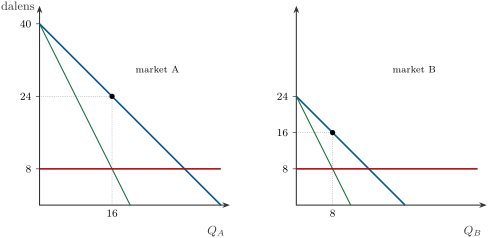
A firm that can tell two groups of buyers apart, and stop them reselling to each other, sets marginal revenue equal to marginal cost in each group. By Proposition 16.6, the group with the less elastic demand pays the higher price. Students’ and pensioners’ discounts, cheaper tickets booked early, and drugs sold for less in poorer countries are all cases. Discrimination can raise output compared with a single price, when the low price brings in buyers who would not buy at all at the single price.
16.6 What erodes a monopoly
Model — Monopoly
Assumes. One seller faces the whole market demand and no other firm can enter; it knows the demand and chooses its price to maximise profit.
Predicts. A price above marginal cost, by a share equal to one over the elasticity of demand; a lower output than a competitive industry with the same costs; a deadweight loss; and a fall in price when rivals enter.
Tested. Consistent with it: when the patent on a medicine expires and generic makers enter, prices fall, and the more makers, the lower the price (opening chart). Markets with more makers may differ in other ways; a test would follow the same medicines as makers enter.
Breaks. When rivals can enter quickly, the threat alone holds the price down; when the price is regulated; when the good lasts and buyers can wait for the price to fall, the firm competes with its own future sales.
On the record — Generic entry and the price of a medicine
A study by the United States Food and Drug Administration followed 181 drugs whose first generic version came to market between 2015 and 2017. Across all of them, the median generic price, at the prices manufacturers charge, was 40 % of the brand’s price before entry, and 49 % at the prices pharmacies pay. The fall was steepest at the first few entrants. The study measured prices before the discounts paid by manufacturers to insurers, and in the prices charged to pharmacies, not those paid by patients. Its sample was limited to the first years after generic entry.
Definition 16.9 (Contestable market)
A market is contestable when a rival could enter quickly and leave without loss, so that even a single seller cannot keep its price above average cost without inviting entry.
Where entry is slow or blocked, competition law steps in. It does not forbid being a monopoly; it forbids certain ways of getting or keeping one.
Definition 16.10 (Abuse of a dominant position)
An abuse of a dominant position is conduct by a firm with a dominant position in a market that exploits buyers or shuts out rivals: unfair prices, limits on production or on technical development, different terms for equivalent deals, or making a sale conditional on buying something else.
In the European Union, Article 102 of the Treaty on the Functioning of the European Union prohibits such abuse where it may affect trade between member states. In the United States, section 2 of the Sherman Act makes it a felony to monopolise, or attempt to monopolise, trade among the states, punishable by fines of up to 100 million dollars for a corporation and up to ten years in prison for a person. Authorities also review large mergers before they happen. Each tool can err both ways: blocking a merger that would have cut costs, or clearing one that raises prices; condemning a low price as an attempt to exclude rivals, or missing one that was.
How it is measured — How a market’s concentration is measured
The concentration ratio of a market adds up the market shares of its largest firms, often the largest four. The Herfindahl index adds up the squares of all the firms’ market shares in percent: a monopoly scores , and four firms with shares of 40, 30, 20 and 10 % score . Both need a definition of the market first, which is often the hardest part: are buses in the same market as trains? A high score does not prove market power, if entry is easy; a low one does not rule it out, if each firm’s product is different.
16.7 Exercises
Exercise 16.1 ★
The inverse demand is . Write the revenue and marginal revenue, and compute marginal revenue at .
Solution
Solution of Exercise 16.1.
, ; at , (the price there is 40).
Exercise 16.2 ★
A firm can sell 1, 2, 3, 4 or 5 units at prices of 10, 9, 8, 7 and 6 dalens. Compute its revenue and the marginal revenue of each unit.
Exercise 16.3 ★
A monopoly faces and has a marginal cost of 10 and no fixed cost. Find its output, price and profit.
Solution
Solution of Exercise 16.3.
gives , , profit .
Exercise 16.4 ★
Read the opening chart. What is the median generic price with one, two, four and six producers? How much lower is it, at each, than with one producer fewer?
Solution
Solution of Exercise 16.4.
61.4 %, 46.5 %, 21.2 % and 6.1 % of the brand’s price. The first producer’s price is 38.6 % below the brand’s; the second brings it down by ; the fourth by ; the sixth by .
Exercise 16.5 ★
A firm sells at 50 dalens with a marginal cost of 30. Compute its markup and Lerner index. If it maximises profit, what is the elasticity of the demand it faces?
Exercise 16.6 ★★
Compute the deadweight loss of the monopoly of Exercise 16.3.
Exercise 16.7 ★★
A monopoly faces with a marginal cost of 20. Find its output and price, the competitive output and the deadweight loss.
Exercise 16.8 ★★
With , the marginal cost rises from 20 to 30. By how much does the monopoly price rise? Show that, with any demand line and a constant marginal cost , the monopoly price is , so it passes on half of any cost rise.
Solution
Solution of Exercise 16.8.
With : , , , a rise of 5 for a cost rise of 10. In general gives and : the price rises by half of any rise in .
Exercise 16.9 ★★
A firm sells in two markets with and , at a marginal cost of 8. Find its prices and quantities if it can charge different prices, and if it must charge one price. Compare its profits.
Solution
Solution of Exercise 16.9.
Different prices: in A, , , ; in B, , , ; profit . One price: below 24 both markets buy, , so and gives , (A buys 20, B buys 4); profit (selling in A only, at 24, gives 256). Discrimination raises the profit by 32 with the same total output.
Exercise 16.10 ★★
A water company has dalens a day, and demand is . Find its output and profit if regulated to price at marginal cost, and the price at which it just covers its costs.
Solution
Solution of Exercise 16.10.
At marginal cost, and : revenue 4000, cost 7600, a loss of 3600, the fixed cost. It just covers its costs where and : at , (check: and ).
Exercise 16.11 ★★
In the table behind the opening chart, the median generic price at manufacturer prices falls from 0.614 to 0.465 of the brand’s price as a second producer enters, and at pharmacy invoice prices from 0.696 to 0.562. Compute the fall in percent in each case. Why can the two kinds of price differ?
Solution
Solution of Exercise 16.11.
Manufacturer prices: . Pharmacy prices: . Pharmacies buy through wholesalers, whose markup is added to the manufacturer’s price; it makes invoice prices higher and falls less in proportion when the manufacturers’ prices fall.
Exercise 16.12 ★★★
What observations in a market for a patented medicine would contradict the monopoly model? Think of the price set, of the elasticity of demand at that price, and of what happens when the patent expires.
Solution
Solution of Exercise 16.12.
A price at which demand is inelastic, since a monopoly never sells there; a markup far from one over the elasticity; or prices that do not fall, or rise, after the patent expires and generic makers enter. Before concluding, one must check that the firm is free to set its price (it may be regulated or negotiated with insurers) and that the elasticity is measured at the right price.
Exercise 16.13 ★★★
A single airline flies a route, but other airlines could move planes onto it within weeks and take them off again at no loss. What does the theory of contestable markets predict for its fares? What would weaken that prediction?
Solution
Solution of Exercise 16.13.
Fares close to the average cost of flying the route, since a higher fare would bring an entrant that could undercut it and leave at no loss. The prediction weakens when entry carries sunk costs (airport slots, advertising, ground staff), when the incumbent can cut fares as soon as an entrant appears and raise them once it leaves, or when slots at the airports are scarce.
Exercise 16.14 ★★★
Prove that a monopoly with a positive marginal cost never chooses a quantity at which demand is inelastic ().
Solution
Solution of Exercise 16.14.
By Proposition 16.6, , which is negative when . At such a quantity marginal revenue cannot equal a positive marginal cost, and selling one unit fewer raises revenue and saves its cost: profit rises. So the monopoly’s quantity is never one where demand is inelastic.
Exercise 16.15 ★★★
A market with demand is served by competitive firms with marginal cost 20. A merger would create a monopoly with a marginal cost of 10. Compare total surplus and consumer surplus before and after. Does the merger pass a total-surplus test? A consumer-surplus test?
Solution
Solution of Exercise 16.15.
Before: , , consumer surplus , producer surplus 0, total 3200. After: , , ; consumer surplus ; producer surplus ; total 3037.5. Total surplus falls by 162.5 and consumers lose 2187.5. The cost saving does not make up for the lost competition: the merger fails both tests, since total surplus falls by 162.5 and consumer surplus by 2187.5.
16.8 Problem: Brenland’s Only Ferry
Problem 16.1
Weekend problem — a monopoly, its deadweight loss and its regulation
A single ferry company carries cars across a lake in Brenland. Demand is crossings a day, where is the fare in dalens. Each crossing costs 4 dalens, and the boats, crew and docks cost 3600 dalens a day whatever the number of crossings.
Part I — The monopoly.
- Write the inverse demand .
- Write the revenue and the marginal revenue.
- Find the monopoly output and fare.
- Compute the profit.
- Compute the elasticity of demand and the Lerner index at the monopoly fare, and check Proposition 16.6.
Part II — What the monopoly costs.
- Find the number of crossings at which the fare equals marginal cost.
- Compute the deadweight loss of the monopoly.
- Compute the travellers’ surplus under the monopoly and at a fare of 4.
- How is the surplus that a fare of 4 would create split under the monopoly?
- Why would the company refuse to charge 4 on its own?
Part III — Regulating the fare.
- A regulator sets the fare at 4. What is the company’s profit?
- Find the fare at which the company just covers its costs, and the number of crossings.
- Compute the deadweight loss at that fare.
- What share of the monopoly’s deadweight loss does the regulated fare recover?
- Instead, 1200 local households each pay a pass of 3 dalens a day, and every crossing costs 4. If all of them keep buying the pass, what are the profit and the deadweight loss?
Part IV — A bridge.
- Without regulation, a bridge opens, charging 8 dalens a crossing for the same trip. What fare does the ferry charge, how many crossings does it make, and what is its profit? (Assume travellers take the ferry when its fare is not above the bridge’s.)
- Compute the deadweight loss of the crossing market at a price of 8, leaving the bridge’s own costs aside.
- Before the bridge is built, the ferry company knows that a bridge would be built if its fare stayed above 8. What does the theory of contestable markets suggest?
- The bridge company and the ferry company propose to merge. What price would the merged firm charge if it kept the same costs? What would have to be true for the merger to benefit travellers?
- State the result of the problem: the deadweight loss of the ferry monopoly and the share recovered by the regulated fare.
Solution
Solution of Problem 16.1.
Fares in dalens; crossings a day.
1. .
2. ; .
3. gives ; .
4. dalens a day.
5. ; .
6. gives .
7. dalens a day.
8. Monopoly: . At 4: .
9. Of the 20000 (before the fixed cost), travellers get 5000, the company 10000, and 5000 are lost.
10. At 4 it covers only the cost of each crossing and loses its fixed cost of 3600 a day; at 14 it makes 6400.
11. dalens a day.
12. At , , and average cost is : the company breaks even.
13. .
14. .
15. The passes bring in a day, the fixed cost, and each crossing pays its cost: profit 0. Crossings are 2000 a day and the deadweight loss is 0.
16. The ferry’s profit rises with its fare up to 14, but above 8 it loses every traveller to the bridge. It charges 8, makes 1600 crossings, and earns a day.
17. .
18. The ferry may keep its fare at or below 8 so that the bridge is never built: the threat of entry alone limits its price.
19. The merged firm is a monopoly again; with the ferry’s costs it charges 14. With a marginal cost its price would be , above 8, so no cost saving on crossings could make the merger good for travellers here.
20. The ferry monopoly’s deadweight loss is 5000 dalens a day; a fare regulated at average cost, 6 dalens, cuts it to 200 and so recovers 96 % of it.