本书暂未推出简体中文版。现有版本:English。
High School Economics · 10–12 年级
31Ideas, Institutions and Growth
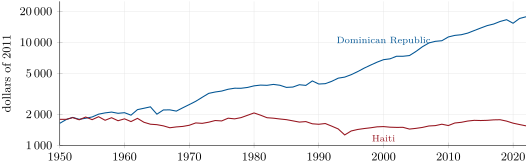
Haiti and the Dominican Republic share one island, its climate and its storms. In 1950 output per person was about the same in both: 1790 dollars in Haiti and 1637 in the Dominican Republic, in the Maddison Project’s estimates. By 2022 the Dominican figure was 17 714 dollars. Haiti’s was 1546, lower than in 1950.
The Solow model says that lasting growth needs better technology, and that capital follows technology. It does not say where better technology comes from, nor why some countries use the best methods and others do not. This chapter takes up both questions: ideas, and the rules under which people produce and use them.
You already know
From the grades 6–9 volume: patents; institutions, natural experiments and the comparison of planned and market economies. From Chapter 18: external benefits. From Chapter 19: rival and excludable goods. From Chapter 29 and Chapter 30: total factor productivity, and why growth in the Solow model needs it to rise.
31.1 Ideas are nonrival
Definition 31.1 (Idea)
An idea, in economics, is a set of instructions for making or doing something: a design, a formula, a method, a program. It is a nonrival good: one person’s use of it does not leave less for anyone else.
A machine can be used by one worker at a time; the design of the machine can be used by every factory at once. That is why ideas can sustain growth where capital cannot: an idea’s returns do not diminish as more people use it. But a nonrival good that others can copy brings its inventor little, and so may not be produced at all: an idea has large external benefits.
31.2 The incentives to invent
Definition 31.2 (Research and development)
Research and development is work done to produce new ideas: new products, new processes, or new knowledge that may lead to them.
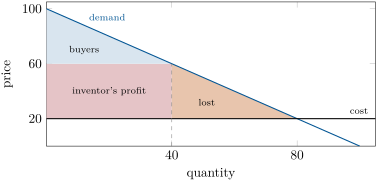
Three ways to pay for it are in use. A patent gives the inventor the sole right to use an idea for a period, often twenty years: the inventor charges a monopoly price, and the deadweight loss of monopoly is the cost of the incentive. Public funding of research, in universities and laboratories, pays for ideas whose results are given away. And a prize pays for a result defined in advance.
Definition 31.3 (Innovation prize)
An innovation prize is a sum promised in advance to whoever first achieves a specified result, after which the idea can be used freely.
On the record — The longitude prizes
A ship at sea could not tell how far east or west it was. In 1714 the British Parliament offered 10 000 pounds for a method accurate to within one degree of longitude, 15 000 for 40 minutes and 20 000 for 30 minutes. A clockmaker received a first 250 pounds in 1737 to improve his sea clock; after decades of trials and disputes over whether his result met the terms, Parliament granted him 8750 pounds in 1773, bringing his total to 23 065 pounds over thirty-six years. The record shows both the strength of a prize, a result anyone may then use, and its weakness: someone must judge whether the result has been reached.
Definition 31.4 (Creative destruction)
Creative destruction is the process by which new products, methods and firms replace old ones, so that growth comes with the closing of firms and the loss of jobs as well as with new ones.
In the United States in the first quarter of 2026, expanding and opening private businesses added 7.4 million jobs, and shrinking and closing ones lost 7.3 million: each about 5.5 % of private employment, for a net change of 88 000. In that quarter 323 000 new establishments opened. Behind a small net change in employment lies a large reallocation of workers from some firms to others.
Model — Ideas-driven growth (toy)
Assumes. Total factor productivity grows in proportion to the number of researchers: , with constant.
Predicts. More researchers bring faster growth, and a growing number of researchers brings ever faster growth.
Tested. Research effort has risen substantially for decades while productivity growth has not: the number of researchers needed to double the density of computer chips is more than 18 times larger than in the early 1970s (Bloom, Jones, Van Reenen and Webb 2020).
Breaks. Ideas are getting harder to find: falls as the easy ideas are used up, and the same growth needs ever more research.
31.3 Institutions
The grades 6–9 volume compared countries split by history, the two Koreas, the two Germanys, and China before and after 1978, and found that the rules under which people own, trade and decide made great differences to income. The same goes for ideas: a firm invests in research, and a worker in skills, only if they expect to keep a good share of the return; a patent is worth little where courts do not enforce it. The opening chart is consistent with that, but a pair of countries is not a natural experiment: Haiti and the Dominican Republic differ in their history, their politics and the disasters that struck them, and the chart alone cannot say which difference mattered most.
31.4 Why the best methods do not spread everywhere
Definition 31.5 (Technology diffusion)
Technology diffusion is the spread of a new method or product from those who first use it to other firms and countries.
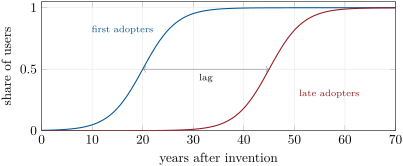
New methods spread slowly: firms must learn them, buy the machines that carry them, train workers and change how they are organised, and a firm sheltered from competition has less reason to bother. Where firms can enter freely and must compete, the best methods spread faster.
31.5 Growth and the environment
Definition 31.6 (Energy intensity)
Energy intensity is the primary energy used per unit of GDP.
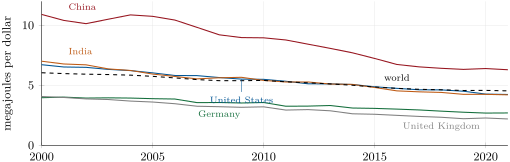
Growth uses resources and produces pollution, and innovation has changed how much. Each dollar of world output used a quarter less primary energy in 2021 than in 2000, from 6.05 to 4.54 megajoules; in the United States energy intensity fell by about 2.2 % a year. Innovation, and a shift of output towards services, have done that. What they have not done is cut the total: world output doubled over those years, so world energy use still rose by half. Whether output can keep growing while the use of energy from fossil fuels, and the emissions that come with it, fall is a question about the speed of innovation and about the prices that steer it: the external costs of Chapter 18.
31.6 Exercises
Exercise 31.1 ★
Rival or nonrival: a recipe; a cake; a computer program; a delivery truck?
Solution
Solution of Exercise 31.1.
Recipe: nonrival. Cake: rival. Program: nonrival (copies cost almost nothing). Truck: rival.
Exercise 31.2 ★
Rival or nonrival: a mathematical theorem; a seat on a train; a song; a dose of vaccine; the formula of the vaccine?
Solution
Solution of Exercise 31.2.
Theorem: nonrival. Train seat: rival. Song: nonrival. Vaccine dose: rival. The formula: nonrival.
Exercise 31.3 ★
From the opening chart, give both countries’ GDP per person in 1950 and in 2022, and the ratio in 2022.
Solution
Solution of Exercise 31.3.
1950: Haiti 1790, Dominican Republic 1637 dollars. 2022: Haiti 1546, Dominican Republic 17 714. Ratio .
Exercise 31.4 ★
From the opening chart, in which decade did the two countries begin to diverge? What was the Dominican figure in 1980 and the Haitian one?
Solution
Solution of Exercise 31.4.
In the 1950s: by 1960 the Dominican Republic was ahead (2075 against 1809). In 1980: 3781 against 2063.
Exercise 31.5 ★
Demand is and the marginal cost is 10. A patent holder sells at the monopoly price. Find price, quantity, profit and the deadweight loss.
Solution
Solution of Exercise 31.5.
Marginal revenue gives , ; profit ; deadweight loss (competitive quantity 40).
Exercise 31.6 ★★
A patent brings a profit of 100 a year for 20 years. Find its present value at 4 %.
Solution
Solution of Exercise 31.6.
.
Exercise 31.7 ★★
An inventor can choose a prize of 1000 now or a patent bringing 80 a year for 20 years. Which is worth more at 5 %?
Solution
Solution of Exercise 31.7.
: the prize of 1000 is worth slightly more.
Exercise 31.8 ★★
In the weekend problem’s market, the patent is lengthened from 20 to 25 years. By how much does its present value at 5 % rise? What does society give up in exchange?
Solution
Solution of Exercise 31.8.
thousand dalens. Society gives up five more years of the deadweight loss, worth , and buyers pay the monopoly price for five years longer.
Exercise 31.9 ★★
American energy intensity fell from 6.72 megajoules per dollar in 2000 to 4.24 in 2021. Find the average annual rate of change.
Solution
Solution of Exercise 31.9.
a year.
Exercise 31.10 ★★
From the energy-intensity chart, give China’s value in 2000 and 2021. By what fraction did it fall? Compare with the world.
Solution
Solution of Exercise 31.10.
10.91 in 2000 and 6.30 in 2021: a fall of about 42 %, against 25 % for the world (6.05 to 4.54).
Exercise 31.11 ★★
The share of firms using a method is , in years. When does it reach 10 %, 50 % and 90 %? A second country follows the same curve 25 years later: when does it reach 50 %?
Solution
Solution of Exercise 31.11.
gives . 10 %: , ; 50 %: ; 90 %: . The second country reaches 50 % at .
Exercise 31.12 ★★★
What evidence contradicts the toy model of ideas-driven growth? Use the model box, and say which assumption fails.
Solution
Solution of Exercise 31.12.
The toy model predicts that rising research effort raises growth. Research effort has risen substantially for decades without faster productivity growth, and keeping up the doubling of chip density needs more than 18 times the researchers of the early 1970s. The assumption that fails is a constant : each researcher finds fewer new ideas over time.
Exercise 31.13 ★★★
Does the opening chart show that institutions cause income differences? Name two other explanations, and the kind of evidence that would separate them.
Solution
Solution of Exercise 31.13.
No: it shows two countries with a similar start and different paths. Other explanations: different histories, political instability, natural disasters, differences in schooling or in trade. To separate them one needs many cases, or a natural experiment in which the rules differ while the other factors do not, as with the countries split by history in the grades 6–9 volume.
Exercise 31.14 ★★★
In the toy model, let , with in per cent a year and the number of researchers per 1000 workers. Find for and . If halves while doubles, what happens to growth, and which record of the chapter does that resemble?
Solution
Solution of Exercise 31.14.
: 1 % a year; : 2 %. If halves while doubles, growth stays at 1 %: research effort rises with no faster growth, as in the finding that ideas are getting harder to find.
Exercise 31.15 ★★★
Who loses from creative destruction, and who gains? Use the job-flow figures of the chapter, and link the answer to the measures of inequality of Chapter 23.
Solution
Solution of Exercise 31.15.
Workers and owners of shrinking and closing firms lose, at least for a time: in one quarter, 7.3 million American jobs were lost while 7.4 million were created. The gains go to the workers and owners of expanding firms and to buyers, through lower prices and better products. When the lost jobs are concentrated among some groups or places, the spread of incomes can widen, which the measures of inequality would show, while average income rises.
31.7 Problem: Two Inventors in Brenland
Problem 31.1
Weekend problem — a patent or a prize
In a town in Brenland, two inventors race to develop a medicine. Yearly demand is ( in thousands of treatments, in dalens), and each treatment costs 20 to make. The winner can take a 20-year patent, or the government can offer a prize instead and let anyone make the medicine. Use a discount rate of 5 %.
Part I — The patent.
- Find the monopoly quantity and price.
- Find the yearly profit.
- Find the yearly consumer surplus and deadweight loss under the patent.
- Find the present value of 20 years of profit.
- Once the patent ends, what are the price, quantity and consumer surplus?
Part II — The prize.
- What prize, paid now, gives the inventor the same present value as the patent?
- With the prize, at what price is the medicine sold from the start?
- Find the present value of the deadweight loss avoided over 20 years.
- Find the present value of the extra consumer surplus over 20 years, and compare it with the prize.
- Development costs 15 000 thousand dalens. Is the medicine developed under the patent? Under the prize?
Part III — What can go wrong.
- The government underestimates demand and offers 12 000. What happens?
- It overestimates and offers 30 000. Who gains, and at whose expense?
- Why does a prize require the government to know more than a patent does?
- Both inventors spend 15 000 racing, and only one wins. What is the social cost of the race? Is it wasted?
- The longitude prizes took decades to pay out. What does that record suggest about defining the result in advance?
Part IV — Longer protection.
- The patent is lengthened to 25 years. Find its new present value.
- With development costing 21 000, which length of patent leads to the medicine being developed?
- What is the cost to buyers of the five extra years, in present value of deadweight loss?
- Why might a longer patent bring more medicines but each at a higher cost to buyers?
- State the result of the problem: the prize that gives the inventor the same present value as the patent, and the deadweight loss it avoids.
Solution
Solution of Problem 31.1.
1. Marginal revenue : , .
2. thousand dalens a year.
3. Consumer surplus ; deadweight loss (the competitive quantity is 80).
4. .
5. Price 20, quantity 80, consumer surplus .
6. 19 940 thousand dalens.
7. At the cost of 20: anyone may make it, and competition brings the price down to cost.
8. .
9. Consumer surplus rises from 800 to 3200 a year, by 2400: . Paying the prize of 19 940 out of it leaves 9970, the deadweight loss avoided.
10. Yes under both: 19 940 exceeds 15 000.
11. 12 000 is below the cost of 15 000: no one develops the medicine, and the whole surplus is lost.
12. The inventor gains more than the patent would have given, paid by taxpayers; the medicine is still sold at cost.
13. To set the prize, the government must estimate demand, costs and the value of the result before the medicine exists; with a patent, the market reveals the value afterwards.
14. 30 000 is spent for one medicine worth 15 000 to develop. The loser’s spending duplicates the winner’s, though the race may bring the medicine sooner.
15. A prize needs a result that can be checked without dispute; when judging it takes years, the reward is delayed and uncertain, which weakens the incentive.
16. .
17. Only the 25-year patent: 22 550 covers 21 000, while 19 940 does not.
18. .
19. A longer patent raises the reward, so more costly medicines become worth developing; but each is sold at the monopoly price for longer, so buyers lose more of the surplus of each.
20. A prize of about 19 940 thousand dalens, paid now, gives the inventor the same present value as the 20-year patent, and it avoids a deadweight loss worth about 9970 thousand dalens in present value.