यह किताब अभी हिन्दी में उपलब्ध नहीं है। संस्करण: English।
High School Economics · कक्षा 10–12
21Public Choice: A First Look
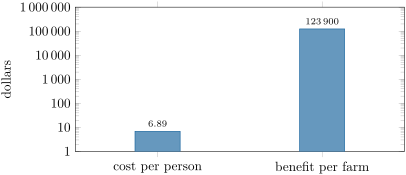
In 1998 the American government’s sugar programme, which kept the price of sugar in the United States above the world price by limiting imports, cost the country’s sugar users about 1.9 billion dollars. Spread over 276 million people, that was 6.89 dollars a person, too little for anyone to notice. Its benefit to sugar producers was about 1.0 billion dollars; spread over the 8070 farms that grew sugar cane or sugar beet, that was up to 124 thousand dollars a farm. The programme had been in place for decades, and it survived.
The earlier chapters asked how markets fail and how a government can correct them. This one asks how governments decide, using the same assumption the book uses for buyers and firms: that voters, elected officials and agencies respond to their own costs and benefits. That assumption does not say they are selfish; it says they respond to incentives. It explains why a programme like sugar’s lasts.
You already know
From the grades 6–9 volume: governments raise taxes and spend them on public services and transfers. From Chapter 10: the deadweight loss of a tax. From Chapter 17: the prisoner’s dilemma. From Chapter 18: the instruments that correct an externality, which a government must choose and set.
Definition 21.1 (Government failure)
Government failure occurs when a government’s action lowers total surplus, or fails to raise it as much as it could, because of the incentives and information of those who decide.
21.1 The uninformed voter
A week before the American presidential election of 2008, the chance that one vote would decide it was estimated at about 1 in 60 million on average, and about 1 in 10 million in the closest states. If the outcome is worth a large sum to a voter, say 10 000 dollars, the expected value of his vote changing it is , less than a cent. Studying the candidates’ programmes for many hours does not pay on such a stake. Most voters vote for other reasons (duty, identity, the pleasure of taking part), but they have little reason to learn the details of the sugar programme.
Definition 21.2 (Rational ignorance)
Rational ignorance is a voter’s choice not to learn about a policy, because the cost of learning is larger than the expected benefit, which is small since one vote rarely decides anything.
21.2 Concentrated benefits, dispersed costs
Definition 21.3 (Interest group)
An interest group is an organised group that seeks to influence policy for its members’ benefit: growers, an industry, a profession, a union.
Definition 21.4 (Concentrated benefits and dispersed costs)
A policy has concentrated benefits and dispersed costs when its gains go to a few, each of whom gains much, and its costs fall on many, each of whom loses little.
The few have both the motive and the means to organise: a large stake each, and few members to bring together. The many have neither. Each would gain from organising against the policy, but each would rather others paid for it: organising is a public good for the losers, and they free ride.
Model — Concentrated benefits, dispersed costs
Assumes. Each group spends on influence up to what the policy is worth to it; organising a group costs more the larger and more scattered it is; voters are rationally ignorant of small costs.
Predicts. Policies that give large gains to a few and small losses to many survive, even when the losses add up to more than the gains.
Tested. Consistent with the US sugar programme, which cost users about 1.9 billion dollars in 1998 and brought producers about 1.0 billion; after the share that went to foreign suppliers and the losses from producing and consuming the wrong amounts, the country lost about 900 million dollars that year, and the programme lasted. The end of US trucking regulation in 1980, against the carriers and the drivers’ union (record below), is a case the simple model does not predict. A test would need many programmes, with the ones that ended counted as well as the ones that lasted.
Breaks. When an issue becomes salient, so that voters notice; when the costs also fall heavily on a few organised groups, which then lobby back.
On the record — Sugar in the United States
A government audit of the programme estimated, in 1999 dollars, that it cost American users of sugar 1.5 billion dollars in 1996 and 1.9 billion in 1998, and brought domestic producers 800 million and 1.0 billion. About 70 % of the producers’ gain went to sugar beet growers and processors, 30 % to sugar cane. Of the net loss to the country, about 300 million dollars in 1996 and 500 million in 1998 was surplus destroyed, and about 400 million each year was paid to foreign producers allowed to sell sugar into the American market at the high domestic price. The audit’s 1997 census count was 973 cane farms and 7097 beet farms.
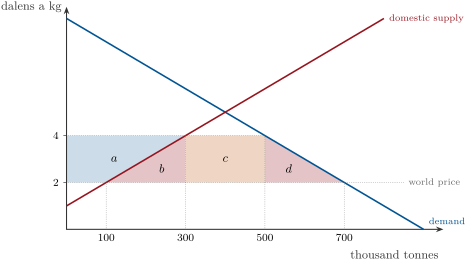
The diagram below shows the same accounts for an invented country, Brenland, which limits sugar imports by a quota. The rise in the domestic price transfers surplus from buyers to domestic growers (area ) and to the holders of import licences (area ); areas and are destroyed, as in any restriction of trade.
21.3 Rent seeking
Definition 21.5 (Rent seeking)
Rent seeking is spending resources to obtain a transfer, a protected position or a licence from the government, rather than to produce something of value.
The cost of a programme is not only its deadweight loss. Firms competing for a licence or a quota spend on lobbyists, lawyers and campaigns, and that spending is lost to everyone. Suppose two firms compete for an import licence worth , and each wins with a probability equal to its share of the total spent. If firm 1 spends and firm 2 spends , firm 1 expects . Its best spending satisfies ; in the symmetric equilibrium , this gives , so each spends and together they spend half the prize. With more competitors, more of the prize is spent getting it.
Model — Rent seeking
Assumes. A transfer goes to whoever spends most on obtaining it, or with a chance that rises with spending; contestants are free to compete.
Predicts. Spending on the contest rises towards the value of the prize; the social cost of a transfer is its deadweight loss plus the resources spent seeking it.
Tested. Hard to measure, since much of the spending is not recorded as such. Licences that could be sold had prices: in the 1970s the right to carry certain goods on certain routes by truck sold for hundreds of thousands of dollars, a measure of the rent the regulation created.
Breaks. When the rules are open to all bidders (an auction of the licence turns the rent into government revenue instead of lobbying), or when rents are small.
21.4 Capture
Definition 21.6 (Regulatory capture)
Regulatory capture occurs when a regulator comes to serve the interests of the industry it regulates rather than those of the public it was set up to protect.
A regulator deals every day with the firms it oversees, depends on them for information, and may hire from them or move to them. The firms are few and attentive; the public is many and rationally ignorant. Capture follows from the same incentives as the sugar programme.
On the record — Capture: trucking in the United States until 1980
For decades a federal commission set American trucking rates and decided who could carry what on which route. Rights to routes became valuable, selling for hundreds of thousands of dollars by the 1970s, and unionised drivers earned about 50 % more than comparable workers. Both the truckers’ association and the drivers’ union strongly opposed ending the regulation. The Motor Carrier Act, signed on 1 July 1980, opened entry and pricing. Truckload rates fell about 25 % in real terms between 1977 and 1982, the value of route rights fell close to zero, and by 1990 there were more than 40 000 licensed carriers, over twice as many as in 1980.
21.5 Imperfect markets, imperfect governments
The earlier chapters showed real market failures with measured costs: pollution that markets do not price, fisheries emptied, insurance pools that unravel. This chapter shows that the cure is chosen by people with their own incentives. The comparison that matters is never a failing market against a perfect government, or a failing government against a perfect market, but one imperfect arrangement against another, each judged by its evidence. A Pigouvian tax that a lobby can lower, a quota that its holders can capture, a regulator that the regulated can win over: each is a case to be measured, not assumed.
21.6 Exercises
Exercise 21.1 ★
A programme costs consumers 600 million dalens a year; Brenland has 3 million households. What does it cost each household?
Solution
Solution of Exercise 21.1.
dalens a year.
Exercise 21.2 ★
The same programme gives 300 million dalens a year to 1500 producers. What does each gain? How many times the cost to a household is that?
Solution
Solution of Exercise 21.2.
dalens each, times the cost to a household.
Exercise 21.3 ★
From the opening chart, how many times larger was the benefit per farm than the cost per person? Why is the benefit per farm an upper bound for a grower?
Solution
Solution of Exercise 21.3.
times. The benefit to producers includes the processors’ gain, so dividing it by the number of farms gives more than a grower received.
Exercise 21.4 ★
For each policy, who has concentrated benefits and who has dispersed costs? A tariff on imported steel; a licence required to work as a hairdresser; a subsidy to a country’s few aircraft makers.
Solution
Solution of Exercise 21.4.
Steel tariff: concentrated benefits to domestic steel makers and their workers, dispersed costs to the buyers of steel and of goods made with it. Hairdressing licence: benefits to licensed hairdressers, who face fewer rivals; costs to all their customers. Aircraft subsidy: benefits to the few makers; costs to all taxpayers.
Exercise 21.5 ★
A voter’s vote decides an election with probability 1 in 10 million, and the better candidate’s win is worth 50 000 dalens to her. What is the expected value of her vote changing the outcome? Is it worth 10 hours of study at 20 dalens an hour?
Solution
Solution of Exercise 21.5.
dalens. Ten hours of study cost 200 dalens: not worth it on that ground alone.
Exercise 21.6 ★★
Two firms compete for a licence worth 800 thousand dalens; each wins with a probability equal to its share of the total spent. Find each firm’s spending and the total in equilibrium.
Solution
Solution of Exercise 21.6.
Each spends thousand dalens; together 400 thousand, half the licence’s value.
Exercise 21.7 ★★
With identical firms in the contest of Exercise 21.6, each spends . Check this for , and compute the total spent for and . What happens as grows?
Solution
Solution of Exercise 21.7.
For : , as found. The total is : thousand for and thousand for . As grows, the total approaches the whole value of the licence.
Exercise 21.8 ★★
Brenland lowers its sugar quota of the diagram from 200 to 100 thousand tonnes. Find the new domestic price, the growers’ gain and the deadweight loss.
Solution
Solution of Exercise 21.8.
gives ; consumption 450, production 350. Growers gain million dalens. The deadweight loss is million.
Exercise 21.9 ★★
Learning how a programme affects her costs a voter 200 dalens of time. The programme costs her 30 dalens a year, and her vote is decisive with probability 1 in a million. Should she learn? What would change her answer?
Solution
Solution of Exercise 21.9.
No. Learning could change her vote, but her vote changes the outcome with probability one in a million, so the expected value of learning is at most about dalens a year against a cost of 200. She would learn if the knowledge were useful for other reasons (she could buy less sugar, say), if learning were cheap, or if she joined others to act together, which raises the effect of her effort.
Exercise 21.10 ★★
In the diagram of Brenland’s sugar market, read the areas , , , , and check that the buyers’ loss equals their sum.
Solution
Solution of Exercise 21.10.
; ; ; (million dalens). The buyers’ loss is .
Exercise 21.11 ★★
A newspaper campaign makes the sugar programme of the opening chart known to most voters. Which assumption of the interest-group model does this change, and what does the model then predict?
Solution
Solution of Exercise 21.11.
The assumption that voters are rationally ignorant of small costs. Once voters know, a representative who backs the programme risks votes, and the model predicts it becomes harder to keep or is cut.
Exercise 21.12 ★★★
What evidence would contradict the interest-group model? Use the trucking record: who gained from the regulation, who opposed its end, and why its end is a puzzle for the model. Suggest what the model leaves out.
Solution
Solution of Exercise 21.12.
A policy with concentrated benefits and dispersed costs that is ended while its beneficiaries still oppose it. In trucking the carriers holding route rights and the unionised drivers gained, and both strongly opposed the end of the regulation; yet it ended in 1980. The model leaves out the shippers, firms that bought transport and bore a concentrated part of its cost; the published evidence on what regulation cost, which made the issue salient; and a period of high inflation in which cutting prices mattered to voters.
Exercise 21.13 ★★★
A regulator’s official earns 60 thousand dalens a year and can expect a job in the regulated industry at 150 thousand if the industry finds him helpful, with probability . A ruling in the industry’s favour raises from 0.1 to 0.4. What is that ruling worth to him, for a job that lasts five years? What rules could weaken this incentive?
Solution
Solution of Exercise 21.13.
The job pays thousand a year more, 450 thousand over five years. The ruling raises the chance of getting it by , so it is worth thousand dalens to him in expectation. A rule barring officials from jobs in the industry for some years after leaving, or decisions taken by panels that rotate, would weaken the incentive.
Exercise 21.14 ★★★
A factory’s pollution causes a deadweight loss of 100 million dalens a year. A tax would remove it, but the lobbying it provokes is expected to set the tax at twice the right level, causing a deadweight loss of 100 million of its own, and the contest costs 30 million. Compare the outcomes. What does the comparison depend on?
Solution
Solution of Exercise 21.14.
No tax: a loss of 100 million. Tax: a loss of million. Here the market failure left alone costs less than the correction. The comparison depends on how far lobbying can push the tax from the right level and on how much the contest costs; with a tax set within, say, a quarter of the right level, the tax would win.
Exercise 21.15 ★★★
Three legislators vote on two projects, each costing 30 to each of them in taxes. Project X brings benefits of 80, 10 and 10 to legislators 1, 2 and 3; project Y brings 10, 80 and 10. Does each project pass a majority vote alone? What happens if legislators 1 and 2 agree to vote for both? Is the outcome efficient?
Solution
Solution of Exercise 21.15.
Alone, X gives net gains : two of three vote against it, and it fails; Y fails the same way. If 1 and 2 vote for both, both pass: each of them nets , and legislator 3 nets . Here the outcome is efficient: each project brings 100 in benefits for 90 in costs. With benefits of 70, 10 and 0, the same deal would pass two projects bringing 80 for 90: vote trading can pass inefficient projects too.
21.7 Problem: Brenland’s Sugar Quota
Problem 21.1
Weekend problem — who gains, who pays and what it costs
In Brenland, demand for sugar is and domestic supply (thousand tonnes a year; in dalens a kilogram). The world price is 2. Brenland has 200 sugar growers and 3 million households. A thousand tonnes at one dalen a kilogram is one million dalens.
Part I — Free trade.
- Find consumption, domestic production and imports at the world price.
- Compute the growers’ producer surplus.
- Compute the buyers’ consumer surplus.
Part II — A quota.
- Imports are limited to 200 thousand tonnes. Find the domestic price.
- Find consumption and domestic production.
- Compute the gain of the growers (area ).
- Compute the quota rent of the licence holders (area ).
- Compute the buyers’ loss.
- Compute the deadweight loss () and check that the accounts add up.
- Which areas are lost to Brenland if the licences go to foreign exporters?
Part III — Who organises.
- Compute the gain per grower and the cost per household.
- How many times the cost per household is the gain per grower?
- The growers’ association spends 40 million dalens a year lobbying for the quota. What share of the growers’ gain is that?
- Is it worth a household’s while to spend one hour, worth 20 dalens, writing to its representative? Explain with the free-rider problem.
- Firms compete for the import licences in a contest like the chapter’s, with two equal contestants. How much do they spend in all?
Part IV — The full cost.
- Add the deadweight loss, the growers’ lobbying and the licence contest of questions 13 and 15. What is the full yearly cost of the quota to Brenland?
- What share of the buyers’ loss reaches the growers as a gain, net of their lobbying?
- If the licences were auctioned, what would change in your answer to question 16?
- Suggest one change that would make the quota’s cost salient to voters.
- State the result of the problem: the gain per grower against the cost per household, and the share of the growers’ gain spent on lobbying.
Solution
Solution of Problem 21.1.
1. Consumption , production , imports 600 thousand tonnes.
2. Supply starts at : million dalens.
3. Demand reaches zero at : million dalens.
4. gives .
5. Consumption 500, production 300 thousand tonnes.
6. million dalens.
7. million dalens.
8. million dalens.
9. and : 400 million. .
10. , and : 800 million dalens.
11. million dalens per grower; dalens per household.
12. 5000 times.
13. .
14. No. Her letter barely changes the chance that the quota ends, and if it ended she would gain at most 400 dalens a year: the expected gain is far below 20. Each household gains if all write, but each would rather the others did: ending the quota is a public good for the buyers, and they free ride.
15. The prize is the quota rent, 400 million; two equal contestants spend half of it, 200 million.
16. million dalens a year.
17. .
18. The licence holders would pay their rent to the government instead of spending it on the contest: the 200 million of contest spending disappears, and the 400 million of rent becomes revenue. The full cost falls to million.
19. For example: printing the cost of the quota on each bag of sugar, or publishing each year’s cost per household.
20. Each grower gains 2 million dalens a year while each household loses 400, five thousand times less; the growers spend 10 % of their gain on lobbying to keep the quota.