এই বইটি এখনো বাংলা ভাষায় পাওয়া যায় না। সংস্করণ: English।
High School Economics · শ্রেণি 10–12
36Fiscal Policy and Public Debt
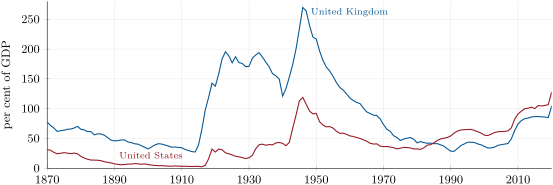
In 1946 the British government owed 270 % of a year’s national income. Thirty years later it owed 47 %. It did not repay most of its debt: in money, the debt grew. What fell was the debt as a share of a national income that grew much faster.
This chapter is about a government’s budget over time: how deficits add to debt, what makes a debt ratio rise or fall, when a debt can be carried, and how the largest debts of the past came down.
You already know
From the grades 6–9 volume: the government’s budget, deficits and debt, and the ageing of populations. From Chapter 26: present value. From Chapter 32: crowding out. From Chapter 34: the multiplier. From mathematics: sequences of the form .
36.1 The budget balance
Definition 36.1 (Primary balance)
The primary balance is government revenue minus government spending other than interest on the debt.
The overall balance is the primary balance minus interest. A government can run a primary surplus and an overall deficit at once, if its interest bill is large.
Definition 36.2 (Automatic stabiliser)
An automatic stabiliser is a part of the budget that, without any new decision, takes in less or pays out more when output falls, such as taxes on income and profits or benefits for the unemployed.
Definition 36.3 (Structural balance)
The structural balance is the budget balance the government would have if output were at potential: the actual balance with the effect of the cycle removed. Like potential output, it is estimated, not observed.
In the euro area as a whole, the general government deficit went from 0.7 % of GDP in 2007 to 6.3 % in 2009, as tax receipts fell with output and spending on benefits and rescues rose.
36.2 How the debt ratio moves
Definition 36.4 (Debt ratio)
The debt ratio is the government’s debt divided by a year’s GDP.
Proposition 36.5 (The debt recurrence)
Let be the debt ratio, the interest rate paid on the debt, the growth rate of nominal GDP and the primary surplus as a share of GDP. Then
Proof. Debt next year is debt this year plus interest minus the primary surplus: . Divide by : . ∎
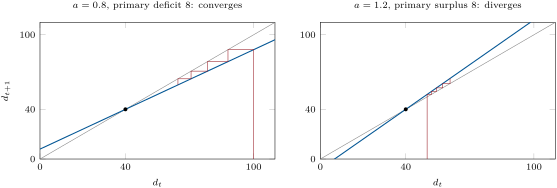
Write . When the interest rate is below the growth rate, : the ratio shrinks by itself unless the government runs primary deficits. When it is above, : the ratio grows unless the government runs primary surpluses. The primary balance that holds the ratio constant is .
Definition 36.6 (Sustainable debt)
A government’s debt is sustainable when the primary balances it can be expected to run keep the debt ratio from rising without limit, without default or unexpected inflation.
Model — Debt dynamics
Assumes. The recurrence (an identity) with given interest rate, growth rate and primary balance.
Predicts. The path of the debt ratio; a stable ratio when , an explosive one when unless primary surpluses offset it.
Tested. Consistent with it, as an accounting relation must be: the United Kingdom after 1945 and the United States after 1946, ratios above 100 % fell for thirty years with nominal growth above the interest rate (the opening chart and the weekend problem).
Breaks. The interest rate depends on the debt: when lenders fear default, they ask for a higher rate, which raises and the debt it was meant to measure, as in Greece in 2010–12. Growth too may fall when the primary surplus is raised to stabilise the debt, through the multiplier.
36.3 Do households look through the debt?
Definition 36.7 (Ricardian equivalence)
Ricardian equivalence is the proposition that, for given government spending, replacing taxes today by borrowing does not change households’ consumption, because they save the tax cut to pay the future taxes that will repay the debt.
Model — Ricardian equivalence
Assumes. Households look ahead to future taxes, can borrow and lend freely, and care about the taxes their heirs will pay.
Predicts. A debt-financed tax cut or rebate is saved, not spent.
Tested. In 2008 American households received one-off stimulus payments. In the three months of receipt they spent about 12–30 % of the payments on nondurable goods, and about 50–90 % counting durables such as cars. Much of the money was spent, not saved.
Breaks. Households that cannot borrow, or do not look far ahead, spend a rebate; the proposition holds best for those who were already saving.
36.4 How large debts ended
The recurrence shows the four ways a debt ratio can come down: growth of real output, inflation, primary surpluses, and default, which cuts itself. A government that borrows in its own currency can always pay in money its central bank creates; the record of the hyperinflations in the grades 6–9 volume shows the price of that exit.
On the record — How the United Kingdom’s debt fell after 1945
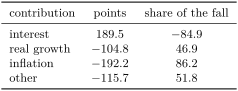
From 1946 to 1975 the British debt ratio fell from 269.8 to 46.7 % of GDP. Nominal GDP grew by 9.0 % a year on average and the long-term interest rate averaged 6.4 %. Year by year, the recurrence splits the fall of 223 points into interest, which added 190 points; real growth, which removed 105; inflation, which removed 192; and the rest, primary surpluses and the gap between the long-term rate and the rate actually paid on the debt, which removed 116. The weekend problem works through it.
Definition 36.8 (Sovereign default)
A sovereign default is a government’s failure to pay interest or principal on its debt as promised, including a forced exchange of its bonds for bonds worth less.
On the record — Greece 2010–12
Greece’s general government deficit reached 15.4 % of GDP in 2009, and its debt rose from 110.9 % of GDP in 2008 to 175.1 % in 2011. Lenders demanded higher rates, and the government borrowed from other euro-area governments and the IMF instead. The second rescue programme, ratified in February 2012, required private bondholders to accept a 53.5 % reduction in the face value of their bonds. The ratio fell to 164.1 % in 2012, then rose again, to 180.4 % in 2013.
Definition 36.9 (Fiscal rule)
A fiscal rule is a lasting limit on a budget figure, such as the deficit, the debt or spending, set in law.
On the record — A fiscal rule in a currency union
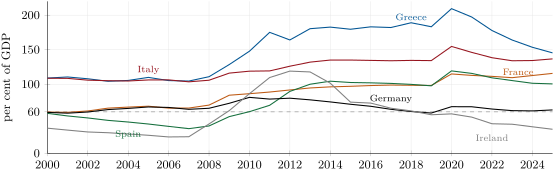
The treaties of the European Union set reference values of 3 % of GDP for the government deficit and 60 % for the government debt. Among the twelve countries that have used the euro since 2002 or earlier, the deficit exceeded 3 % of GDP in 124 of the 288 country-years from 2002 to 2025, 43 %. In 2025 the debt was below 60 % in Ireland (34.8 %), close to it in Germany (62.8 %), and far above it in Spain (100.5 %), France (115.7 %), Italy (136.7 %) and Greece (145.4 %).
36.5 Exercises
Exercise 36.1 ★
A government’s deficit is 4 % of GDP, and its interest payments are 3 % of GDP. Find its primary balance.
Solution
Solution of Exercise 36.1.
: a primary deficit of 1 % of GDP.
Exercise 36.2 ★
Revenue is 40, spending other than interest 38 and interest 5, all in per cent of GDP. Find the primary balance and the overall balance.
Exercise 36.3 ★
From the opening chart, when did the British debt ratio peak, and at what level? What was it in 1975?
Solution
Solution of Exercise 36.3.
In 1946, at 269.8 %; 46.7 % in 1975.
Exercise 36.4 ★
From the opening chart, compare the American debt ratio in 1946 and in 2020.
Solution
Solution of Exercise 36.4.
118.9 % in 1946 and 128.1 % in 2020: higher in 2020 than at the end of the Second World War.
Exercise 36.5 ★
The debt ratio is 60 %, the interest rate 4 % and nominal growth 3 %, with a balanced primary budget. Find next year’s ratio.
Solution
Solution of Exercise 36.5.
.
Exercise 36.6 ★★
From a ratio of 100 %, with , and a primary deficit of 1 % of GDP, find the ratio after one, two and three years.
Solution
Solution of Exercise 36.6.
: , , .
Exercise 36.7 ★★
From a ratio of 100 %, with , and a balanced primary budget, find the ratio after one, two and three years.
Solution
Solution of Exercise 36.7.
: 102.9, 105.9 and 109.0 %.
Exercise 36.8 ★★
The ratio is 120 %, and . Find the primary balance that keeps the ratio constant.
Solution
Solution of Exercise 36.8.
of GDP, a primary surplus.
Exercise 36.9 ★★
The ratio is 100 % and . The interest rate rises from 3 % to 5 %. How does the stabilising primary balance change?
Solution
Solution of Exercise 36.9.
From (a primary deficit is allowed) to (a surplus is needed): a change of about 1.9 points of GDP.
Exercise 36.10 ★★
From the chart of euro-area debt, which country’s ratio rose most from 2007 to 2025, and which fell most after 2012? Use the record’s values for 2025 and 2007 values of 35.7 % (Spain), 65.5 % (France) and 24.0 % (Ireland).
Solution
Solution of Exercise 36.10.
Spain: from 35.7 to 100.5 %, a rise of 64.8 points (France: 50.2 points). Ireland’s fell most after 2012, from 119.0 to 34.8 %, by 84.2 points; Germany’s also fell, from 79.8 to 62.8 % ( points).
Exercise 36.11 ★★
Tax receipts are 40 % of GDP and move in proportion to it, and benefits rise by 0.3 % of GDP when output falls by 3 %. By how much does the deficit widen, in per cent of GDP, with no new decision?
Solution
Solution of Exercise 36.11.
Receipts fall by % of GDP, benefits rise by 0.3: the deficit widens by about 1.5 points.
Exercise 36.12 ★★★
What evidence contradicts Ricardian equivalence? Which assumption of the model does it point to?
Solution
Solution of Exercise 36.12.
Households that received the 2008 rebates spent about 50–90 % of them within three months, counting durables, instead of saving them for future taxes. It points to the assumption that households can borrow freely and look far ahead: many spend extra cash when it arrives.
Exercise 36.13 ★★★
Let satisfy , with . Show that , and deduce when the ratio converges.
Solution
Solution of Exercise 36.13.
, so by induction . With , and ; with the gap grows without limit unless .
Exercise 36.14 ★★★
A government owes 100 % of GDP in long-term bonds at a fixed rate. Prices rise by 10 % more than expected in one year, with real output unchanged. Ignoring interest and the primary balance, what is the new ratio? Who loses?
Solution
Solution of Exercise 36.14.
Nominal GDP rises by 10 % while the debt does not: . Bondholders lose: their bonds buy about 9 % less.
Exercise 36.15 ★★★
A government owes 170 % of GDP, half of it to private bondholders, who accept a cut of 53.5 % in the face value of their bonds. Find the new ratio. Why might it rise again afterwards?
Solution
Solution of Exercise 36.15.
The private half, 85 % of GDP, is cut by points: the ratio falls to about 124.5 %. It may rise again if output keeps falling, if deficits continue, or if the remaining debt pays high rates.
36.6 Problem: How the United Kingdom’s Debt Ratio Fell, 1946–1975
Problem 36.1
Weekend problem — growth, inflation and surpluses
From 1946 to 1975 the British debt ratio fell from 269.8 % to 46.7 % of GDP. Over 1947–1975, nominal GDP grew by 9.0 % a year on average, the long-term interest rate averaged 6.42 %, consumer price inflation 5.82 % and real growth 3.05 %. The table splits the change in the ratio, year by year with the recurrence, using the long-term rate as the interest rate on the debt (in percentage points of GDP, summed over the years; share of the fall in per cent, computed from unrounded values).
Part I — The averages.
- By how many points did the ratio fall?
- Check that real growth and inflation roughly account for nominal growth.
- With a ratio of 270 %, and , find next year’s ratio with a balanced primary budget.
- In the same year, what primary balance would have kept the ratio constant?
- Was the interest rate above or below nominal growth on average? What does the recurrence then predict?
Part II — The decomposition.
- How many points did interest add?
- How many points did real growth and inflation remove?
- Find the net effect of nominal growth over the interest rate, in points.
- Find its share of the fall.
- What is in the row “other”? Find its share.
Part III — Reading it.
- Inflation removed more than real growth. Why does inflation lower the ratio of a debt with fixed interest rates?
- Who bore that part of the cost?
- Why is the long-term rate only an approximation of the rate paid on the debt?
- The long rate rose from 2.6 % in 1946 to 14.6 % in 1975. Why might lenders have asked for more as the period went on?
- From the opening chart, the American ratio fell from 118.9 % in 1946 to 33.6 % in 1975. Find the fall in points.
Part IV — Lessons.
- Which of the four exits did this record use, and which not?
- Which exit did Greece use in 2012?
- With below , can a government run primary deficits for ever without the ratio exploding? Use the recurrence.
- Why does the record not show that the same fall could be repeated with low inflation?
- State the result of the problem: the share of the fall due to nominal growth above the interest rate.
Solution
Solution of Problem 36.1.
1. points.
2. : about 9.0 %, as observed.
3. .
4. : a primary deficit of 14.9 % of GDP would have kept the ratio constant.
5. Below: 6.42 % against 9.0 %. The ratio falls even with a balanced primary budget.
6. 189.5 points.
7. points.
8. points.
9. .
10. Primary surpluses and other changes in the debt (sales of assets, revaluations, differences between the data and the approximation): 115.7 points, 52 %.
11. Prices raise nominal GDP, while the debt, fixed in money, does not rise with them.
12. The holders of the bonds, whose interest and repayment bought less.
13. The debt consists of bonds issued in earlier years at the rates of those years, and of short-term debt at other rates; the average rate paid differs from the current long rate.
14. As inflation rose, lenders expected more of it and asked for compensation in the rate.
15. points.
16. Real growth, inflation and primary surpluses; not default.
17. Default: private bondholders accepted a 53.5 % cut in face value.
18. Yes: with and a constant primary deficit, the ratio tends to , a finite level.
19. Inflation removed 192 of the 223 points; with low inflation nominal growth would have been lower, and interest rates too perhaps; the record shows one path only.
20. Nominal growth above the interest rate accounts for 107.5 of the 223.1 points, about 48 % of the fall; the rest came from primary surpluses and from the gap between the long-term rate and the rate actually paid.