Dit boek is nog niet beschikbaar in het Nederlands. Edities: English.
High School Economics · Bovenbouw
26Present Value
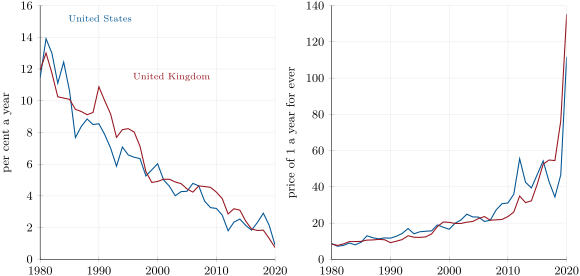
In 1981 the American government could borrow for the long term only by promising 13.9 % a year. In 2020 it paid 0.9 %. A promise of one dollar a year for ever, priced at those yields, was worth 7.2 dollars in 1981 and 111.8 dollars in 2020: more than fifteen times as much, for the same promise.
A dollar to be received in the future is worth less than a dollar today, because a dollar today can be lent out at interest. How much less depends on the interest rate, and on how far away the payment is. This chapter turns that idea into a tool, the present value, with which one can price a bond, compare a payment now with payments later, and decide whether an investment is worth its cost.
You already know
From the grades 6–9 volume: compound interest and doubling time. From Chapter 12: the real interest rate, close to the nominal rate minus inflation. From the mathematics volumes: the sum of a finite geometric series, for ; the exponential and the logarithm; limits of sequences.
26.1 Compounding
A sum lent at the rate a year, with interest added once a year, is worth after years. If interest is added times a year at the rate each time, it is worth ; the more often, the more it earns, but there is a ceiling.
Proposition 26.1 (The limit of compounding)
For every real , as .
Proof. For , . With , when , and as , because this is the derivative of at 1. So the exponent tends to , and since is continuous the result follows. (For both sides are 1.) ∎
Definition 26.2 (Continuous compounding)
Continuous compounding at the rate is the limit of compounding ever more often: a sum grows to after years.
At 5 % a year, 1000 grows in ten years to 1628.89 with yearly compounding and to with continuous compounding: the difference is small at low rates.
26.2 Discounting and present value
Definition 26.3 (Present value and discount rate)
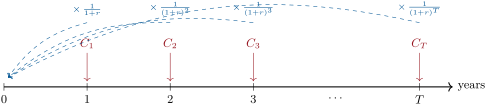
The present value of a payment due in years, at the yearly rate , is : the sum that, lent today at , would grow to in years. The rate used is the discount rate
, and computing present values is discounting
.
The present value of a stream of payments , one at the end of each year, is the sum of their present values:
Definition 26.4 (Annuity and perpetuity)
An annuity pays the same sum at the end of each year for a fixed number of years. A perpetuity
pays the same sum at the end of each year for ever.
Proposition 26.5 (Annuity and perpetuity)
At a rate , an annuity paying a year for years has present value , and a perpetuity paying a year has present value .
Proof. With , the annuity is worth . Since , we have , which gives . As , because , and the value tends to . ∎
At 4 %, 7 a year for 30 years is worth today, against for 7 a year for ever: the payments after year 30 are worth only 54 today.
26.3 Bonds and their yields
Definition 26.6 (Bond and coupon)
A bond is a loan in the form of a security that can be sold: the borrower promises fixed payments on fixed dates. Most bonds pay a coupon
, a fixed sum each year, and repay their face value at maturity.
Definition 26.7 (Yield to maturity)
A bond’s yield to maturity is the discount rate at which the present value of its payments equals its price.
How it is measured — What a bond’s yield is
A bond’s price is observed in the market; its yield is computed from that price and the promised payments. When the yield of long-term government bonds is quoted, as in the opening chart, it is this rate for bonds of one long maturity, often ten years. A yield is a promise kept, if the payments are made and the bond is held to maturity; it says nothing of the inflation that will erode those payments.
Proposition 26.8 (Price and yield move in opposite directions)
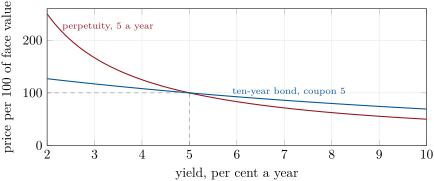
The price of a perpetuity paying falls when its yield rises, and so does the price of a two-year bond paying a coupon and then .
Proof. The perpetuity’s price is , decreasing in . The two-year bond’s price is , a sum of two terms each of which decreases as rises, since and are positive. ∎
Model — Bond price by present value
Assumes. The promised payments are certain; the price is their present value at the market’s yield.
Predicts. A bond’s price falls when yields rise and rises when they fall, more for long bonds than for short ones.
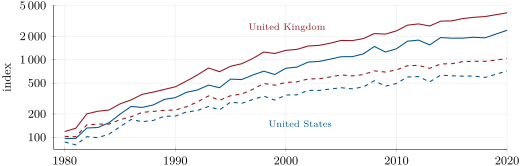
Tested. Consistent with it: from 1981 to 2020 long yields in the United States fell from 13.9 % to 0.9 %; an index of the total return on American government bonds, prices plus coupons, went from 100 at the end of 1979 to 2396 in 2020, and to 718 after inflation (the chart below). Most of that rise is reinvested coupons, so the index does not isolate the price effect; a test would follow the prices of long and short bonds through the same changes of yield.
Breaks. When payments are not certain: a borrower that may default sees its bonds fall even as safe yields fall; and when inflation is higher than expected, the fixed payments buy less, which the nominal yield does not show.
On the record — Britain’s perpetual bonds
A perpetual bond pays its coupon for ever and repays nothing unless the borrower chooses to buy it back. On 5 July 2015 the British government repaid at their face value the last four perpetual bonds in its debt, among them 161.2 million pounds of a stock paying 2.5 % a year, 2.50 for each 100 of face value; the repayment completed the removal of all such bonds from its debt.
26.4 Net present value
Definition 26.9 (Net present value)
The net present value of an investment is the present value of all its payments and receipts, with costs counted as negative: an investment with a positive net present value at the discount rate earns more than lending the money at that rate.
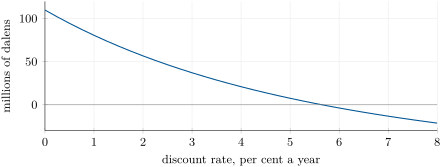
A bridge that costs 100 now (the chart below) and brings a net 7 a year for 30 years has a net present value of at 4 %, and of at 6 %. The same project is worth undertaking or not depending on the rate: the higher the rate, the less the distant receipts count.
Two rules keep the calculation honest. Payments in money of the day are discounted at a nominal rate; payments in today’s prices, at a real rate, close to the nominal rate minus expected inflation. Mixing them, discounting payments that grow with prices at a nominal rate, or fixed payments at a real rate, gives the wrong answer. And the rate must be the return the money could earn elsewhere at a similar risk.
26.5 Exercises
Exercise 26.1 ★
Compute the value of 1000 lent at 3 % a year for 10 years, with yearly compounding.
Solution
Solution of Exercise 26.1.
.
Exercise 26.2 ★
Compute the value of 500 lent at 6 % a year for 12 years. Compare with the doubling time given by the rule of 70 of the grades 6–9 volume.
Solution
Solution of Exercise 26.2.
: the sum has doubled in 12 years. The rule of 70 gives years, close to the 12 found.
Exercise 26.3 ★
Find the present value of 1000 due in 5 years at 4 %.
Solution
Solution of Exercise 26.3.
.
Exercise 26.4 ★
Find the present value of 200 due in one year and 200 due in two years, at 5 %.
Solution
Solution of Exercise 26.4.
.
Exercise 26.5 ★
From the opening chart, give the American long-term yield and the computed price of 1 a year for ever in 1981 and in 2020. By what factor did the price rise?
Solution
Solution of Exercise 26.5.
13.9 % and 7.2 in 1981; 0.9 % and 111.8 in 2020. The price rose by a factor of .
Exercise 26.6 ★★
Find the present value of 1000 a year for 20 years at 3 %.
Solution
Solution of Exercise 26.6.
.
Exercise 26.7 ★★
A loan of 10 000 at 5 % is repaid by equal payments at the end of each of 10 years. Find the yearly payment.
Solution
Solution of Exercise 26.7.
The payment solves : .
Exercise 26.8 ★★
Find the price of a perpetuity paying 50 a year at a yield of 4 % and at 5 %. By what percentage does it fall?
Solution
Solution of Exercise 26.8.
and : a fall of 20 %.
Exercise 26.9 ★★
Two bonds each pay 100 once, one in one year and one in ten years, and nothing else. Find their prices at yields of 3 % and 4 %, and the percentage fall of each.
Solution
Solution of Exercise 26.9.
One year: , , a fall of about 1.0 %. Ten years: , , a fall of about 9.2 %. The long bond is far more sensitive to the yield.
Exercise 26.10 ★★
A machine costs 1000 and earns 300 a year, in today’s prices, for 4 years. The nominal interest rate is 5 % and expected inflation 2 %. Using the approximate real rate, find the net present value.
Solution
Solution of Exercise 26.10.
The real rate is about . .
Exercise 26.11 ★★
Find the value of 1000 after 10 years at 5 % with continuous compounding, and with yearly compounding.
Solution
Solution of Exercise 26.11.
; .
Exercise 26.12 ★★★
A government’s bond prices fall while the yields of safe bonds of the same maturity fall too. Does this contradict the model of bond prices? What does it suggest?
Solution
Solution of Exercise 26.12.
No: the model prices certain payments. A fall in price while safe yields fall means the payments are no longer seen as certain: lenders fear default, or, for bonds in a currency the government can print, higher inflation. The yield on that government’s bonds has risen relative to safe yields; the gap measures the extra return lenders ask for the risk.
Exercise 26.13 ★★★
A two-year bond pays a coupon of 5 after one year and 105 after two, and sells for 96.38. Find its yield to maturity, by solving a quadratic equation in .
Solution
Solution of Exercise 26.13.
, so and (the other root is negative). Then .
Exercise 26.14 ★★★
Prove that for , using the proposition on the limit of compounding.
Solution
Solution of Exercise 26.14.
. The inner term tends to by the proposition, and is continuous on , so the whole tends to .
Exercise 26.15 ★★★
Project A costs 100 and pays 150 in ten years. Project B costs 100 and pays 30 a year for 4 years. Compute both net present values at 2 % and at 5 %, and explain why the ranking changes.
Solution
Solution of Exercise 26.15.
At 2 %: A, ; B, ; A is better. At 5 %: A, ; B, ; B is better. A’s receipt lies further in the future, so a higher rate lowers its present value more.
26.6 Problem: Financing a Bridge
Problem 26.1
Weekend problem — a bridge, its value and its bond
A town in Brenland can build a bridge for 100 million dalens, paid now. The tolls will bring 8 a year and the maintenance cost 1 a year, both at the end of each of the next 30 years, after which the bridge is worn out.
Part I — Present values.
- Compute the discount factors for years 1, 10 and 30 at 4 %.
- Compute the present value at 4 % of the net receipts of 7 a year, using the annuity formula.
- Find the bridge’s net present value at 4 %.
- Find it at 2 %.
- Find it at 6 %.
Part II — The break-even rate.
- Explain why the net present value falls as the rate rises.
- Compute it at 5 %. Between which two of the rates computed does it reach zero?
- Bisect: compute it at 5.5 %.
- Compute it at 5.75 %, and give the interval that now contains the break-even rate.
- Starting from an interval of 2 points (4 to 6 %), how many halvings give the rate to within 0.01 point? The chart of the bridge’s net present value in this chapter shows the curve; read the break-even rate from it.
Part III — A perpetual bond.
- The town borrows the 100 by selling a perpetual bond at a yield of 4 %. What coupon must it pay each year?
- Each year for 30 years the town pays the coupon from the net tolls. Find the present value at 4 % of what is left over.
- After year 30 the coupons must be paid from taxes. Find the present value today of those coupons, and check that Questions 12 and 13 together give the net present value of Question 3.
- A year after the issue, yields on such bonds rise to 5 %. Find the bond’s new price per 100. Who loses?
- What would a two-year bond paying a coupon of 4 and then 104 be worth at 5 %? Why does the perpetual bond fall more?
Part IV — Interpretation.
- The tolls and the maintenance cost rise with prices, so that the 7 is in today’s prices; the nominal rate is 6 % and expected inflation 2 %. Which rate should be used, and what is the net present value?
- Traffic disappoints, and the net receipts are only 5 a year. Find the net present value at 4 %.
- Find the net yearly receipts at which the net present value at 4 % is zero.
- Give two reasons why the right discount rate for the bridge might differ from the rate on the town’s bonds.
- State the result of the problem: the net present value at 4 % and the break-even discount rate.
Solution
Solution of Problem 26.1.
1. ; ; .
2. .
3. million dalens.
4. .
5. .
6. The cost is paid now and does not depend on the rate; each receipt’s present value falls as rises.
7. . It is positive at 5 % and negative at 6 %, so it reaches zero between them.
8. About : the rate lies between 5.5 and 6 %.
9. About : the rate lies between 5.5 and 5.75 %.
10. After halvings the interval is points wide; needs , so . The curve crosses zero at about 5.66 %.
11. a year.
12. a year for 30 years: .
13. The coupons from year 31 on form a perpetuity worth at the end of year 30, so today. , the net present value of Question 3 up to rounding (21.0 unrounded).
14. per 100: the bondholders lose 20 % of their capital; the town’s debt is unchanged.
15. , a fall of under 2 %. The two-year bond is repaid soon and only two payments are discounted at the higher rate; the perpetual bond’s payments run for ever, and the distant ones lose most.
16. The receipts are in today’s prices, so the real rate, about : the net present value is 21.0, as in Question 3.
17. .
18. a year.
19. The town borrows at a low rate because its taxes stand behind the bond, but the bridge’s receipts are risky; and the 100 could earn a different return in another use, which is the return given up.
20. The bridge’s net present value at 4 % is 21.0 million dalens, and its break-even discount rate is about 5.66 %.