本书暂未推出简体中文版。现有版本:English。
High School Economics · 10–12 年级
17Oligopoly and a First Look at Games
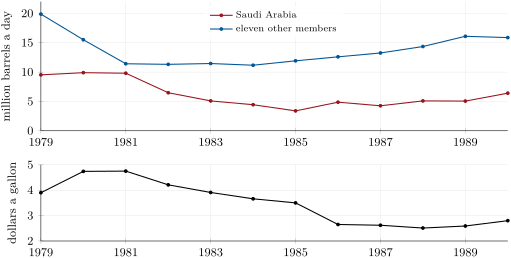
Between 1981 and 1985, Saudi Arabia cut its output of crude oil from 9.81 million barrels a day to 3.39 million: by two-thirds. The other members of the oil exporters’ organisation, OPEC, which had agreed to share the cuts, produced 11.42 million barrels a day in 1981 and 11.92 million in 1985. Saudi Arabia was holding the price up almost alone. At the end of 1985 it gave up: in 1986 it pumped 4.87 million barrels a day, and the price of oil fell from about 27 dollars a barrel to below 10.
A market with a few large sellers is not like the markets of the last two chapters. Each seller’s best choice depends on what the others do, and each knows it. This chapter gives the tool for such situations, the theory of games, and uses it to explain why sellers would like to agree on high prices, why their agreements tend to break, and what the law does about it.
You already know
From the grades 6–9 volume: firms compete for buyers, and competition keeps prices down. From Chapter 15: economic profit and free entry. From Chapter 16: the monopoly output, where marginal revenue equals marginal cost, and the deadweight loss.
17.1 Few sellers, or many different ones
Definition 17.1 (Oligopoly)
An oligopoly is a market with a few sellers, each large enough for its choices to change the price and the other sellers’ profits.
Mobile phone networks, aircraft makers, cement in a region and oil exporters are oligopolies. The opposite case has many sellers who each sell something a little different.
Definition 17.2 (Product differentiation and monopolistic competition)
Product differentiation means that sellers’ products differ in ways buyers care about: place, taste, brand, design. Monopolistic competition
is a market with many sellers of differentiated products and free entry.
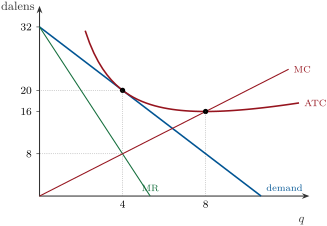
Restaurants, hairdressers and clothes shops fit. Each seller faces a demand curve of its own that slopes down, because some buyers prefer its product, so it sets a price above marginal cost, like a small monopoly. Free entry does the rest: while there are profits, new sellers open and take some of each seller’s buyers, until the demand curve of each just touches its average cost curve.
17.2 Games
Definition 17.3 (Game, strategy, payoff)
A game is a situation in which several players each choose an action, and each player’s result depends on the choices of all. A strategy
is a choice open to a player; a player’s payoff
is what she gets for each combination of strategies.
With two players and two strategies each, the game fits in a table. Each cell gives the payoffs of the row player, then of the column player.
Definition 17.4 (Dominant strategy)
A strategy is dominant for a player if it gives her a higher payoff than any other strategy, whatever the other players do.
Definition 17.5 (Nash equilibrium)
A Nash equilibrium is a combination of strategies, one for each player, in which no player can raise her payoff by changing her strategy while the others keep theirs.
To find the Nash equilibria of a table, mark each player’s best reply to each strategy of the other; a cell in which both payoffs are marked is an equilibrium. If each player has a dominant strategy, the cell where both play it is the only equilibrium.
17.3 The prisoner’s dilemma and the cartel
Definition 17.6 (Cartel and collusion)
A cartel is a group of firms that agree to limit their output or fix their prices, to earn together what a monopoly would. Collusion
is any such cooperation among rivals to raise prices, by an explicit agreement or a tacit one.
Example 17.7 (Two quarries)
Two quarries sell gravel; demand is (thousand tonnes a year, kests a tonne) and each tonne costs 24 kests to produce. A monopoly would sell where , that is 48: so the cartel gives each quarry a quota of 24, the price is 72, and each earns thousand kests. If one quarry produces 32 while the other keeps to 24, the price is : the first earns and the second . If both produce 32, the price is 56 and each earns .
| quarry B | ||
| quarry A | 24 (quota) | 32 |
| 24 (quota) | 1152, 1152 | 960, 1280 |
| 32 | 1280, 960 | 1024, 1024 |
Definition 17.8 (Prisoner’s dilemma)
A prisoner’s dilemma is a game in which each player has a dominant strategy, but the equilibrium in which all play it gives every player less than another combination would.
A cartel is a prisoner’s dilemma. Each member gains by selling more than its quota at the high price that the others’ restraint keeps up, and if all reason so, the cartel collapses. The OPEC members who produced above their quotas in the early 1980s, while Saudi Arabia cut, were playing the dominant strategy.
Model — The cartel as a prisoner’s dilemma
Assumes. Each member of a cartel chooses its own output to maximise its own profit; the agreement cannot be enforced in court; the game is played once.
Predicts. Each member produces more than its quota; the price falls towards the level without a cartel; cartels break down unless members can punish cheating.
Tested. Consistent with it: OPEC in 1981–85, while Saudi Arabia cut its output by two-thirds to defend the price, the other members did not cut theirs; when Saudi Arabia stopped in 1986, the price collapsed (opening chart).
Breaks. When the same firms meet year after year and cheating is quickly seen, cartels can last: the lysine cartel of the 1990s met regularly and raised prices by 70 % within nine months. In laboratory experiments, players cooperate in a one-shot dilemma more often than the model predicts.
On the record — OPEC, 1981–86
In the early 1980s, the oil exporters’ organisation set production quotas for its members to hold the price up as demand for oil fell. Several members cheated on their quotas or refused them. Saudi Arabia, the largest producer, acted as the swing producer: it cut its own output to keep the total down, from 9.81 million barrels a day in 1981 to 3.39 million in 1985. Then it abandoned that role and produced at full capacity. In 1986 the price of oil fell from about 27 dollars a barrel to below 10, and the real price of petrol in the United States fell by about a quarter. Iran and Iraq were at war through most of the decade, which shaped their output whatever the quotas said.
17.4 Playing again and again
Definition 17.9 (Repeated game)
A repeated game is the same game played by the same players several times, each player seeing what the others did before choosing again.
In a repeated game, a player can make her future choices depend on the others’ past ones. A trigger strategy keeps to the quota as long as the other does, and produces the high output for ever after the first time the other cheats. Against it, cheating brings a gain once and a loss every year after. In the quarries’ game, cheating with the best possible output brings 144 thousand kests in the year of cheating (the weekend problem computes it) and costs in each later year: two years of punishment remove the gain. The more the players care about the future, and the faster cheating is seen, the easier it is to sustain a cartel.
17.5 Cartels and the law
Cartels are illegal in most countries, and their members are fined, and in some countries jailed. In the lysine case of the 1990s, an executive of one member firm informed the FBI, the American federal police; the firm was fined 100 million dollars, and three of its executives went to prison.
Definition 17.10 (Leniency programme)
A leniency programme cancels or reduces the fine of a cartel member that reports the cartel to the competition authority and helps prove it.
The European Union has run one since 1996; under its notice of 2006, the first member to report gets full immunity, and later members who bring evidence of real value get reductions of 30 to 50 %, 20 to 30 %, and up to 20 %. Leniency starts a race to report: each member fears that another will report first, and once one is expected to report, every member’s best reply is to report too.
Facts as of 2026
On 1 April 2025 the European Commission announced fines of 458 million euros on 15 carmakers and their trade association, which it found had coordinated for more than 15 years to avoid paying for the recycling of old cars and not to compete on how recyclable their cars were. The carmaker that revealed the cartel avoided a fine of about 35 million euros; another had its fine halved, to 75 million euros, for cooperating.
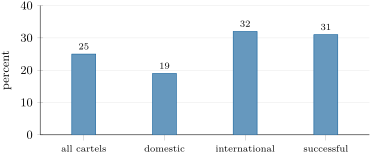
How much do cartels raise prices? A survey of hundreds of studies, with 699 estimates, found a median overcharge, the rise of the price above what it would have been without the cartel, of 25 %, and a mean of 42 %, pulled up by a few very large ones.
Not every game is a dilemma. In a coordination game the players want to make the same choice: drive on the same side of the road, use the same plug. There are then several Nash equilibria, and the theory alone does not say which one is reached; custom, a law or a first mover does.
17.6 Exercises
Exercise 17.1 ★
In this game, payoffs are (row, column). Row: Top gives (4, 1) against Left and (2, 3) against Right; Bottom gives (3, 0) and (1, 2). Does either player have a dominant strategy? What is the outcome?
Exercise 17.2 ★
Two cafés each choose a high or a low price. Profits (A, B): both high (10, 10); A high and B low (4, 12); A low and B high (12, 4); both low (6, 6). Find each café’s dominant strategy and the outcome.
Solution
Solution of Exercise 17.2.
Low is dominant for each café ( and ). Both charge low and earn 6 each, although both high would give 10 each.
Exercise 17.3 ★
Payoffs (row, column): (Top, Left) (5, 2); (Top, Right) (3, 1); (Bottom, Left) (4, 1); (Bottom, Right) (2, 3). Which player has a dominant strategy? Find the Nash equilibrium.
Exercise 17.4 ★
Two firms choose a standard, A or B. Payoffs: both A (3, 3); both B (1, 1); different standards (0, 0). Find all the Nash equilibria.
Solution
Solution of Exercise 17.4.
Both A and both B: in each, a firm that switched alone would get 0. Both firms prefer the first.
Exercise 17.5 ★
Read the opening chart. By how much did Saudi output fall between 1981 and 1985, and the others’ output change? What happened to both and to the price in 1986?
Solution
Solution of Exercise 17.5.
Saudi output fell by million barrels a day (about 65 %); the others’ rose from 11.42 to 11.92. In 1986 Saudi output rose to 4.87 and the others’ to 12.60, and the real price of petrol fell from 3.50 to 2.65 dollars a gallon.
Exercise 17.6 ★★
Demand is and two firms each have a marginal cost of 10. Each can produce 22.5 (half the monopoly output) or 30. Build the payoff table and find the equilibrium.
Solution
Solution of Exercise 17.6.
Both 22.5: , each . One at 30, the other at 22.5: , profits and . Both 30: , each 900. Producing 30 is dominant (, ); the equilibrium is (30, 30), a prisoner’s dilemma.
Exercise 17.7 ★★
Same question with , a marginal cost of 10, and outputs of 30 or 40.
Solution
Solution of Exercise 17.7.
Both 30: , each . 40 against 30: , profits and . Both 40: , each . 40 is dominant; the equilibrium is (40, 40), with 1600 each against 1800.
Exercise 17.8 ★★
In Exercise 17.7, the other firm keeps to 30. Find, with a derivative, the output that maximises the first firm’s profit, and its gain over keeping to 30.
Solution
Solution of Exercise 17.8.
, so at ; and , a gain of .
Exercise 17.9 ★★
Two cartel members each choose to stay silent or to report the cartel. Silent, each expects a profit of 60 (including the risk of being caught). If one reports, it gets immunity and earns 0, and the other is fined: . If both report, each gets half the fine: . Find the Nash equilibria. How does the leniency programme threaten the cartel?
Solution
Solution of Exercise 17.9.
Against silence, silence is best (); against reporting, reporting is best (). Both (silent, silent) and (report, report) are equilibria. A member that thinks the other may report does better to report first: if the chance that the other reports is , staying silent gives and reporting , so reporting is better as soon as . Mutual suspicion can push the cartel into the reporting equilibrium.
Exercise 17.10 ★★
Read the overcharge chart. A cartel with the median overcharge of an international cartel sells goods worth 660 million euros at its prices. How much did buyers pay because of the cartel?
Solution
Solution of Exercise 17.10.
The median international overcharge is 32 %: without the cartel the goods would have cost million euros, so buyers paid 160 million euros more.
Exercise 17.11 ★★
Find all the Nash equilibria: (Top, Left) (3, 2); (Top, Right) (0, 0); (Bottom, Left) (0, 0); (Bottom, Right) (2, 3). Which would each player prefer?
Solution
Solution of Exercise 17.11.
(Top, Left) and (Bottom, Right). The row player prefers the first (3 against 2), the column player the second.
Exercise 17.12 ★★★
What evidence contradicts the one-shot model of the cartel? Use the lysine cartel and laboratory experiments, and say which assumption of the model fails in each.
Solution
Solution of Exercise 17.12.
The lysine cartel lasted for years and raised prices by 70 % within nine months: its members met again and again and watched each other, so the assumption that the game is played once fails. In laboratory one-shot dilemmas many players cooperate: the assumption that each player cares only about her own money payoff fails for them.
Exercise 17.13 ★★★
In a repeated game, cooperation brings each year, cheating once brings then for ever, and each player values a kest next year at kests now (). Admitting that , show that a trigger strategy deters cheating if . Find the smallest for the two quarries.
Solution
Solution of Exercise 17.13.
Keeping to the quota gives ; cheating gives . The first is at least the second when . Quarries: gives , .
Exercise 17.14 ★★★
Explain why a firm in monopolistic competition makes zero profit in the long run although its price is above its marginal cost, and why it produces less than the output at which its average cost is lowest.
Solution
Solution of Exercise 17.14.
New sellers enter while there are profits, taking buyers from each seller, until each seller’s demand curve just touches its average cost curve: at that point the price equals average cost, so the profit is zero. The demand curve slopes down, so it touches the average cost curve where that curve slopes down too, to the left of its lowest point; and since marginal revenue is below the price, so is marginal cost.
Exercise 17.15 ★★★
Which side of the road to drive on is a coordination game. Write its payoff table for two drivers, find its equilibria, and explain why a law settles it while no law could settle a prisoner’s dilemma without a penalty.
Solution
Solution of Exercise 17.15.
Both left (1, 1); both right (1, 1); different sides (, ). Both matching combinations are equilibria. Once a law names one side, each driver’s best reply to the others obeying it is to obey it too: the law only picks the equilibrium. In a prisoner’s dilemma each player’s best reply is to break an agreement, so a rule works only if a penalty changes the payoffs.
17.7 Problem: Two Quarries in Kestria
Problem 17.1
Weekend problem — a cartel, cheating and punishment
Two quarries supply all the gravel in a Kestrian valley. Demand is , with in thousand tonnes a year and in kests a tonne; each quarry’s cost is 24 kests a tonne, with no fixed cost. Profits are in thousand kests a year.
Part I — The cartel.
- Find the output and price that a single owner of both quarries would choose.
- The cartel splits that output equally. Give each quarry’s quota and profit.
- Compute the deadweight loss of the cartel, compared with a price equal to marginal cost.
- Quarry B keeps to its quota of 24. Write quarry A’s profit as a function of its own output .
- Find, with the derivative, the output that maximises it, the price and A’s profit.
Part II — Without a cartel.
- For any output of quarry B, find A’s best output (its best reply) as a function of .
- Find the outputs at which each quarry’s output is the best reply to the other’s.
- Compute the price and each quarry’s profit there.
- Build the payoff table with the strategies 24 and 32 for each quarry.
- Show that the game is a prisoner’s dilemma.
Part III — Cheating and punishment.
- Compute A’s gain from its best cheating output (question 5) in the year it cheats.
- What does B earn that year?
- After cheating is seen, both produce 32 for ever. How much does A lose in each later year, compared with the cartel?
- Without discounting, how many years of punishment remove the gain?
- With a kest next year worth kests now, are two years of punishment enough? Compute the discounted loss.
Part IV — A ten-year horizon.
- The quarries’ licences end in ten years. In the tenth year, is there any reason to keep to the quota? Explain.
- What does this imply for the ninth year, and for the years before?
- In practice, firms rarely know when their game ends. Why does that help the cartel?
- Under a leniency programme, a quarry that reports the cartel pays no fine. How does that change the comparison of question 14?
- State the result of the problem: the gain from cheating on the cartel, and the punishment that removes it.
Solution
Solution of Problem 17.1.
1. gives ; .
2. Quota 24 each; profit .
3. At , ; deadweight loss .
4. .
5. gives ; ; .
6. is largest where : .
7. gives for each.
8. ; each earns .
9. Both 24: (1152, 1152). A 24, B 32: price 64, (960, 1280). A 32, B 24: (1280, 960). Both 32: (1024, 1024).
10. 32 is dominant for each (, ), and the equilibrium gives each 1024, less than the 1152 of keeping to the quota.
11. .
12. At a price of 60, B earns .
13. a year.
14. One year (128) is less than 144; two years (256) are more. Two years of punishment remove the gain.
15. : yes. One year alone, 116.4, is not enough.
16. No: nothing can punish cheating in the last year, so each quarry plays its dominant strategy and produces 32.
17. In the ninth year each knows the tenth will be played at 32 whatever happens, so the threat of punishment is empty and each produces 32 in the ninth year too; the same reasoning runs back to the first year, and the cartel never works.
18. If there is always a chance that the game goes on, there is always a future that a cheater can lose, and the trigger strategy keeps its force.
19. A member can now cheat and report, escaping the fine, while the other is fined: the punishment that holds the cartel together weighs less against the gains of leaving it, and each member must also fear being reported.
20. Cheating on the cartel’s quota brings a quarry 144 thousand kests in the year it cheats; a punishment in which both produce 32 costs it 128 thousand kests a year, so two years of punishment remove the gain (one year is not enough).