এই বইটি এখনো বাংলা ভাষায় পাওয়া যায় না। সংস্করণ: English।
High School Economics · শ্রেণি 10–12
38Trade beyond Ricardo, and Trade Policy
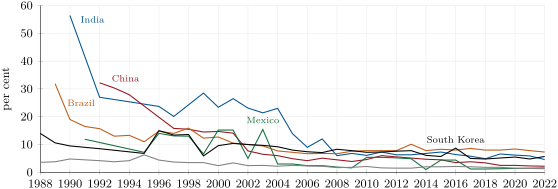
In 1990 India’s imports paid, on average, a tariff of 56 % of their value. In 2022 they paid 4.6 %. China’s average fell from 32 % in 1992 to 2.2 %, Brazil’s from 32 % in 1989 to 7.3 %. Within three decades, the large economies that had protected their producers most opened to imports, while the European Union’s tariffs, already low, fell to 1.3 %.
This chapter widens the reasons for trade beyond the comparative advantage of Chapter 3, then measures who gains and who loses, and what tariffs do.
You already know
From the grades 6–9 volume: exports, imports, tariffs, import quotas, and trade as a share of output. From Chapter 3: comparative advantage and the terms of trade. From Chapter 8: consumer and producer surplus. From Chapter 10: who pays a tax. From Chapter 21: rent seeking.
38.1 Why countries trade
Definition 38.1 (Factor endowment)
A country’s factor endowment is the quantity it has of each factor of production: land, capital, skilled and unskilled labour.
Model — The endowments model (Heckscher–Ohlin)
Assumes. Countries share the same technologies but differ in their endowments; goods differ in the factors they use intensively.
Predicts. A country exports the goods that use its abundant factor intensively; trade raises the return to its abundant factor and lowers the return to its scarce factor.
Tested. Mixed. The first test, in 1953, found American exports more labour-intensive than its imports, the reverse of the prediction for a capital-rich country; a later test across many countries found far less trade in factors than the model predicts, and fitted better once technology was allowed to differ across countries (Trefler 1995).
Breaks. When technologies differ, which is Ricardo’s reason for trade; and it says nothing of the large trade between similar countries.
Definition 38.2 (Intra-industry trade)
Intra-industry trade is the export and import of goods of the same kind, such as cars sold both ways between two countries.
Similar countries trade cars for cars because each firm produces a few varieties at large scale, and buyers like variety. Trade lets each variety be made where its producer is, for a larger market, at a lower cost per unit. Within any industry, the firms that export are the larger and more productive ones: American exporting firms in 2002 employed about two and a half times as many workers as other firms of the same industry, and their value added per worker was about a tenth higher (Bernard, Jensen, Redding and Schott 2007);
opening to trade moves workers from the less productive firms, which shrink, to the more productive, which grow.
Definition 38.3 (Global value chain)
A global value chain is the sequence of stages, from design and parts to assembly and sale, by which a product is made in several countries.

38.2 Winners and losers inside a country
Trade raises a country’s total income, as Chapter 3 proved, but not everyone’s. Workers in industries that compete with imports can lose their jobs, and those in the places where such industries gather can see wages fall for years.
Open question — Trade and wages
Large local losses. Autor, Dorn and Hanson (2013) compared American local labour markets more and less exposed to Chinese imports from 1990 to 2007: the more exposed had higher unemployment, lower participation and lower wages, and more people on benefits; the rise in imports explains, conservatively, a quarter of the fall in American manufacturing employment over those years. The design measures differences between places, not the national total, which also includes gains elsewhere.
Gains spread across buyers. Fajgelbaum and Khandelwal (2016) estimate that trade typically favours poorer households, who spend more of their income on traded goods. Their estimate rests on a model of demand fitted to aggregate data, not on observed households.
How large overall. How much of the rise in the spread of wages trade explains, against technology, has no agreed estimate; the two studies above measure different things, one the loss in exposed places, the other the gain to buyers, and neither gives the national share.
38.3 A tariff and a quota
Definition 38.4 (World price and small open economy)
The world price of a good is the price at which it is traded on world markets. A small open economy
trades at world prices that its own purchases and sales are too small to change.
Proposition 38.5 (The cost of a tariff)
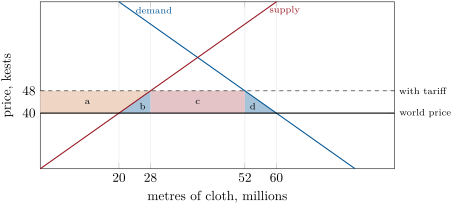
In a small open economy with linear demand and supply, a tariff per unit that leaves some imports causes a deadweight loss of , where is the rise in domestic production and the fall in consumption.
Proof. The domestic price rises by . Consumer surplus falls by the area between the two prices left of the demand curve, a trapezium . Producer surplus rises by the trapezium left of the supply curve. Tariff revenue is times the new imports, the rectangle . The net change is , two triangles of height and bases and . ∎
Triangle is the cost of producing at home, at a cost above the world price, cloth that could have been imported; triangle is the value of the cloth that buyers no longer buy, though they valued it above its world price. An import quota that lets in the same quantity raises the price by the same amount, but the rectangle goes to whoever holds the import licences, not to the government.
Model — A tariff in a small open economy
Assumes. A fixed world price and competitive domestic markets.
Predicts. The domestic price rises by the full tariff; buyers lose, domestic producers and the treasury gain, and the country loses two triangles.
Tested. After the American tariffs of 2018 the prices of the targeted imports, before duty, did not fall: the tariffs passed fully into what American buyers paid.
Breaks. When domestic sellers can set their prices: after the American tariff on washing machines in 2018, the price of washers rose by nearly 12 %, and the price of dryers, which bore no tariff, rose by as much (Flaaen, Hortaçsu and Tintelnot 2020). A large country’s tariff can also lower the world price of what it buys, shifting part of the cost to foreign sellers; the American record of 2018 found no such shift.
On the record — The American tariffs of 2018–19
The United States raised tariffs on many imports in 2018, and its trading partners retaliated. Both studies of the episode found complete pass-through to the duty-inclusive prices paid by Americans and large falls in imports and exports. The losses to American consumers and firms buying imports were about 51 billion dollars, or 0.27 % of GDP; after counting the tariff revenue and the gains of domestic producers, the net loss of real income was 7.2 billion dollars, 0.04 % of GDP. By the end of 2018 the cost was running at about 1.4 billion dollars a month.
38.4 The arguments for protection
Definition 38.6 (Infant-industry argument)
The infant-industry argument holds that a young industry should be protected until it has learned to produce at the costs of its foreign rivals.
The argument holds only if the industry’s future cost savings, in present value, exceed the cost of protecting it, and if lenders would not finance the learning themselves. Protection, once granted, creates producers who gain from keeping it: an industry that never grows up can lobby to stay protected, the rent seeking of Chapter 21. A large country can gain from a tariff through better terms of trade, but only if others do not retaliate. A country may also keep the capacity to make goods it would need in a war, a cost paid for security.
Definition 38.7 (Anti-dumping duty)
An anti-dumping duty is a tariff on an import judged to be sold below its price at home or below its cost.
38.5 Trade agreements and the single market
Definition 38.8 (Trade agreement, customs union, single market)
A trade agreement is a treaty in which countries lower their barriers to each other’s goods. A customs union
is an agreement that removes tariffs between its members and sets common tariffs on the rest of the world. A single market
goes further: goods, services, capital and people move between its members under common rules, without checks at the borders.
The World Trade Organization, which began on 1 January 1995, succeeded the General Agreement on Tariffs and Trade, under which tariffs had been negotiated down since 1947. The European Union’s single market took effect on 1 January 1993. An agreement that lowers tariffs only between its members can draw imports away from cheaper producers outside: its gain from new trade must be set against that diversion.
38.6 Exercises
Exercise 38.1 ★
Demand is and supply ; the world price is 20. Find imports under free trade, and the domestic price and imports with a tariff of 5 per unit.
Solution
Solution of Exercise 38.1.
Free trade: , , imports 40. With the tariff, : , , imports 20.
Exercise 38.2 ★
The world price is 50 and a country imposes a 10 % tariff. What is the domestic price in a small open economy?
Solution
Solution of Exercise 38.2.
.
Exercise 38.3 ★
From the opening chart, give China’s average tariff in 1992 and 2022.
Solution
Solution of Exercise 38.3.
32.2 % in 1992 and 2.2 % in 2022.
Exercise 38.4 ★
From the opening chart, which of the six had the highest average tariff in 2022? Compare it with India’s in 1990.
Solution
Solution of Exercise 38.4.
Brazil, at 7.3 %: less than a seventh of India’s 56.4 % in 1990.
Exercise 38.5 ★
A quota of 20 units raises the domestic price from the world price of 20 to 25. Find the licence rent.
Solution
Solution of Exercise 38.5.
.
Exercise 38.6 ★★
In Exercise 38.1, find the tariff revenue and the deadweight loss.
Exercise 38.7 ★★
In Exercise 38.1, the tariff is 10. Find imports, revenue and the deadweight loss.
Solution
Solution of Exercise 38.7.
: , no imports and no revenue. Deadweight loss : the tariff is prohibitive.
Exercise 38.8 ★★
In Exercise 38.1, compare the tariff of 5 with a quota of 20 units. What is the same, and who gets the rectangle?
Solution
Solution of Exercise 38.8.
The quota gives the same price, 25, the same quantities and the same deadweight loss, 50. The rectangle of 100 goes to whoever holds the licences instead of the government.
Exercise 38.9 ★★
In Exercise 38.1, the country is large: a tariff of 5 lowers the world price from 20 to 18, so the domestic price is 23. Find imports, revenue, the part of the revenue paid by foreign sellers, the deadweight loss and the country’s net gain or loss.
Solution
Solution of Exercise 38.9.
At 23: , , imports 28. Revenue , of which foreign sellers pay . Deadweight loss . Net gain , if the partner does not retaliate.
Exercise 38.10 ★★
A bicycle sells for 100 on the world market and uses 60 of imported parts, which pay no tariff. A 10 % tariff on bicycles raises their domestic price to 110. By how much does it raise the value added that domestic assemblers can earn, in per cent? This is the effective rate of protection.
Solution
Solution of Exercise 38.10.
Value added rises from to : by 25 %, two and a half times the nominal tariff.
Exercise 38.11 ★★
In the 2018 record, the losses to buyers were 51 billion dollars and the net loss 7.2 billion. Explain the difference.
Solution
Solution of Exercise 38.11.
Most of what buyers paid went to the American government as tariff revenue and to American producers as higher prices; only the two triangles, and the losses from retaliation, are a net loss to the country.
Exercise 38.12 ★★★
For a large country, the model allows a tariff to lower the price foreign sellers receive. What did the record of 2018 show, and what does it imply about who paid?
Solution
Solution of Exercise 38.12.
The prices of the targeted imports before duty did not fall: pass-through was complete, so American buyers paid the whole tariff and the United States gained nothing in its terms of trade.
Exercise 38.13 ★★★
Protecting an industry costs 10 a year for five years. From year 6 on, it saves 8 a year for ever. At 5 %, compare the present values. What else must be true for protection to be the right tool?
Solution
Solution of Exercise 38.13.
Cost: . Savings: at the start of year 6, worth today. The savings are larger; but protection is the right tool only if the savings would not come without it (lenders would not finance the learning), and if the protection really ends after five years.
Exercise 38.14 ★★★
A country rich in skilled labour opens to trade with a country rich in unskilled labour. According to the endowments model, whose wages fall in each country?
Solution
Solution of Exercise 38.14.
In the country rich in skilled labour, the scarce factor, unskilled labour, loses; in the country rich in unskilled labour, skilled labour, its scarce factor, loses.
Exercise 38.15 ★★★
An anti-dumping duty can be requested by domestic producers. Why might it be used more than the cases of true dumping justify?
Solution
Solution of Exercise 38.15.
Domestic producers gain from any duty that raises their rivals’ prices, while buyers’ losses are spread thin; judging prices “below cost” leaves room for argument. Producers therefore have reason to ask for duties often, and to spend on lobbying for them: rent seeking.
38.7 Problem: Kestria’s Tariff on Cloth
Problem 38.1
Weekend problem — a tariff, a quota and retaliation
In Kestria, demand for cloth is and domestic supply is , in millions of metres, with in kests per metre. Kestria is small and can import any quantity at the world price of 40 kests.
Part I — Free trade and a tariff.
- Find consumption, production and imports under free trade.
- Kestria imposes a tariff of 20 %. Find the domestic price.
- Find consumption, production and imports with the tariff.
- Find the loss of consumer surplus and the gain of producer surplus, in millions of kests.
- Find the tariff revenue.
Part II — The deadweight loss.
- Find the two triangles and the deadweight loss.
- Check that the loss of consumers equals the gains of producers and of the government plus the deadweight loss.
- Kestria uses a quota of 24 million metres instead. What is the domestic price?
- Find the licence rent. Who gets it if licences are sold at auction? If they are given to foreign exporters?
- What is Kestria’s total loss in the second case?
Part III — Retaliation.
- Brenland answers with a tariff on Kestria’s grain, which lowers the price Kestria’s grain exporters receive from 30 to 27 kests. Kestria’s grain supply is and demand . Find grain exports before and after.
- Find the loss of grain producers.
- Find the gain of grain buyers in Kestria.
- Find Kestria’s net loss on grain.
- Find Kestria’s total net loss, cloth and grain together.
Part IV — Interpretation.
- Who in Kestria gains from the cloth tariff? Who loses from the retaliation?
- Why might cloth producers lobby for the tariff although Kestria as a whole loses?
- Which result of the 2018 record does Part I resemble?
- What would change if Kestria were large enough to lower the world price of cloth?
- State the result of the problem: the deadweight loss of the tariff, and the net loss to Kestria after retaliation.
Solution
Solution of Problem 38.1.
1. Consumption 60, production 20, imports 40 million metres.
2. kests.
3. Consumption 52, production 28, imports 24.
4. Consumer surplus falls by ; producer surplus rises by million kests.
5. million kests.
6. Production triangle ; consumption triangle ; deadweight loss 64 million kests.
7. .
8. 48 kests, the price at which Kestria’s own buyers and producers leave a gap of 24.
9. million kests: to the government if licences are auctioned, to the foreign exporters if they are given to them.
10. million kests.
11. Before: production 40, consumption 20, exports 20. After: production 34, consumption 26, exports 8.
12. million kests.
13. million kests.
14. million kests.
15. million kests.
16. Cloth producers and the treasury gain from the tariff, cloth buyers lose; after retaliation grain producers lose, grain buyers in Kestria gain a little.
17. Their gain of 192 is concentrated on a few firms, while the buyers’ loss of 448 is spread over everyone.
18. Complete pass-through: the domestic price rose by the full tariff.
19. Part of the tariff would be paid by foreign sellers through a lower world price, and Kestria might gain, unless its partners retaliated.
20. The deadweight loss of the tariff is 64 million kests; after Brenland’s retaliation, Kestria’s net loss is 106 million kests.