本书暂未推出简体中文版。现有版本:English。
High School Economics · 10–12 年级
19Public Goods and Common Resources
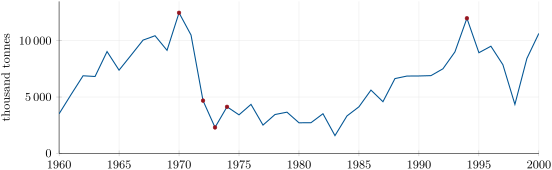
In 1970 Peru’s fishing fleet landed 12.5 million tonnes of fish, most of it anchoveta, a small fish ground into meal for animal feed. Three years later it landed 2.3 million. An El Niño had warmed the sea in 1972 and cut the cold, rich water the fish feed in; but the stock had already been reduced by overfishing. The catch did not pass 12 million tonnes again until 1994.
No one owned the anchoveta in the sea. Each boat that caught a tonne left one tonne less for the others, and none had a reason to leave fish to breed. This chapter sorts goods by two questions, whether one person’s use leaves less for others and whether anyone can be kept from using them, and shows what goes wrong, and what has worked, for the goods that markets handle badly.
You already know
From the grades 6–9 volume: a property right is the right to use a thing, to keep its fruits and to sell it, protected by law. From Chapter 18: an externality is an effect on others not paid for through a price. From Chapter 17: a Nash equilibrium, and the prisoner’s dilemma, in which each player’s best choice leaves both worse off.
19.1 Four kinds of goods
Definition 19.1 (Rival and excludable goods)
A good is a rival good when one person’s use of it leaves less for others. It is an excludable good
when those who do not pay can be kept from using it.
Definition 19.2 (Private, public and club goods; common resources)
A private good is rival and excludable. A public good
is neither rival nor excludable. A club good
is excludable but not rival, at least until it is crowded. A common resource
is rival but not excludable.
| Rival | Not rival | |
|---|---|---|
| Excludable | private goods: bread, a haircut, a bicycle | club goods: a cinema screening, a streaming service, an uncrowded toll road |
| Not excludable | common resources: fish in the open sea, groundwater, a free road at rush hour | public goods: national defence, a flood barrier, a lighthouse’s light, a published theorem |
A market supplies private goods well, because those who pay get the good and those who do not, do not. The other three kinds raise two different problems. For a public good, no one can be made to pay; for a common resource, no one can be made to stop.
19.2 Free riding
Definition 19.3 (Free rider)
A free rider is a person who benefits from a good without paying for it, because he cannot be excluded.
Example 19.4 (A contribution game)
Four neighbours each hold 10 dalens. Each may put any part of it into a fund for street lights; the fund is doubled in value (the lights are worth twice what they cost) and the benefit is shared equally among the four. A dalen given returns dalen to the giver, whatever the others do: giving nothing is each one’s dominant choice. If all give nothing, each keeps 10; if all give 10, the fund of 40 yields 80, and each gets 20. The Nash equilibrium is the worst outcome of all four’s joint choices, as in the prisoner’s dilemma.
Public goods still get provided, in four main ways:
- Taxes: the state provides the good and makes everyone pay, which ends free riding by law.
- Exclusion: a technology that keeps non-payers out turns a public good into a club good (encrypted television, a paywall).
- Bundling: the good is sold with a private one that pays for it (free radio paid by advertising).
- Private provision with enforced charges, as the record of British lighthouses shows.
On the record — Lighthouses paid by port dues
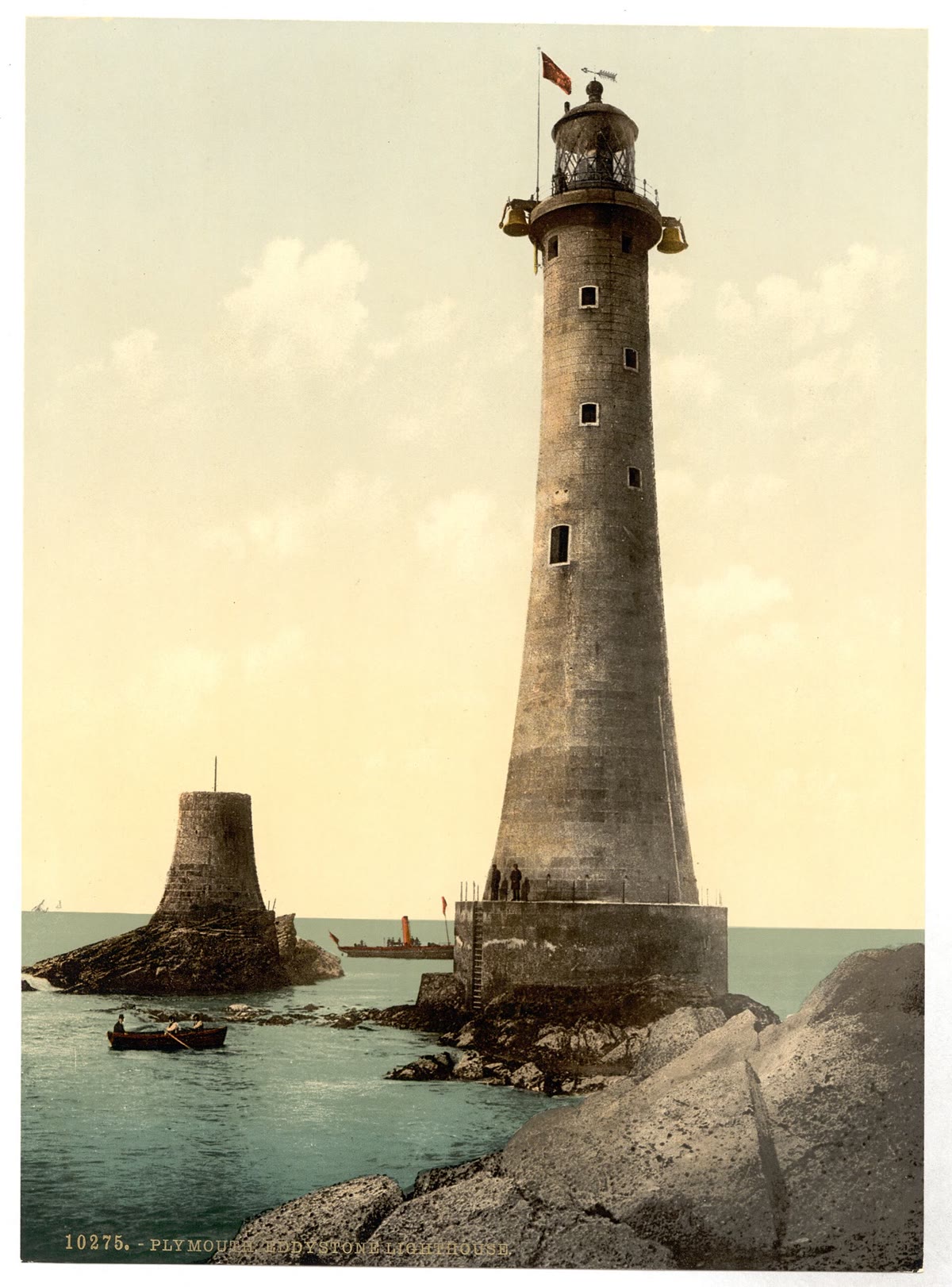
A lighthouse’s light is the textbook public good: any ship may see it, and its use by one ship leaves no less for another. Yet from the seventeenth to the nineteenth centuries many British lighthouses were built and run privately, paid by light dues that ships were charged when they entered port. A study of 1974 used this record to argue that a public good can be supplied without the state building it. Later studies answered that the right to charge the dues was granted by the Crown and that the dues were compulsory, so the state’s power did the excluding; lighthouses that relied on voluntary payment did not last. Both sides agree on the facts: the light was paid for by a charge attached to something that could be excluded, entry to a port.
19.3 Overuse of a common resource
Definition 19.5 (Tragedy of the commons)
The tragedy of the commons is the overuse of a common resource by users who each bear only part of the cost of their use.
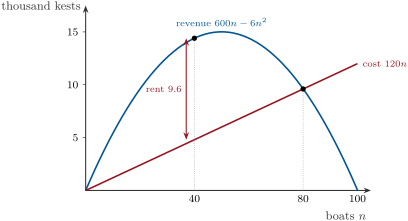
Take a fishing ground. The more boats fish it, the fewer fish each boat catches, because the stock is smaller. A boat owner who decides whether to join compares his own catch with his cost; he ignores that his boat lowers every other boat’s catch. That is a negative externality, imposed by each boat on all the others.
Model — Open access to a common resource
Assumes. Anyone may enter; each boat’s catch falls as the number of boats rises; boats are alike and cost the same.
Predicts. Boats enter until the value of a boat’s catch equals its cost: the fishery’s rent (its revenue minus its cost) is dissipated, and beyond some fleet size the total catch falls as boats are added.
Tested. Across more than 11 000 fisheries from 1950 to 2003, those without catch shares collapsed about twice as often as those with them (Costello, Gaines and Lynham 2008, below). Consistent with it, though the 1972 El Niño also struck: Peru’s fleet grew until the anchoveta collapsed in 1972–73. The northern cod off Newfoundland fell to about 1 % of its former level, and in 1992 the government closed the fishery; more than 35 000 fishermen and plant workers lost their jobs.
Breaks. Where users are few, know each other, and enforce their own rules (field studies found long-lasting rules in Swiss and Japanese mountain villages, Spanish and Philippine irrigation and some fisheries; Ostrom 1990), and where rights to the catch are secure and can be traded.
19.4 Answers and their record
Definition 19.6 (Individual transferable quota)
An individual transferable quota is the right to catch a fixed share of a total allowed catch, which its holder may use, lease or sell.
The answers follow from the diagnosis. If the problem is that no one owns the resource, give someone a right to it: a property right over a pasture or a forest, or a right to a share of the catch. A quota holder gains nothing by racing others for the fish, since his share is his, and the value of his quota rises when the stock is well kept. Quotas are a tradable-permit market applied to a fishery: the total catch is capped, and the permits go to the boats that can use them at the least cost. Where users are few and live together, their own rules, with monitors and graduated penalties, can do the same work without the state or a market.
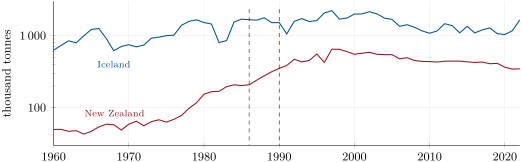
A chart of catches cannot show whether quotas worked: a falling catch may be a quota protecting a stock, or a stock in decline. The test needs many fisheries and a measure of collapse. A study of more than 11 000 fisheries from 1950 to 2003 found that nearly a third of those without catch shares had collapsed, and only about half that share of those managed by catch shares. Quotas have their own record of trouble: who receives them at the start, and whether a few firms come to hold them all, are questions the model does not settle.
On the record — The anchoveta collapse, 1972–73
Peru’s catch rose from 3.5 million tonnes in 1960 to 12.5 million in 1970. In 1972 an El Niño stopped the rising of cold, nutrient-rich water along the coast. Fish that had already been heavily caught found less food, and the catch fell to 4.7 million tonnes in 1972 and 2.3 million in 1973. The two causes cannot be fully separated, but a stock that has been fished down has less to fall back on when the sea turns against it.
International commons are harder still. The atmosphere, the open ocean and migrating fish stocks belong to no country, and no state can tax the others. An agreement among countries to restrain their use is a contribution game: each country gains from the others’ restraint and is tempted to free ride on it, and nothing forces it to sign or keep its word.
19.5 Exercises
Exercise 19.1 ★
Classify as private good, club good, common resource or public good, and say why: a sandwich; fish in the open ocean; national defence; a film in a cinema.
Solution
Solution of Exercise 19.1.
A sandwich: private (rival, excludable). Fish in the open ocean: common resource (rival, not excludable). National defence: public good (protecting one person does not protect another less, and no one in the country can be left out). A film in a cinema: club good (a ticket is needed, and one more viewer leaves the film to the others, until the seats run out).
Exercise 19.2 ★
Classify: a fireworks display seen from all over town; a paid swimming pool that is rarely full; groundwater pumped by farmers; a pair of shoes.
Solution
Solution of Exercise 19.2.
Fireworks seen from all over town: public good. A swimming pool that is rarely full: club good. Groundwater: common resource, since what one farmer pumps is lost to the others and no one can be stopped from drilling. Shoes: private good.
Exercise 19.3 ★
A road is free and empty at night and free and jammed at rush hour. Classify it in each case, and say how a toll would change the classification.
Solution
Solution of Exercise 19.3.
Empty at night: a public good, since one more car takes nothing from the others. Jammed at rush hour: a common resource, since each car slows all the others. A toll makes the road excludable: a club good at night, and at rush hour a private good, in effect, whose price can keep the road from jamming.
Exercise 19.4 ★
From the opening chart, read Peru’s catch in 1970 and 1973 (in millions of tonnes, to one decimal) and compute the fall in percent.
Solution
Solution of Exercise 19.4.
12.5 million tonnes in 1970 and 2.3 million in 1973: a fall of .
Exercise 19.5 ★
In the opening chart, in which year did Peru’s catch first pass 12 million tonnes again after 1973? How many years after the collapse was that?
Solution
Solution of Exercise 19.5.
In 1994, 21 years after 1973.
Exercise 19.6 ★★
In a lake, each boat catches tonnes a season when boats fish. Fish sell at 2 dalens a tonne, and a boat costs 60 dalens a season. Under open access, how many boats fish, and what is the total catch?
Solution
Solution of Exercise 19.6.
A boat’s catch is worth ; boats enter until , so . Each catches 30 tonnes; the total is 1200.
Exercise 19.7 ★★
In Exercise 19.6, cheaper engines cut the cost of a boat to 40 dalens. Find the new open-access fleet and the total catch. Who gains from the cheaper engines?
Solution
Solution of Exercise 19.7.
gives ; each boat catches 20 tonnes, and the total is again 1200. No one gains: the saving on engines is used up by the 20 extra boats, and the rent stays zero.
Exercise 19.8 ★★
In Exercise 19.6, find the number of boats that maximises the lake’s rent, the total catch, and the rent.
Solution
Solution of Exercise 19.8.
, largest at . Each boat catches 40 tonnes; the total is 800 and the rent dalens.
Exercise 19.9 ★★
The lake’s authority in Exercise 19.6 issues transferable quotas for the efficient total catch. How many tonnes does it allow, and what does the right to catch one tonne for one season lease for?
Solution
Solution of Exercise 19.9.
800 tonnes. At 20 boats a tonne costs dalens to catch and sells for 2, so the right to catch it leases for 0.5 dalen ().
Exercise 19.10 ★★
A swimming club costs 30 000 dalens a year plus 20 dalens for each member. At a fee of 80 dalens a year, how many members must it have to cover its cost? Why can a club good be sold, while a public good cannot?
Solution
Solution of Exercise 19.10.
gives members. The club can shut its gate to those who do not pay, so a fee can be charged; a public good cannot exclude, so a fee cannot be enforced.
Exercise 19.11 ★★
From the chart of Iceland’s and New Zealand’s catches, read each country’s catch in the year its quotas became transferable and in 2020. Do these numbers show that the quotas worked? Explain.
Solution
Solution of Exercise 19.11.
New Zealand: about 210 thousand tonnes in 1986 and 365 thousand in 2020. Iceland: about 1520 thousand tonnes in 1990 and 1040 thousand in 2020. They do not show it either way: a catch is set by the quota itself, by the stock and by the market, and a lower catch may mean a stock protected by a tight quota or a stock in decline. The test needs measures of the stocks, across many fisheries with and without quotas.
Exercise 19.12 ★★★
What evidence would contradict the open-access model’s prediction that a common resource is always overused? Use the field studies in the model box, and say which of the model’s assumptions they break.
Solution
Solution of Exercise 19.12.
Common resources kept in good order for a long time by their users, without private ownership of the resource or state control: the mountain pastures, irrigation systems and fisheries of the field studies. They break the assumption of free entry (outsiders are kept out, so the resource is not open access) and the assumption that each user ignores the others’ loss (users who watch each other and punish overuse make that loss their own).
Exercise 19.13 ★★★
players each hold 10 dalens and choose a contribution between 0 and 10; the total is multiplied by , with , and shared equally. Show that giving nothing is each player’s dominant choice, and that all giving 10 leaves every player better off than all giving nothing.
Solution
Solution of Exercise 19.13.
Player gets . A dalen more from changes this by , whatever the others give, so is dominant. If all give 10, each gets , what each gets if all give nothing.
Exercise 19.14 ★★★
Two countries each decide whether to cut emissions. Cutting costs the country that cuts 10; each cut brings a benefit of 6 to each country. Write the payoff table, find the Nash equilibrium, and show that it is a prisoner’s dilemma. What would an agreement need to hold?
Solution
Solution of Exercise 19.14.
Payoffs (first country, second): both cut ; only the first cuts ; only the second cuts ; neither . Not cutting is dominant for each ( and ), so the equilibrium is , worse for both than : a prisoner’s dilemma. An agreement must be checked and must punish the country that breaks it, for instance by the others’ withdrawing their own cuts in later rounds.
Exercise 19.15 ★★★
A one-tonne quota earns its holder a rent of 6 dalens a season, every season. At an interest rate of 5 % a season, what is the most a buyer would pay for the quota? What happens to its price if the stock recovers and the rent rises to 8? If the authority announces that all quotas will be cancelled after one season?
Solution
Solution of Exercise 19.15.
dalens. With a rent of 8, . If the quota ends after one season, it is worth only that season’s rent, about 6 dalens.
19.6 Problem: The Kestrian Fishery
Problem 19.1
Weekend problem — open access, the efficient fleet and a quota market
In a bay of Kestria, each boat catches tonnes of fish a season when boats fish. Fish sell at 6 kests a tonne, and running a boat for a season costs 120 kests. Anyone may fish.
Part I — Open access.
- Write the value of one boat’s catch and the bay’s total revenue as functions of .
- How many boats fish under open access?
- Find each boat’s catch, the total catch and the rent at that fleet.
- Show that a boat that joins lowers every other boat’s catch. By how much does the 80th boat cut the others’ total catch?
- Explain why each owner ignores that loss.
Part II — The efficient fleet.
- Write the rent , revenue minus cost, and find the that maximises it.
- Find each boat’s catch, the total catch and the rent at that fleet.
- Find the fleet that maximises the total catch, and the catch there.
- Compare the three fleets: which catches most, which earns most?
- How much rent does open access dissipate each season?
Part III — Quotas.
- The authority caps the season’s catch at the efficient total and issues one-tonne transferable quotas. How many quotas does it issue?
- Compute the rent per tonne at the efficient fleet: price minus the cost of catching a tonne.
- Explain why a quota for one tonne and one season leases at that rent.
- A quota gives the right to one tonne every season for ever. At an interest rate of 5 % a season, what does it sell for?
- Why would an owner who holds quotas want the stock kept healthy?
Part IV — Limits.
- The authority gives the quotas free to the 80 boats fishing on the day of the reform, equally. How many tonnes does each receive, and what is its quota worth?
- After trading, 40 boats fish. What do the 40 boats that leave receive, and from whom?
- If the authority sets the total at 2100 tonnes by mistake, how many boats fish, and what is the rent?
- Name one cost of quotas that the model leaves out.
- State the result of the problem: the rent dissipated under open access and the price of a one-tonne quota.
Solution
Solution of Problem 19.1.
1. One boat: kests. The bay: .
2. : .
3. 20 tonnes a boat, 1600 tonnes in all, rent .
4. With 79 boats each catches 21 tonnes; the 80th lowers that to 20, so the other 79 lose 79 tonnes in all, while it catches 20: the total catch falls by 59.
5. The owner pays his boat’s cost and receives his boat’s catch; the tonne each of the others loses is their loss, not his.
6. ; at .
7. 60 tonnes a boat, 2400 tonnes, rent kests.
8. is largest at : 2500 tonnes.
9. 50 boats catch most (2500 tonnes); 40 boats earn most (9600 kests); open access, 80 boats, catches least (1600) and earns nothing.
10. 9600 kests a season.
11. 2400 quotas.
12. A boat costs 120 and catches 60 tonnes: 2 kests a tonne. The rent is kests a tonne ().
13. A boat earns 4 kests above its cost on each tonne it is allowed to catch. A holder will not lease for less, and a fisher will not pay more; with many of each, the lease settles at 4.
14. kests.
15. The quota’s price is the value of the rents it will earn; a healthier stock means cheaper fishing and a higher rent, so a run-down stock lowers the value of what the holder owns.
16. 30 tonnes each, worth kests.
17. Each sells its 30 tonnes of quota, 2400 kests, to the boats that stay, which end with 60 tonnes each.
18. gives or ; the cheapest way to catch 2100 tonnes is with 30 boats, each catching 70. The rent is , 600 less than at the efficient total.
19. For example: counting each boat’s landings and punishing cheating; fish thrown back to keep within the quota; quotas gathered in a few hands.
20. Open access dissipates the whole rent of the bay, 9600 kests a season; under quotas, the right to catch one tonne for one season leases for 4 kests, and a permanent one-tonne quota sells for 80 kests at 5 % interest.